

Groupthink is a psychological phenomenon that occurs within a group of people in which the desire for harmony or conformity in the group results in an irrational or dysfunctional decision-making outcome. Cohesiveness, or the desire for cohesiveness, in a group may produce a tendency among its members to agree at all costs.[1] This causes the group to minimize conflict and reach a consensus decision without critical evaluation.[2][3]
The Illusion of Asymmetric Insight
The Misconception: You celebrate diversity and respect others’ points of view. The Truth: You are driven to create and form groups and then believe others are wrong just because they are oth…

Collaborative Groups Protocol
A practical formula for creating and sustaining small, effective groups — designed to work together at scale.
Collaborative Groups Protocol
A practical formula for creating and sustaining small, effective groups — designed to work together at scale.
Out-group homogeneity
The out-group homogeneity effect is the perception of out-group members as more similar to one another than are in-group members, i.e. "they are alike; we are diverse".[1] Perceivers tend to have impressions about the diversity or variability of group members around those central tendencies or typical attributes of those group members. Thus, outgroup stereotypicality judgments are overestimated, supporting the view that out-group stereotypes are overgeneralizations.[2] The term "outgroup homogeneity effect", "outgroup homogeneity bias" or "relative outgroup homogeneity" have been explicitly contrasted with "outgroup homogeneity" in general,[3] the latter referring to perceived outgroup variability unrelated to perceptions of the ingroup.
(PDF) Algorithmically Mediating Communication to Enhance Collective Decision-Making in Online Social Networks
PDF | Many collective decision-making contexts involve communication among group members. Sometimes this communication helps the collective reach an... | Find, read and cite all the research you need on ResearchGate

10Groups
10Groups is a political compass test that examines one's political beliefs on a varity of coordinate charts. The test is based on different parts from SapplyValues and 8values. You will be presented by a statement, and then you will answer with your opinion on the statement, from Strongly Agree to Strongly Disagree, with each answer slightly affecting your scores. At the end of the quiz, your answers will be displayed on a political compass. There are 83 questions in the test.
Groupe (mathématiques)
En mathématiques, un groupe est une des structures algébriques fondamentales de l'algèbre générale. C'est un ensemble muni d'une loi de composition interne associative admettant un élément neutre et, pour chaque élément de l'ensemble, un élément symétrique.

Habits of High-Functioning Teams
I often struggle to explain what it means to be part of a high-functioning software team. Sure, there are mountains of literature, and an entire genre of LinkedIn thought leadership that professes all kinds of guidelines and heuristics about what makes teams work, but in my experience, it’s hard to internalize these ideas and follow someone else’s model if you’ve never seen what good looks like.
Concentric Groups, Knowledge Bridges and Epistemic Communities
vs Elitism, Celebrity and Oligarchy This article is part of a series: ‘Stigmergy: Systems of Mass Collaboration’. Note: Concentric circles relate to sound amplification – the voic…

Misperceptions About Others
Perceptions about others play an important role in shaping people's attitudes and behaviors, as well as social norms more broadly. This review presents a meta-analysis of the recent empirical literature that examines perceptions about others in the field, covering over a million observations for a total of 434 elicited perceptions. We document a number of stylized facts. Misperceptions about others are widespread, asymmetric, much larger when about out-group members, and positively associated with one's own attitudes. Experimental treatments to recalibrate misperceptions generally work as intended; they sometimes lead to meaningful changes in behaviors, though this often occurs only immediately after the treatments. We discuss different conceptual frameworks that could explain the origin, persistence, and rigidity of misperceptions about others. We point to several directions for future research.

Education for collective intelligence
Collective Intelligence (CI) is important for groups that seek to address shared problems. CI in human groups can be mediated by educational technologies. The current paper presents a framework to ...

So It Is, So It Shall Be: Group Regularities License Children's Prescriptive Judgments
Abstract When do descriptive regularities (what characteristics individuals have) become prescriptive norms (what characteristics individuals should have)? We examined children's (4–13 years) and adults' use of group regularities to make prescriptive judgments, employing novel groups (Hibbles and Glerks) that engaged in morally neutral behaviors (e.g., eating different kinds of berries). Participants were introduced to conforming or non‐conforming individuals (e.g., a Hibble who ate berries more typical of a Glerk). Children negatively evaluated non‐conformity, with negative evaluations declining with age (Study 1). These effects were replicable across competitive and cooperative intergroup contexts (Study 2) and stemmed from reasoning about group regularities rather than reasoning about individual regularities (Study 3). These data provide new insights into children's group concepts and have important implications for understanding the development of stereotyping and norm enforcement.

"Thinking is an instrument that serves collective action." So important but also so easy to lose sight of this

Ronen Tamari
This title is clickbait for me 😅 journals.azbuki.bg/philosophy/epistemic-stigmerg…
Collective Intelligence Research

Explorations into the idea that a group of humans is "more intelligent" than the sum of their "IQ" (i.e. "groups of individuals doing things collectively that seem intelligent")
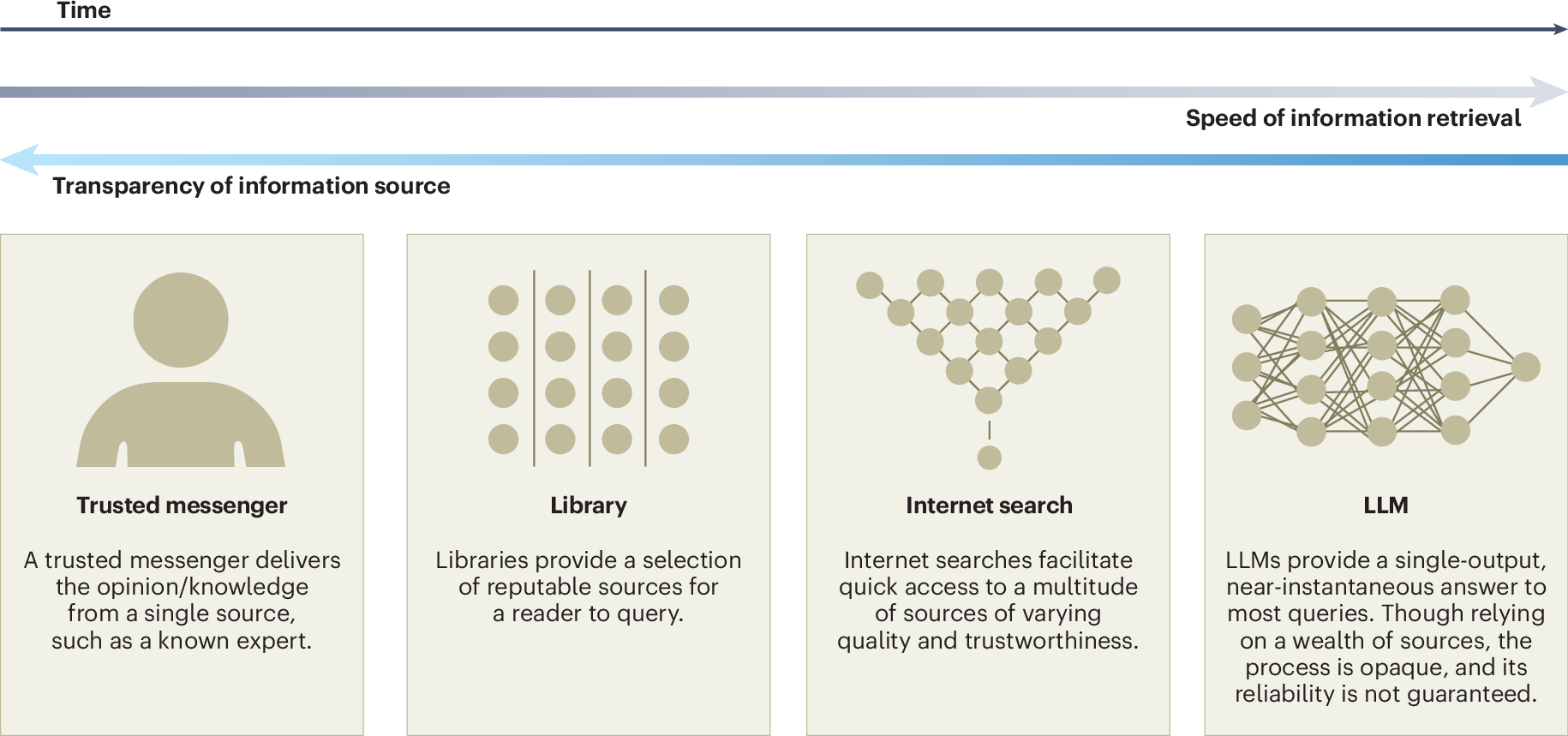
How large language models can reshape collective intelligence

Sharing Notes about Collective Intelligence — Pop Junctions

Socially Minded Intelligence: How Individuals, Groups, and Artificial Intelligence Can Make Each Other Smarter (or Not)

Profile: Adrien Treuille

NOVA | The Wisdom of the Crowds | Season 45 | Episode 6
Mapping Citizen Science through the Lens of Human-Centered AI