

The interrupt descriptor table (IDT) is a data structure used by the x86 architecture to implement an interrupt vector table. The IDT is used by the processor to determine the memory addresses of the handlers to be executed on interrupts and exceptions.
Patterns and Anti-Patterns of the Primary Interrupt
The interrupt rotation can be a software engineer’s torture chamber.

Engineering High-Performance Parsers with Data-Oriented Design
Notes from building Yuku: the AST is flat arrays of u32 indices instead of a pointer tree, and memory layout, allocation, strings, unicode, and serialization all follow from that one decision.
OBD2 Explained - A Simple Intro [v2.0 | 2021] 🌟
dbt-labs/dbt-core
dbt enables data analysts and engineers to transform their data using the same practices that software engineers use to build applications.
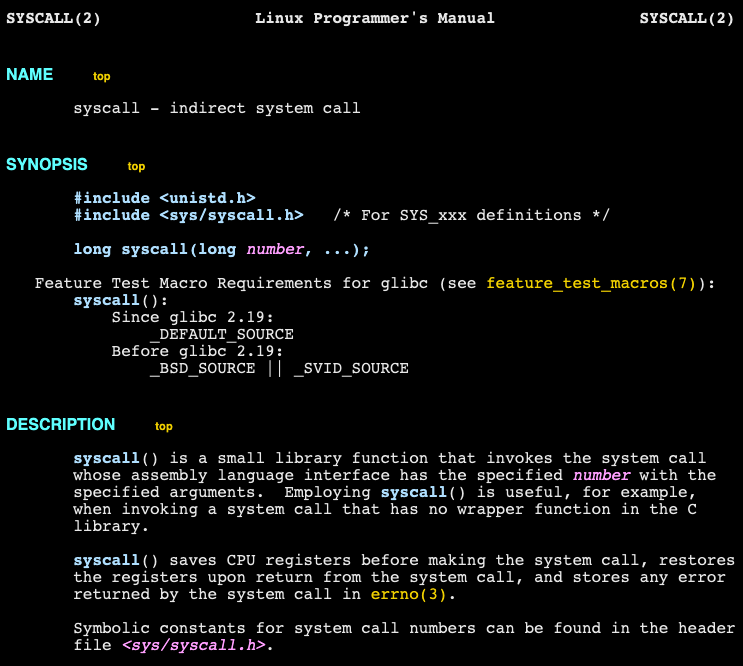
Linux System Call Tables by Architecture · syscall.sh
The Linux syscall table for 38 architectures: every system call number, argument and register, with a table per architecture, from Linux 3.3 to 7.3.
mitchellh/libxev
libxev is a cross-platform, high-performance event loop that provides abstractions for non-blocking IO, timers, events, and more and works on Linux (io_uring or epoll), macOS (kqueue), and Wasm + WASI. Available as both a Zig and C API.
The SQLite R*Tree Module
An R-Tree is a special index that is designed for doing range queries. R-Trees are most commonly used in geospatial systems where each entry is a rectangle with minimum and maximum X and Y coordinates. Given a query rectangle, an R-Tree is able to quickly find all entries that are contained within the query rectangle or which overlap the query rectangle. This idea is easily extended to three dimensions for use in CAD systems. R-Trees also find use in time-domain range look-ups. For example, suppose a database records the starting and ending times for a large number of events. A R-Tree is able to quickly find all events that were active at any time during a given time interval, or all events that started during a particular time interval, or all events that both started and ended within a given time interval. And so forth.
omp — a coding agent with the IDE wired in
Subagents, plan mode, LSP, DAP, hindsight memory, hashline edits, time-traveling rules — with a native Rust engine doing the heavy lifting.

Timestamp Identifiers (TIDs) - AT Protocol
A compact timestamp-based identifier for revisions and records.

iddqd, or the hardest kind of unsafe Rust | Oxide Computer Company
How our Rust collections library defends against adversarial trait implementations.
RISC-V International
RISC-V is an open standard Instruction Set Architecture (ISA) enabling a new era of processor innovation through open collaboration.

x86 calling conventions
This article describes the calling conventions used when programming x86 architecture microprocessors.
F.32. pg_stat_statements — track statistics of SQL planning and execution
F.32. pg_stat_statements — track statistics of SQL planning and execution # F.32.1. The pg_stat_statements View F.32.2. The pg_stat_statements_info View F.32.3. Functions …

Boomerang | Proceedings of the 35th annual ACM SIGPLAN-SIGACT symposium on Principles of programming languages
Bidirectional programming languages are a practical approach to the view update problem. Programs in these languages, called lenses, define both a view and an update policy - i.e., every program can be read as a function mapping sources to views as well ...

Mutual intelligibility for schema idiolects.

GitHub - idiolect-dev/idiolect: Mutual intelligibility for schema idiolects.
github.com