

Language transfer is the application of linguistic features from one language to another by a bilingual or multilingual speaker and may occur across both languages in the acquisition of a simultaneous bilingual. It may also occur from a mature speaker's first language (L1) to a second language (L2) they are acquiring, or from an L2 back to the L1.[1] Language transfer (also known as L1 interference, linguistic interference, and crosslinguistic influence) is most commonly discussed in the context of English language learning and teaching, but it can occur in any situation when someone does not have a native-level command of any target language, as when translating into a second language. Language transfer is also a common topic in bilingual child language acquisition as it occurs frequently in bilingual children especially when one language is dominant.[2]
Is Cross-Lingual Transfer in Bilingual Models Human-Like? A Study with Overlapping Word Forms in Dutch and English
Bilingual speakers show cross-lingual activation during reading, especially for words with shared surface form. Cognates (friends) typically lead to facilitation, whereas interlingual homographs (false friends) cause interference or no effect. We examine whether cross-lingual activation in bilingual language models mirrors these patterns. We train Dutch-English causal Transformers under four vocabulary-sharing conditions that manipulate whether (false) friends receive shared or language-specific embeddings. Using psycholinguistic stimuli from bilingual reading studies, we evaluate the models through surprisal and embedding similarity analyses. The models largely maintain language separation, and cross-lingual effects arise primarily when embeddings are shared. In these cases, both friends and false friends show facilitation relative to controls. Regression analyses reveal that these effects are mainly driven by frequency rather than consistency in form-meaning mapping. Only when just friends share embeddings are the qualitative patterns of bilinguals reproduced. Overall, bilingual language models capture some cross-linguistic activation effects. However, their alignment with human processing seems to critically depend on how lexical overlap is encoded, possibly limiting their explanatory adequacy as models of bilingual reading.

False Friends Are Not Foes: Investigating Vocabulary Overlap in Multilingual Language Models
Subword tokenizers trained on multilingual corpora naturally produce overlapping tokens across languages. Does token overlap facilitate cross-lingual transfer or instead introduce interference between languages? Prior work offers mixed evidence, partly due to varied setups and confounders, such as token frequency or subword segmentation granularity. To address this question, we devise a controlled experiment where we train bilingual autoregressive models on multiple language pairs under systematically varied vocabulary overlap settings. Crucially, we explore a new dimension to understanding how overlap affects transfer: the semantic similarity of tokens shared across languages. We first analyze our models' hidden representations and find that overlap of any kind creates embedding spaces that capture cross-lingual semantic relationships, while this effect is much weaker in models with disjoint vocabularies. On XNLI and XQuAD, we find that models with overlap outperform models with disjoint vocabularies, and that transfer performance generally improves as overlap increases. Overall, our findings highlight the advantages of token overlap in multilingual models and show that substantial shared vocabulary remains a beneficial design choice for multilingual tokenizers.
Beyond the Rosetta Stone: Unification Forces in Generalization Dynamics
Large language models (LLMs) struggle with cross-lingual knowledge transfer: they sometimes hallucinate when asked in one language about facts expressed in a different language during training. This work introduces a controlled setting to study the causes and training dynamics of this phenomenon by training small Transformer models from scratch on synthetic multilingual datasets. Depending on (1) the correlation between facts and the language they were learned in (informativeness), and (2) the ease of language identification (extractability), models either develop unified representations across languages or separate representations; only when representations are unified do facts transfer across languages. Based on these insights, we propose a unifying perspective which explains a range of prior observations concerning cross-lingual transfer in multilingual LLMs. Our work shows controlled settings can shed light on pre-training dynamics and suggests methods to encourage representational unification as part of training that would improve LLMs’ cross-lingual transfer.
How Language Seems To Shape One's View Of The World
Research suggests that speaking another language fluently changes what you pay attention to and how you remember events. But some say the idea that language can make you see and think differently is overblown.

Keeping actively bilingual makes our brains more efficient at relaying information
There is increasing evidence that bilingualism can affect how the brain works. Older, lifelong bilinguals have demonstrated better cognitive skills in tasks that require increased cognitive control. These…

How Arrival Turned Linguistics Into One of the Most Gripping Dramas of the Year
If you’ve ever been to a foreign country where you don’t speak the language, you know that an inability to communicate can be frustrating, if not a bit

Targeted Multilingual Adaptation for Low-resource Language Families
The "massively-multilingual" training of multilingual models is known to limit their utility in any one language, and they perform particularly poorly on low-resource languages. However, there is evid
How I Learned a Language in 90 Days
Becoming bilingual opens up a whole new world of different people, different cultures, and different emotions. It also takes a huge time commitment—on

Stephen Krashen: Language Acquisition and Comprehensible Input
Mitigating Cross-Lingual Cultural Inconsistencies in LLMs via...
Despite their impressive capabilities, multilingual large language models (MLLMs) frequently exhibit inconsistent behaviour when the prompt's language changes. While such adaptation is generally...
Gallil Maimon on Twitter / X
We saw cases of knowledge transfer (answering in speech facts only seen in text) when looking at interleaved speech-text LMs like the ones from our paper - https://t.co/tgzJ3X4hhCWe are working now on understanding how this works, what is needed, how to boost:)— Gallil Maimon (@GallilMaimon) May 1, 2026
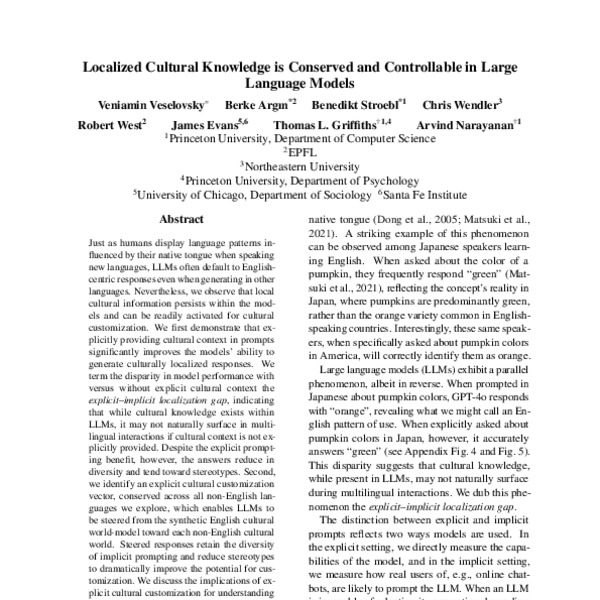
Localized Cultural Knowledge is Conserved and Controllable in Large Language Models
Large language models (LLMs), like human language learners, show patterns influenced by their dominant training language. Just as humans display language patterns influenced by their native tongue (semantic accents) when learning new languages, LLMs often default to English-centric responses even when generating in other languages. However, we observe that explicitly providing cultural context in prompts significantly improves the models' ability to generate culturally localized responses. We term this phenomenon the explicit-implicit localization gap, indicating that while cultural knowledge exists within LLMs, it may not naturally surface in multilingual interaction without explicitly including cultural context. In this paper, we (1) quantify this gap in multiple LLMs using a new cultural localization benchmark and find large (\ensuremath>10%) gaps in the majority of investigated models. (2) Demonstrate a fundamental trade-off between localization accuracy and output diversity. (3) Through mechanistic interpretability, we identify the underlying localization mechanisms within LLMs and show that these mechanisms are both language and task agnostic, with individual steering vectors effectively generalizing across different languages and culturally-relevant tasks.
Infantilizing babies helps them learn language
Pretend conversations early on lead to better vocabularies later.

Is Bilingualism Really an Advantage?
For most of their lives, bilinguals might not show any real benefits. The true edge may come far later.

English language
English is a West Germanic language in the Indo-European language family. It emerged in early medieval England and has since become a global lingua franca. The namesake of the language is the Angles, one of the Germanic peoples who migrated to Britain after the end of Roman rule. English is the most spoken language in the world, primarily due to the global influences of the former British Empire and the United States. It is the most widely learned second language in the world, with more second-language speakers than native speakers. However, English is only the third-most spoken native language, after Mandarin Chinese and Spanish.

Linguistic relativity
Linguistic relativity asserts that language influences one's worldview and cognition. One form of linguistic relativity, linguistic determinism, regards peoples' languages as determining and influencing the scope of cultural perceptions of their surrounding world.[1]