

A large language model (LLM) is a neural network trained on a vast amount of text for natural language processing tasks, especially language generation. LLMs can typically generate, summarize, translate, and analyze text in many contexts, and are a foundational technology behind modern chatbots.[1] Biased or inaccurate training data can make an LLM's output less reliable.[2]
What are Large Language Models(LLMs)?
The architecture of Large Language Model primarily consists of multiple layers of neural networks, like recurrent layers, feedforward layers, embedding layers, and attention layers. These layers work together to process the input text and generate output predictions.

what are large language models actually doing? i read the 2025 textbook "Foundations of Large Language Models" by tong xiao and jingbo zhu and for the first time, i truly understood how they work. here’s everything you need to know about llms in 3 minutes↓
what are large language models actually doing?i read the 2025 textbook "Foundations of Large Language Models" by tong xiao and jingbo zhu and for the first time, i truly understood how they work.here’s everything you need to know about llms in 3 minutes↓ pic.twitter.com/OeYLuU3cWh— Alex Veremeyenko (@alex_verem) July 26, 2025

Beyond Model Collapse: Scaling Up with Synthesized Data Requires...
Large Language Models (LLM) are increasingly trained on data generated by other LLM, either because generated text and images become part of the pre-training corpus, or because synthetized data is...

Alex Veremeyenko on Twitter / X
what are large language models actually doing?i read the 2025 textbook "Foundations of Large Language Models" by tong xiao and jingbo zhu and for the first time, i truly understood how they work.here’s everything you need to know about llms in 3 minutes↓ pic.twitter.com/OeYLuU3cWh— Alex Veremeyenko (@alex_verem) July 26, 2025
Beyond Chat: Exploring Alternative Interfaces for Large Language Models
Large Language Models (LLMs) have taken the world by storm in recent years, powering increasingly sophisticated chatbots and…

The AI Cognitive Trojan Horse: How Large Language Models May...
Large language model (LLM)-based conversational AI systems present a challenge to human cognition that current frameworks for understanding misinformation and persuasion do not adequately address....
LLM in a Flash: Efficient Large Language Model Inference with Limited Memory
Large language models (LLMs) are central to modern natural language processing, delivering exceptional performance in various tasks…
LLMs and World Models, Part 1
How do Large Language Models Make Sense of Their “Worlds”?

LLMs are good at playing you
Large language models seem just like humans, but some of this is in our heads.

AI Large Language Model Training: The Potential Risks of Ideological Skewing — PSG Consulting
LLMs (AI Large Language Models) have become part of everyday life. Systems such as ChatGPT, Claude, Gemini, Meta AI (Llama) and X.ai's Grok handle billions of interactions daily. They increasingly shape what information people encounter and in what order, subtly deciding what's important and even what is true, sometimes without users realizing it. Because LLMs wield growing power over information exposure, it is vital to recognize the political and ideological structures at multiple stages of their design, and to identify manipulation risks.

How much LLM training data is there, in the limit? – Educating Silicon
Recent large language models such as Llama 3 and GPT-4 are trained on gigantic amounts of text. Next generation models need 10x more. Will that be possible? To try to answer that, here’s an estimate of all the text that exists in the world.
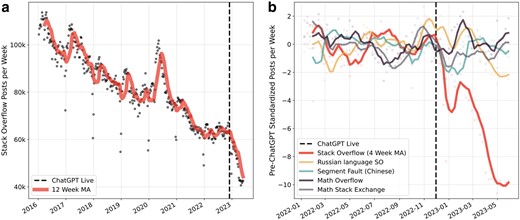
Large language models reduce public knowledge sharing on online Q&A platforms
Abstract. Large language models (LLMs) are a potential substitute for human-generated data and knowledge resources. This substitution, however, can present
14 LLMs that aren’t ChatGPT
ChatGPT isn't your only option for generating content and insight from AI. Here are 14 large language models giving ChatGPT a run for its money.

I finally understand how large language models actually work After reading the 2025 textbook “Foundations of LLMs” It blew my mind and cleared up years of confusion Here’s everything i learned (in plain english):
I finally understand how large language models actually workAfter reading the 2025 textbook “Foundations of LLMs”It blew my mind and cleared up years of confusionHere’s everything i learned (in plain english): pic.twitter.com/Db7NHTks55— Louis Gleeson (@aigleeson) July 31, 2025

Communication Bias in Large Language Models: A Regulatory Perspective
Artificial intelligence (AI) involves computational systems designed to perform tasks that traditionally require human intelligence, such as perception, reasoning, and language understanding. Large language models (LLMs), a prominent subset of AI, are built on advanced neural network architectures that can generate new data, including text, images, and audio. LLMs use various technologies to identify patterns in a given set of training data, without requiring explicit instructions about what to look for.12,35 LLMs typically assume that the training data follows a probability distribution; once they have identified existing patterns, they can generate new instances that are similar to the original data. By drawing from and combining training data, LLMs can create new content that transcends the initial dataset.17 But this process has technical limitations. For instance, LLMs can hallucinate by producing plausible yet factually incorrect or fabricated information; they can struggle with ambiguous or missing data, leading to blind spots in their outputs; and they can reflect and amplify existing preconceptions present in their algorithms or training data, leading to communication bias, which we focus on here.

Mitigating Cross-Lingual Cultural Inconsistencies in LLMs via...
Despite their impressive capabilities, multilingual large language models (MLLMs) frequently exhibit inconsistent behaviour when the prompt's language changes. While such adaptation is generally...