Linkword is a mnemonic system promoted by Michael Gruneberg since at least the early 1980s for learning languages based on the similarity of the sounds of words. The process involves creating an easily visualized scene that will link the words together. One example is the Russian word for cow : think and visualize "I ran my car over a cow."
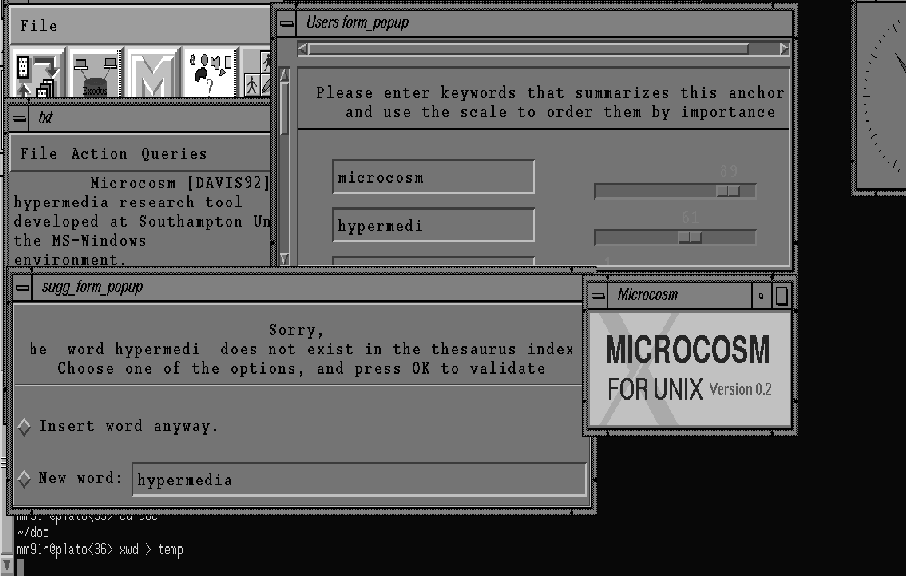
Vision and Reality of Hypertext and GUIs: 2.1.13 Microcosm @mprove
Microcosm (cf. 2.1.13) is a research project at the University of Southampton. Like Intermedia five years before, Microcosm is designed around the idea that material of diverse sources and formats should be tied together into one hypertext. To achieve this goal links have to be separated from the documents. They are stored and maintained in special link databases. In contrast to Intermedia, Microcosm plays the active role in gathering the necessary data out of the documents. For each topic it stores data on which documents contain information about it and also where inside the documents the information is located. This elaborated conception of links can be seen more as a kind of Memex’ trails than simple one-to-one links. Given this structure dynamic linking becomes possible. This means that links can be associated with generic text strings. Wherever this string shows up a link is placed automatically. This has the effect that documents that are imported for the first time into Microcosm can have links immediately.
Word embedding
In natural language processing, a word embedding is a representation of a word. The embedding is used in text analysis. Typically, the representation is a real-valued vector that encodes the meaning of the word in such a way that the words that are closer in the vector space are expected to be similar in meaning. Word embeddings can be obtained using language modeling and feature learning techniques, where words or phrases from the vocabulary are mapped to vectors of real numbers.

An Ode to Links
A URL is a technical thing: a hostname, a path, a port, an origin, some query parameters, etc. But a link is a cultural thing: an invitation, a citation, a…
brianpetro/obsidian-smart-connections
Find related notes and excerpts while writing. Your link building copilot displays relevant content in graph + list view. A local embedding model powers semantic search. Zero setup. No API key.
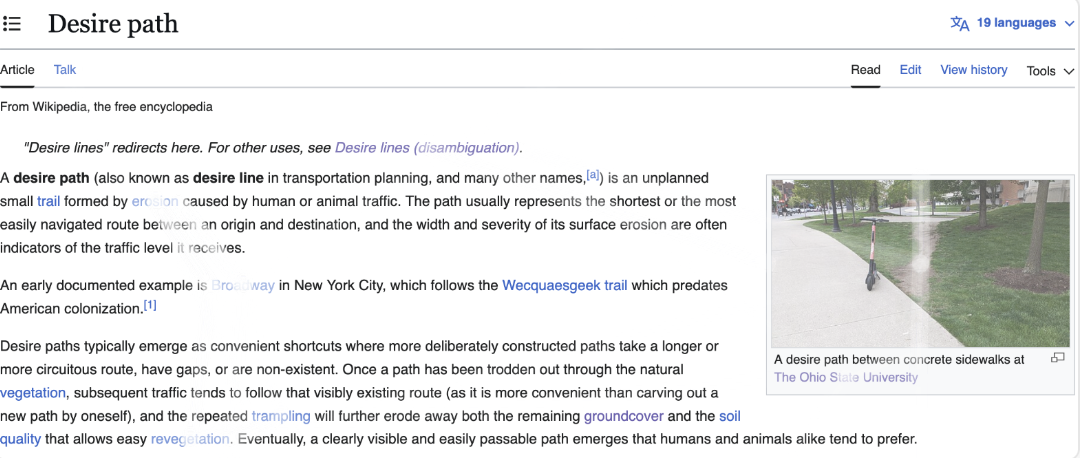
Desire Paths for Wikipedia
An extension that remembers the path of a cursor over the linked pages of Wikipedia, “wearing” them into the page.
Web Tiles as the base for Lexicon Embeds
Yeah this would be absolutely fantastic. I don’t see yet how the Bsky app would discover which embed to use for a linked record but I assume some sort of definition in the actual record? Anyway, hope to read more about this


WordHippo!
Thesaurus and word tools for your creative needs. Find the word you're looking for!

kshitijgetsac/Comparative-Analysis-of-Vision-Language-Connectors
Trying to study the effect of different connectors , (linear, MLP and Cross Attention) to analyze what paradigms do LLM'S use or make a best guess
Lexicon Embeds Overview
There’s an excellent discussion and thread about syntax highlighting of code blocks happening today: I think most notably there’s some alignment around using a lexicon to represent code blocks (say Tangled’s strings) and embedding those, rather than just doing syntax highlighting w/in the constraints of a bsky post. This seems like a good place to hammer a bunch of things out.
Beginner's Guide to Linkers
A typical example of what triggers this explanation is when I help someone who has a link error like:
Jared Goering on Twitter / X
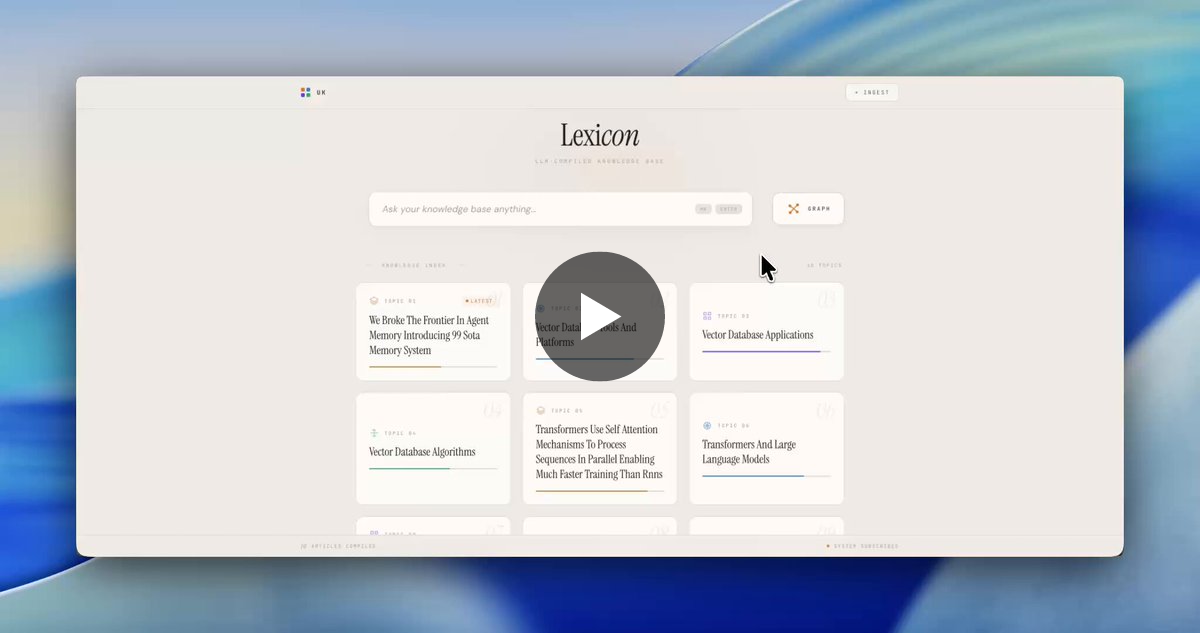
Saw this and immediately built it. Open-sourced the whole thing:Ingest URLs, PDFs, tweets, images → LLM compiles a linked markdown wiki → Q&A with citations, knowledge graph, contradiction linting, auto-research, export to HTML/PDF/slides.Been using it nonstop as a personal… https://t.co/ypaXlEA7pn pic.twitter.com/8Z2DLAyQjH— Jared Goering (@jaredgoering) April 4, 2026
A-MEM: Agentic Memory for LLM Agents
While large language model (LLM) agents can effectively use external tools for complex real-world tasks, they require memory systems to leverage historical experiences. Current memory systems enable basic storage and retrieval but lack sophisticated memory organization, despite recent attempts to incorporate graph databases. Moreover, these systems' fixed operations and structures limit their adaptability across diverse tasks. To address this limitation, this paper proposes a novel agentic memory system for LLM agents that can dynamically organize memories in an agentic way. Following the basic principles of the Zettelkasten method, we designed our memory system to create interconnected knowledge networks through dynamic indexing and linking. When a new memory is added, we generate a comprehensive note containing multiple structured attributes, including contextual descriptions, keywords, and tags. The system then analyzes historical memories to identify relevant connections, establishing links where meaningful similarities exist. Additionally, this process enables memory evolution - as new memories are integrated, they can trigger updates to the contextual representations and attributes of existing historical memories, allowing the memory network to continuously refine its understanding. Our approach combines the structured organization principles of Zettelkasten with the flexibility of agent-driven decision making, allowing for more adaptive and context-aware memory management. Empirical experiments on six foundation models show superior improvement against existing SOTA baselines. The source code for evaluating performance is available at https://github.com/WujiangXu/A-mem, while the source code of the agentic memory system is available at https://github.com/WujiangXu/A-mem-sys.

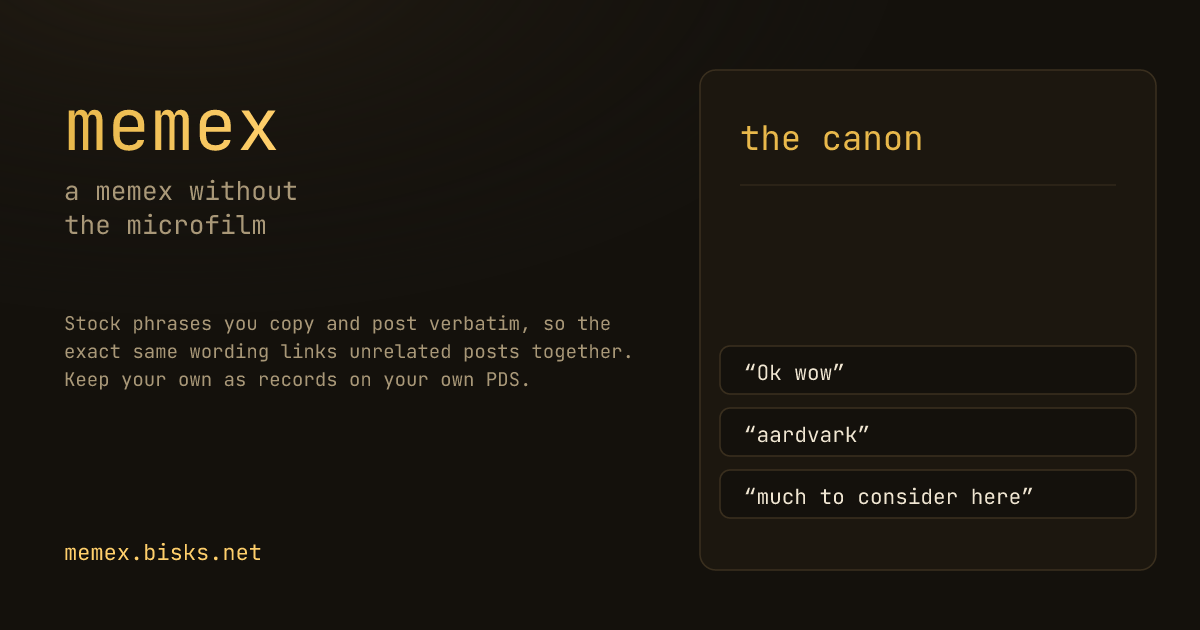
memex — stock phrases that link your posts
A phrasebook of quotable, re-quotable stock phrases — the same wording links otherwise-unrelated posts together, memex-style. Seeded from @tk0l.bsky.social's original thread. Sign in to add your own, kept as records on your own PDS.
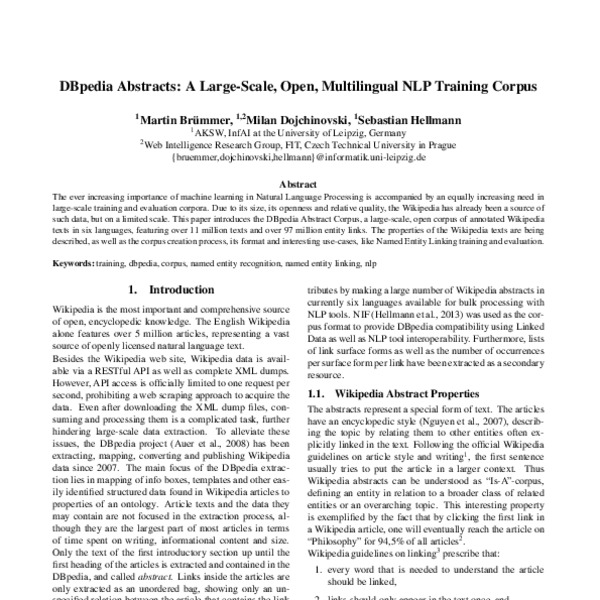
DBpedia Abstracts: A Large-Scale, Open, Multilingual NLP Training Corpus
The ever increasing importance of machine learning in Natural Language Processing is accompanied by an equally increasing need in large-scale training and evaluation corpora. Due to its size, its openness and relative quality, the Wikipedia has already been a source of such data, but on a limited scale. This paper introduces the DBpedia Abstract Corpus, a large-scale, open corpus of annotated Wikipedia texts in six languages, featuring over 11 million texts and over 97 million entity links. The properties of the Wikipedia texts are being described, as well as the corpus creation process, its format and interesting use-cases, like Named Entity Linking training and evaluation.