

In number theory, a narcissistic number[1][2] (also known as a pluperfect digital invariant (PPDI),[3] an Armstrong number[4] (after Michael F. Armstrong)[5] or a plus perfect number)[6] in a given number base b {\displaystyle b} is a number that is the sum of its own digits each raised to the power of the number of digits.
The Winning Variant
A/B testing, algorithmic optimization, and the small act of ignoring both — and what it means to make something by hand when a number can tell you what would have worked better.

What Is To Be Done?
I don’t want to criticize people who seem to like the situation… Instead I’ll focus on people who are trying to do something other than be a number, even as they are subsumed by the new reality of number supremacy.

A mystery with memory leaks and a magic number
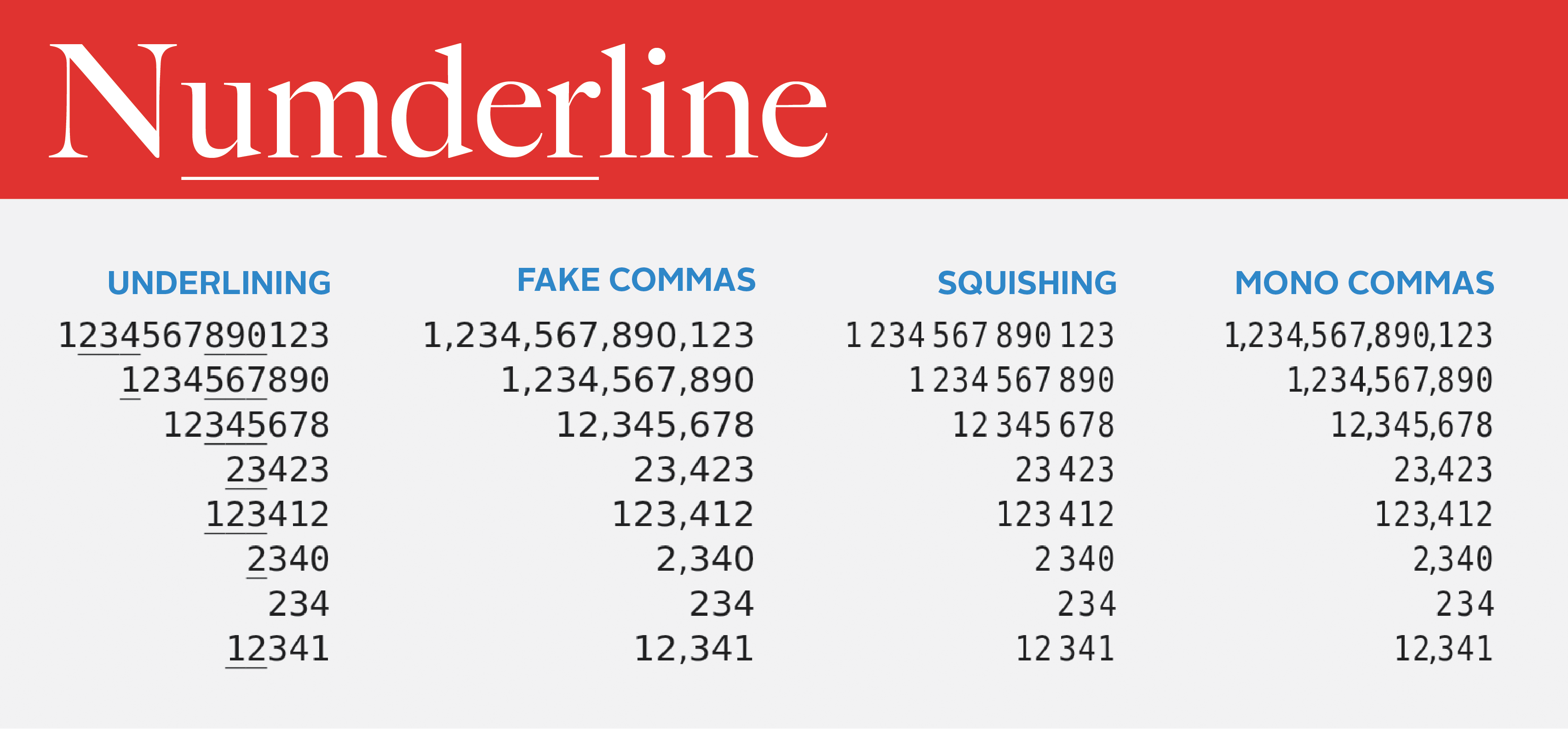
Commas in big numbers everywhere: An OpenType adventure
My job involves a lot of staring at large numbers, mostly latencies innanoseconds, and picking out magnitudes like microseconds. I noticedmyself constantly c...
A Digital Signature Based on a Conventional Encryption Function
A new digital signature based only on a conventional encryption function (such as DES) is described which is as secure as the underlying encryption function -- the security does not depend on the difficulty of factoring and the high computational costs of modular arithmetic are avoided. The signature system can sign an unlimited number of messages, and the signature size increases logarithmically as a function of the number of messages signed. Signature size in a ‘typical’ system might range from a few hundred bytes to a few kilobytes, and generation of a signature might require a few hundred to a few thousand computations of the underlying conventional encryption function.

Grade 3 » Operations & Algebraic Thinking » Represent and solve problems involving multiplication and division. » 1 | Common Core State Standards Initiative
Interpret products of whole numbers, e.g., interpret 5 × 7 as the total number of objects in 5 groups of 7 objects each. For example, describe a context in which a total number of objects can be expressed as 5 × 7.
Akin's Laws of Spacecraft Design
1. Engineering is done with numbers. Analysis without numbers is only an opinion.
Numbers station
Recording of the E03 "Lincolnshire Poacher" interval signal, followed by a coded transmission of five numbers: 0–2–5–8–8
Mathematicians still don’t know the fastest way to multiply numbers
A 23-year-old student overturned an ancient conjecture about one of math’s simplest operations
Your Loyalty To Sony Or Xbox Means Nothing, Analyst Says
It's a good idea to remember that "you're a number on a spreadsheet" to Sony and Microsoft.

Why Can't Transformers Learn Multiplication?...
Language models are increasingly capable, yet still fail at a seemingly simple task of multi-digit multiplication. In this work, we study why, by reverse-engineering a model that successfully...

Why Can't Transformers Learn Multiplication?...
Language models are increasingly capable, yet still fail at a seemingly simple task of multi-digit multiplication. In this work, we study why, by reverse-engineering a model that successfully...
Has an AI discovered new maths?
A theory of type polymorphism in programming
The aim of this work is largely a practical one. A widely employed style of programming, particularly in structure-processing languages which impose n…
when everyone has a different explanation of why the bad numbers are not that bad or why the small number is still very important, the simplest explanation is that the bad number is actually just indeed very bad

Christopher Mims
So I guess either Bluesky becomes a nonprofit or we all start sharing our Threads handles on here…?
