


Non-place or nonplace is a neologism coined by the French anthropologist Marc Augé to refer to anthropological spaces of transience where human beings remain anonymous, and that do not hold enough significance to be regarded as "places" in their anthropological definition. Examples of non-places would be motorways, hotel rooms, airports and shopping malls. The term was introduced by Marc Augé in his work Non-places: introduction to an anthropology of supermodernity, although it bears a strong resemblance to earlier concepts introduced by Edward Relph in Place and Placelessness and Melvin Webber in his writing on the 'nonplace urban realm'.
What are non-things - Interni Magazine
Interni Magazine - In his book ‘Le non cose’ (The non-things), the philosopher Byong-chul Han reflects on the hyper-connected society where the constant attention to data and information fades the (concrete) power of things. Destabilizing us

Third Places as Mini-Cosmopolitans - Surfing Modernity
What happens to identity in times of movement and change? In my second post, I proposed the importance of cultivating a third space that is not dependent on…
The Origins Of <br>‘Planetary Realism’ And <br>‘Whole Earth’ Thinking | NOEMA
There is no escaping an interconnected world.

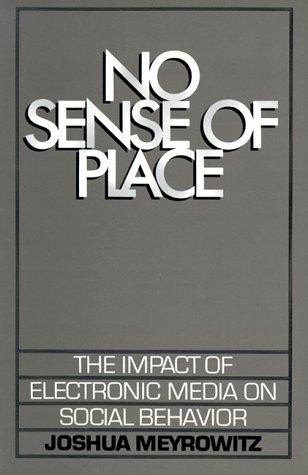
No Sense of Place by Joshua Meyrowitz | Open Library
No sense of place by Joshua Meyrowitz, unknown edition,
Architecture and the Internet: Designing places in cyberspace
Cyberspace, as the information space is called, has become accessible in the past decade through the World Wide Web. And although it can only be experienced through the mediation of computers, it is quickly becoming an alternative stage for everyday economic, cultural, and other human activities. As such, there is a potential and a need to design it according to place–like principles. Making places for human inhabitation is, of course, what architects, landscape architects, and town planners have been doing in physical space for thousands of years. It is curious, therefore, that Cyberspace designers have not capitalized on the theories, experiences, and practices that have been guiding physical place–making. While most 3D environments closely mimic physical spaces, they are, by and large, devoid of the essential characteristics that differentiate a ‘place’ from mere ‘space.’ And only rarely are they sensitive to, and take advantage of, the peculiarities of Cyberspace. We believe that this state of affairs is temporary, characteristic of early adoption stages of new technologies. As the Web matures, and as it assumes more fully its role as a destination rather than as means of communication, there will be a growing need to design it according to place–making principles. By looking at physical architecture as a case study and metaphor for organizing space into meaningful places, this paper explores the possibility of organizing Cyberspace into spatial settings that not only afford social interaction, but, like physical places, also embody and express cultural values. At the same time, because Cyberspace lacks materiality, is free from physical constraints, and because it can only be ‘inhabited’ by proxy, these ‘places’ may not necessarily resemble their physical counterparts.
Nowhere to Go: The Loss of Third Places
A Philosopher’s One-Word Theory to Explain Why the World Feels So Weird
Once you learn what the "uni-context" is, you won't stop seeing it everywhere

The Relation of Environment to Anti-Environment
The ground rules, the pervasive structure, the overall pattern eludes perception except in so far as there is an anti-environment or a counter-situation constructed to provide a means of direct attention. Paradoxically, the ten percent of the typical situation that Drucker designates as the area of effective cause and as the area of opportunity, this small factor is the environment. The new TV environment is an electric circuit that takes as its content the earlier environment, the photograph and the movie in particular. Thus to put the artefacts from such a culture into a museum or anti-environment is an act of nullification rather than of revelation. To create an anti-environment for such electric technology would seem to require a technological extension of consciousness itself. The structural features of environment and anti-environment appear in the age-old clash between professionalism and amateurism, whether in sport or in studi.

Projects – discover our non-empty spaces
Fostering spaces for growth is an important part of our trajectory. We seek to harness the combined power of practice, critical inquiry and creativity to address some of the issues of our times - health, environmental awareness, social equality and multilingual, trans-cultural collaborations.
Thoughts on Cyberpositionality: The Construction of Digital Communities in Digital Spaces, Damien Patrick Williams
I found Rebecca Monteleone, Martin Perez Comisso, and Elma Hajric’s “Cyberpositionality: Sociotechnical Location in the Digital Age” (2024) to be an extremely timely and important article which can…

Addressable Space Web - Summer of Protocols
Addressable Space Chenoe Hart 1. Hidden Floors You may not notice in everyday life when a building you walk into is constructed of words and numbers in addition to bricks and mortar. Consider the composition of One Burrard Place, a condominium in Vancouver. It was described as

Neighbourhoods
Neighbourhoods is a web3 framework for groupware and socials that helps communities design and select custom cultural patterns using Holochain.

Digital Locality
The Paper Pilot's digital garden of thoughts on philosophy, politics, and sociology. Reading time: ~10 minute read | Published: Nov 21, 2024 | Updated: Aug 3, 2026

The Disappearance of Third Places
Modeling non-dual awareness via constraint closure: a reinterpretation of groundlessness
Abstract. Non-dual awareness (NDA) refers to a shift in consciousness in which the usual distinction between subject and object dissolves, and experience i

there is a piece to be written about this "no contact" as a very specific kind of moral panic about status, intergenerational mobility, and maybe dementia. because it is wild how much this no contact thing riles up older people.

Michael Hobbes
Another one. The premise: Young people are cutting off their parents for minor mistakes and misunderstandings. The lead anecdote: A woman severs ties with her family for refusing to get vaccinated before her wedding — to a man who *lost his mother and brother to COVID*
