


In astronautics, a powered flyby, or Oberth maneuver, is a maneuver in which a spacecraft falls into a gravity well and then uses its engines to further accelerate as it is falling, thereby achieving additional speed. The resulting maneuver is a more efficient way to gain kinetic energy than applying the same impulse outside of a gravity well. The gain in efficiency is explained by the Oberth effect, wherein the use of a reaction engine at higher speeds generates a greater change in mechanical energy than its use at lower speeds. In practical terms, this means that the most energy-efficient method for a spacecraft to burn its fuel is at the lowest possible orbital periapsis, when its orbital velocity is greatest. In some cases, it is even worth spending fuel on slowing the spacecraft into a gravity well to take advantage of the efficiencies of the Oberth effect. The maneuver and effect are named after Hermann Oberth, an Austro-Hungarian-born German physicist and a founder of modern rocketry, who first described them in 1927.
Flywheel Effect: Why Positive Feedback Loops are a Meta-Competitive Advantage
A fascinating adventure through Competitive Advantages, Mental Models, and practical lessons for operators. Also lots of fun pictures here!

rpg-actor in space
Fire your rpg.actor through gravity wells, ride orbits up to escape velocity, and smash the ships.
Getting Ahead By Being Inefficient
Inefficient does not mean ineffective, and it is certainly not the same as lazy. You get things done – just not in the most effective way possible. You’re a bit sloppy, and use more energy. But don’t feel bad about it. There is real value in not being the best.

Why efficiency is dangerous and slowing down makes life better | Psyche Ideas
The urge to do everything faster and better is risky. Far wiser to do what’s good enough for the range of possible futures

Overtake on the Turn, Overwhelm on the Straight
Sometimes, doing the right thing is just way too hard. So you have use the best approximate substitute available. When you can't fly like a bird, you can…

Leshem (Legend) Choshen 🤖🤗 @ACL @ICML on Twitter / X
I agree, what I say is that you talk about how much you lose of the gradient you compute, and I say, but if you just compute less, the result would lose less and still be equivalent or worse probably?More steps=more information that's true, but a bit of a separate battle right?— Leshem (Legend) Choshen 🤖🤗 @ACL @ICML (@LChoshen) August 17, 2026
Akin's Laws of Spacecraft Design
1. Engineering is done with numbers. Analysis without numbers is only an opinion.
Maximum power principle
The maximum power principle or Lotka's principle has been proposed as the fourth principle of energetics in open system thermodynamics, where an example of an open system is a biological cell. According to Howard T. Odum, "The maximum power principle can be stated: During self-organization, system designs develop and prevail that maximize power intake, energy transformation, and those uses that reinforce production and efficiency."

The physics behind spring animations - The Blog of Maxime Heckel
A deep dive into the inner workings of spring animations in Framer Motion.

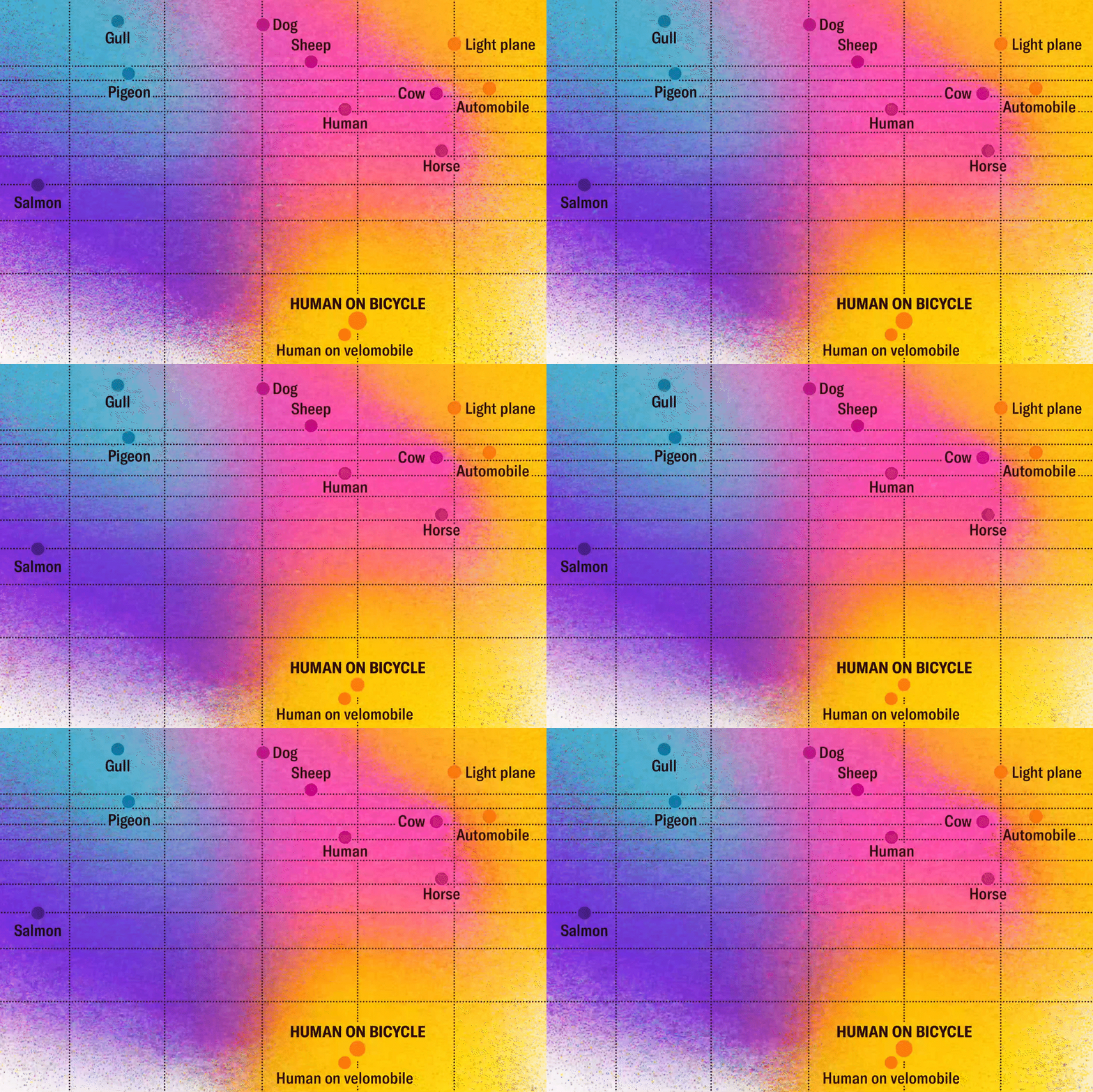
A Human on a Bicycle Is among the Most Efficient Forms of Travel in the Animal Kingdom
A famous graphic, now updated, compares locomotion in the animal kingdom
Quote Origin: The Optimist Invents the Airplane and the Pessimist the Parachute – Quote Investigator®
George Bernard Shaw? Gladys Bronwyn Stern? W. H. H. MacKellar? Gil Stern? Mack McGinnis?
The Optimization Trap: Why Too Much Efficiency Makes Us Fragile with Olivier Hamant
Accelerator Program Details — TinySeed
TinySeed is not just another venture fund: Our year-long remote accelerator program is designed to help founders with a revenue-generating SaaS optimize product-market fit and grow faster.

Wirth's law
Wirth's law is Niklaus Wirth's variant of the Jevons paradox: Software is getting slower more rapidly than hardware is getting faster.
