


Olivier De Schutter is a Belgian legal scholar specialising in economic and social rights, with a specific focus on the role of social rights in the fight against poverty and their status in European integration: he coined the term "the Social Constitution of Europe" to describe the role of the European Social Charter on the European continent. He served as the United Nations Special Rapporteur on the right to food from 2008 to 2014. He is a professor of international human rights law, European Union law and legal theory at the University of Louvain (UCLouvain) in Louvain-la-Neuve, Belgium, as well as at the College of Europe and at Sciences Po in Paris. He was a regular visiting professor at Columbia University between 2008 and 2012 and has regularly contributed to the American University Washington College of Law's Academy on Human Rights and Humanitarian Law. He is the first chair of the Belgian Advisory Council on Policy Coherence for Development and he co-chairs the International Panel of Experts on Sustainable Food Systems (IPES-Food), a group of experts from various disciplines and regions who work together towards developing proposals for food systems reform. A Member of the UN Committee on Economic, Social and Cultural Rights between 2015 and 2020, he was appointed the UN Special Rapporteur on extreme poverty and human rights, and took up his functions on May 1, 2020.
Humanitarian Governance
This review examines humanitarian governance, defined as the increasingly organized and internationalized attempt to save the lives, enhance the welfare, and reduce the suffering of the world's most vulnerable populations. Political scientists and international relations scholars are only now beginning to explain this rapidly growing global governance of humanity, which is particularly evident in the developing literatures on humanitarian intervention, emergency relief, peacebuilding, and refugee protection. As they increasingly engage this relatively unexplored area of global life, political scientists are using the familiar analytics of the global governance literature to explain the origins, design, and effectiveness of this collective activity. This essay, though, interjects an alternative perspective, one that draws from critical theory, to widen the research agenda of the study of humanitarian governance. Specifically, the essay raises six central questions: What kind of world is being imagined and produced? What accounts for the tremendous growth of humanitarian governance over the last century? Who governs? How is humanitarian governance organized and accomplished? What are the principal techniques of control? By what authority do humanitarians govern and what do they do with that authority?

Un démantèlement d’ampleur des lois environnementales est en cours en Europe, alerte un collectif d’ONG
Vingt mesures de dérégulation ou d’affaiblissement du droit de l’environnement ont été adoptées depuis 2024 au niveau de l’Union européenne ; trente nouveaux reculs sont en cours de discussion, ont comptabilisé les organisations non gouvernementales.
Einzelheiten zur Initiative | Europäische Bürgerinitiative
The EU Inc. Proposal: how far does it really go?
A post by Gillis Waelkens and Stéphanie De Smet (Clifford Chance)

Reinventing Commons Governance in Modern Times | David Bollier
I gave the following remarks about commons governance on September 27 as part of the U!REKA Lab Lecture Series. U!REKA -- which stands for Urban Research and Education Knowledge Alliance -- is a consortium of eight European universities that studies urban commons. The subtitle of my talk was "Find Answers by Living the Questions."
Work, Justice, and Collective Capital Institutions: Revisiting Rudolf Meidner and the Case for <span style="font-variant:small-caps;">Wage‐Earner</span> Funds
ABSTRACT This article makes the case for a specific variety of what we call Collective Capital Institutions (CCIs), by returning to the idea of Wage‐Earner Funds (WEFs) – a 1970s Swedish policy proposal designed gradually to shift ownership and control over parts of the economy to democratically controlled institutions. We identify two attractive rationales in favour of such a scheme and argue that both can fruitfully be transposed to the current worldwide economic situation. The egalitarian rationale is that WEFs could help in the pursuit of equality by giving a wider set of people a stake in collectively owned companies and a right to their profits. The democratic rationale is that WEFs redistribute not only these profits, but also the power over economic decisions made within companies. We then contrast such schemes for collective capital ownership with the similar but much more privatised proposals set out in, for instance, John Rawls's idea of a ‘property‐owning democracy’. We argue that CCIs ultimately are more likely to contribute to the development of the ‘sense of justice’ within society that is needed for a stable just society. We conclude that CCIs deserve a great deal more exploration in academic and political discussions of egalitarian economic systems.

W Social, le réseau social européen et open source qui ne l’était pas vraiment
Censé être un grand jour pour l’internet européen, le 17 juin dernier a pris des airs de farce. Le lancement de W, le réseau social européen, a


Elena Rossini 🌈 (@_elena@mastodon.social)
#WSocial will open up their beta program today… and I have a SCOOP for you: it appears that they have quietly gone closed-source! This is ironic, considering that the @EUCommission@ec.social-network.europa.eu just unveiled their Tech Sovereignty Package, emphasizing the importance of #OpenSource. And yet they have migrated their main ATproto accounts to W Social - whose code can no longer be inspected! My full article - with a great analysis by @aral@mastodon.ar.al: 🔗: https://blog.elenarossini.com/w-social-public-institutions-and-the-theater-of-european-digital-sovereignty/ #FOSS #DigitalSovereignty #BigTech
EU–INC — One Europe. One Standard. — Pan-European legal entity.
EU–INC is a proposal for a pan-European standardized legal entity to unlock pan-European startup scaling.


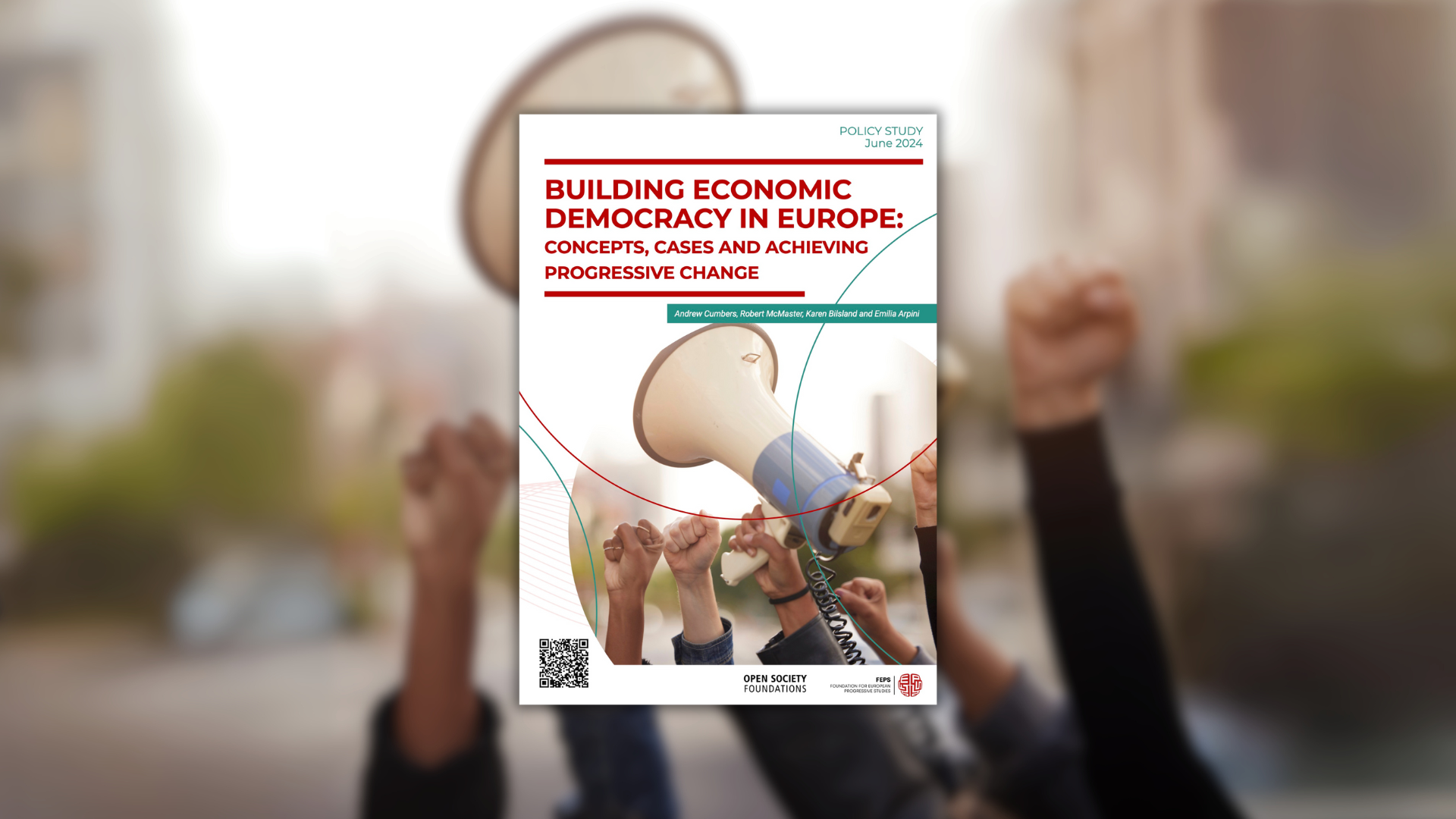
Building Economic Democracy in Europe - Foundation for European Progressive Studies
Concepts, Cases and Achieving Progressive Change
OSZE-Jahrbuch 2014: Jahrbuch zur Organisation für Sicherheit und Zusammenarbeit in Europa (OSZE)
Jahrbuch zur Organisation für Sicherheit und Zusammenarbeit in Europa (OSZE)

@wsocial.eu und @eurosky.social wollen alles besser machen: keine Bots, keine Desinformation und nur europäische Technologie. Doch was taugen sie wirklich? Mein Mini-Scoop vorweg: Der ehemalige Armeechef Thomas Süssli sitzt im "Advisory Board" von @wsocial.eu THREAD
Just launched at Public Spaces in Amsterdam, The European Social Stack Open Declaration! A set of common principles agreed by complementary technology leaders 🫶 Read the declaration, add your signature, and share: european.social #EUSocialStack #Europe

