

In patent law, a patent pool is a consortium of two or more companies agreeing to cross-license patents relating to a particular technology. The creation of a patent pool can save patentees and licensees time and money, and, in case of blocking patents, it may also be the only reasonable method for making the invention available to the public.[1] Competition law issues are usually important when a large consortium is formed.
Patents in Open Source
The relationship between the patent system and software hasn’t always been clear. Software is a unique construction, incorporating both creative and functional aspects. While creative aspects of software are protected under copyright law, the functional aspects of software may be protectable via patent law.1 The interaction between patent law and open source licenses is the focus of this chapter.
How To Protect Your Intellectual Property Across Borders
Protect Your Intellectual Property with strong IP rights. Safeguard patents, trademarks, designs, and trade secrets to stay competitive in global markets.

Human Gene Patenting: Yes, Companies Can Own Your DNA
The idea of patenting a gene seems strange, and it's a practice that's made weirder by virtue of the fact that the genes of living humans can also be

Video Library: Patent Eligibility Restoration Act (PERA) and 35 U.S.C. § 101
Video content for proposed legislation concerning patent eligible subject matter under US law
How Extending Patent Protection For Antibiotics Creates Perverse Incentives To Render Them Useless
We take antibiotics and their ability to kill practically all bacteria for granted. But scientists are increasingly warning that we may be about to leave what might come to be seen as a golden age …

How Intellectual Property Reinforces Inequality
In its recent, unanimous decision that human genes cannot be patented, the Supreme Court gave a rare victory to the cause of economic fairness.

Tragedy of the anticommons
The tragedy of the anticommons is a type of coordination breakdown, in which a commons does not emerge, even when general access to resources or infrastructure would be a social good. It is a mirror-image of the older concept of tragedy of the commons, in which numerous rights holders' combined use exceeds the capacity of a resource and depletes or destroys it. The "tragedy of the anticommons" covers a range of coordination failures, including patent thickets and submarine patents. Overcoming these breakdowns can be difficult, but there are assorted means, including eminent domain, laches, patent pools, or other licensing organizations.

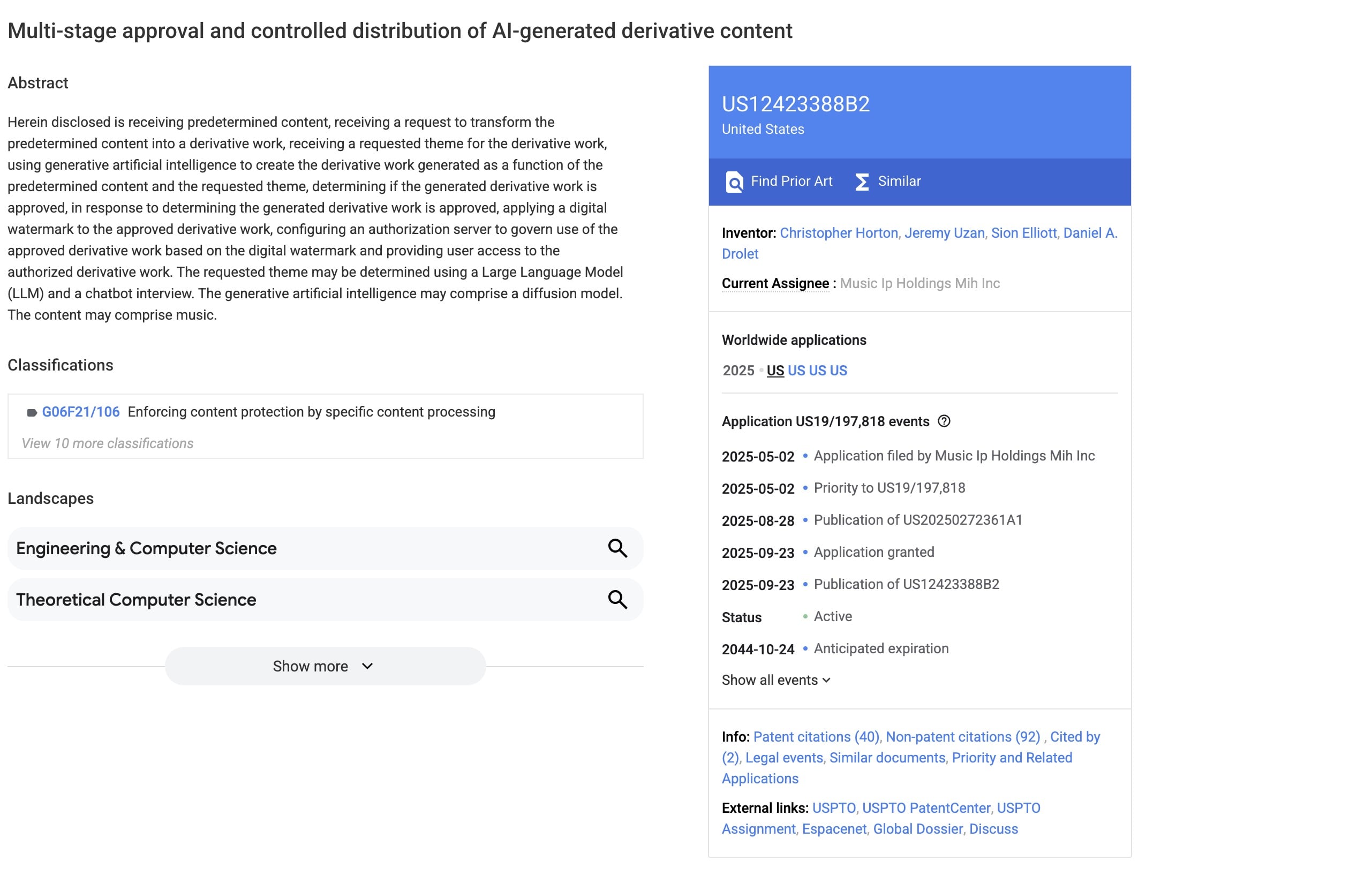
Inside the UMG-backed patent portfolio targeting AI music derivatives: A technical blueprint for the walled garden model? - Music Business Worldwide
An entity linked to UMG has been building a patent portfolio around AI-music infrastructure…
From ownership to stewardship: reimagining intellectual property governance through the Knowledge Commons Framework
Contemporary intellectual property (IP) governance remains strongly shaped by proprietary logics of exclusivity, control, and rights allocation, even as knowledge production becomes increasingly co...

Getting Touchy About Patents | Official jQuery Blog
jQuery: The Write Less, Do More, JavaScript Library
Microsoft patents system to freeze games and inject ads during downtimes — watching commercials earns ad-free playtime credits
Is this patent a sign of things to come?


Laws of Tech: Commoditize Your Complement
A classic pattern in technology economics, identified by Joel Spolsky, is layers of the stack attempting to become monopolies while turning other layers into perfectly-competitive markets which are commoditized, in order to harvest most of the consumer surplus; discussion and examples.

These experts figured out why so many bogus patents get approved
Empirical research reveals three big problems with how patents are vetted.

Papers and patents are becoming less disruptive over time
Theories of scientific and technological change view discovery and invention as endogenous processes1,2, wherein previous accumulated knowledge enables future progress by allowing researchers to, in Newton’s words, ‘stand on the shoulders of giants’3–7. Recent decades have witnessed exponential growth in the volume of new scientific and technological knowledge, thereby creating conditions that should be ripe for major advances8,9. Yet contrary to this view, studies suggest that progress is slowing in several major fields10,11. Here, we analyse these claims at scale across six decades, using data on 45 million papers and 3.9 million patents from six large-scale datasets, together with a new quantitative metric—the CD index12—that characterizes how papers and patents change networks of citations in science and technology. We find that papers and patents are increasingly less likely to break with the past in ways that push science and technology in new directions. This pattern holds universally across fields and is robust across multiple different citation- and text-based metrics1,13–17. Subsequently, we link this decline in disruptiveness to a narrowing in the use of previous knowledge, allowing us to reconcile the patterns we observe with the ‘shoulders of giants’ view. We find that the observed declines are unlikely to be driven by changes in the quality of published science, citation practices or field-specific factors. Overall, our results suggest that slowing rates of disruption may reflect a fundamental shift in the nature of science and technology.

The Moat or the Commons — Warman Notes
American capital financed AI on the assumption it would be the next great monopoly. Open-weight models are commoditizing the capability that monopoly was supposed to protect. The collision between the two now defines the direction of the U.S. AI industry — and the country.