

Perceptual coding is a method of lossy data compression that exploits the limitations of human sensory system in order to reduce data size. It is widely applied in audio, image and video compression standards, where certain details are removed or simplified because they are unlikely to be noticed under regular listening or viewing conditions.
Semantic Compression
An introduction to the idea that code should be approached with a mindset towards compressing it semantically, rather than orienting it around objects.

Compression: Crash Course Computer Science #21
media minimization
Media minimization refers to the minimization of the kind of media that is usually high-bandwidth, such as images and videos.
JPEG XL
The JPEG XL Image Coding System[8] (JPEG XL, sometimes shortened to JXL) is an image format that supports both lossy and lossless compression. It was developed by the Joint Photographic Experts Group (JPEG), Google and Cloudinary. It is a free and open standard defined by ISO/IEC 18181. The standard consists of four parts that cover the Core coding system, File format, Conformance testing, and Reference software, respectively.
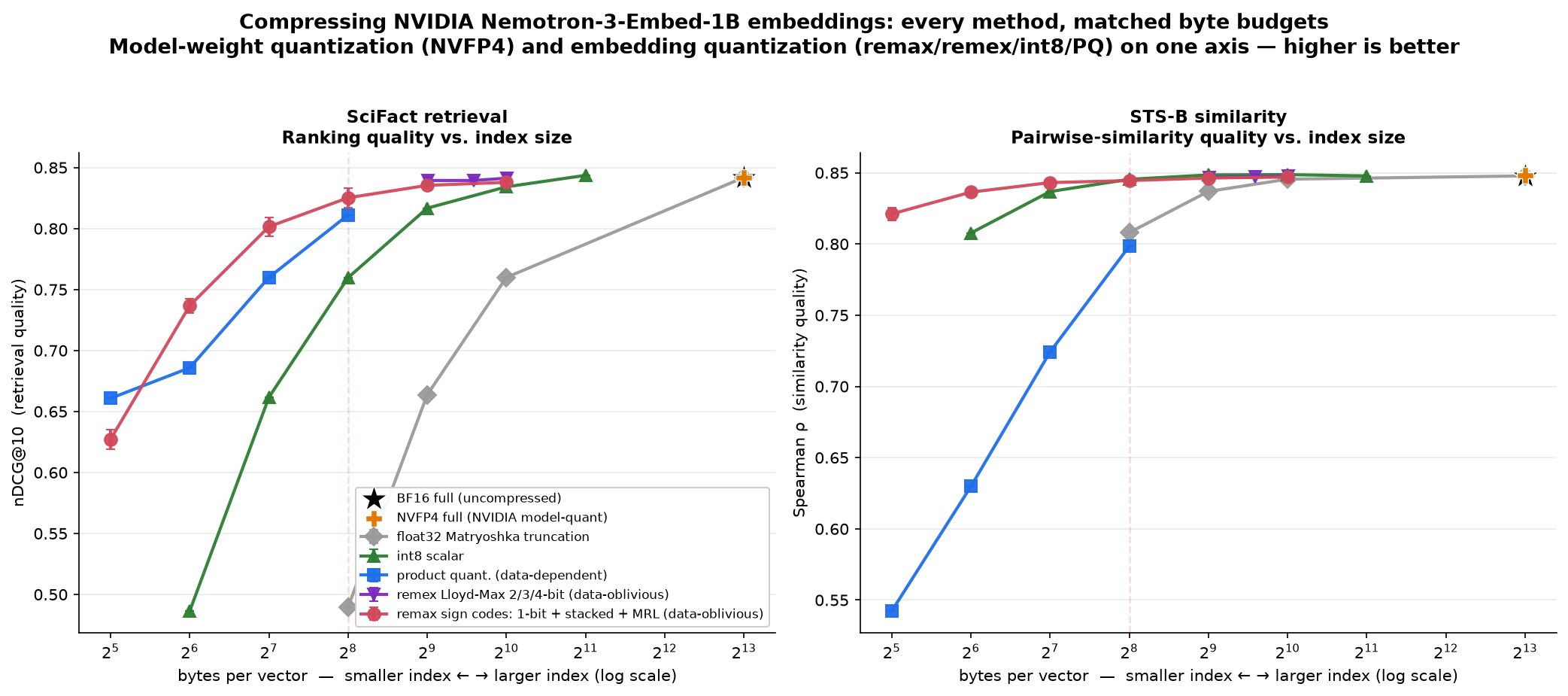
A 4-Bit Model and a 1-Bit Index
Running NVFP4 Nemotron on a CPU, then mapping every embedding-compression method at matched byte budgets. The two quantizations compose.
Compression is prediction | ngrok blog
Compression and LLMs are trying to solve the exact same problem: predicting what comes next. Learn the fundamentals of compression and how better prediction leads to better shrinkage.
Permacomputing
Permacomputing is a term originating from the demoscene, known for squeezing the most out of very restricted computing resources, such as the 4k intro with a maximum executable file size of 4096 bytes. Artist programmer Ville-Matias Heikkilä, aka Viznut, coined the term in a text he published on his website in 2020 1. What stands out in this writing is the holistic approach to computing and sustainability by taking inspiration from permaculture. In both computing and agriculture, problems are usually solved by increasing control over a process, which often goes hand in hand with an increase in resource use. Permaculture uses methods that lets nature do the work, minimizing the reliance on artificial energy. Heikkilä sees similarities between how both permaculture practitioners and hackers find clever solutions to problems. He writes that the existence of computers can only be justified by their ability to augment the potential of humans to have a strengthening effect on ecosystems.
Robustness of Practical Perceptual Hashing Algorithms to...
Perceptual hashing algorithms (PHAs) are widely used for identifying illegal online content and are thus integral to various sensitive applications. However, due to their hasty deployment in...

Things unlearned
This post is part of a series, starting at Reflections on a decade of coding.
Consistently faster and smaller compressed bitmaps with Roaring | Daniel Lemire, Computer Science Professor
Computer Science Professor
The Data Minimization Principle in Machine Learning
The principle of data minimization aims to reduce the amount of data collected, processed or retained to minimize the potential for misuse, unauthorized access, or data breaches. Rooted in...
Permacomputing | viznut
This is a collection of random thoughts regarding the application of permacultural ideas to the computer world.
Permacomputing | viznut
This is a collection of random thoughts regarding the application of permacultural ideas to the computer world.
Compression Dictionary Transport - HTTP | MDN
Compression Dictionary Transport is a way of using a shared compression dictionary to dramatically reduce the transport size of HTTP responses.
Perkeep
Perkeep (née Camlistore) is a set of open source formats, protocols, and software for modeling, storing, searching, sharing and synchronizing data in the post-PC era. Data may be files or objects, tweets or 5TB videos, and you can access it via a phone, browser or FUSE filesystem.