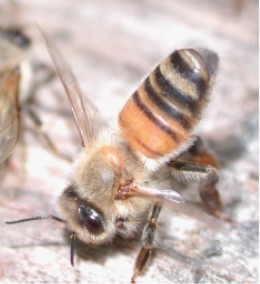
A pheromone is a chemical that is secreted or excreted by an organism, which triggers a social response in members of the same species. There are alarm pheromones, food trail pheromones, sex pheromones, and many others that affect behavior or physiology. Pheromones are used by many organisms, from basic unicellular prokaryotes to complex multicellular eukaryotes. Their use among insects has been particularly well documented. In addition, some vertebrates, plants and ciliates communicate by using pheromones. The ecological functions and evolution of pheromones are a major topic of research in the field of chemical ecology.
Herding Aphids: How 'Farmer' Ants Keep Control Of Their Food
Chemicals on ants' feet tranquilise and subdue colonies of aphids, keeping them close by as a ready source of food, says new research. The study throws new light on the complex relationship between ants and the colonies of aphids whose sugary secretions the ants eat.

Plants hear their pollinators, and produce sweet nectar in response | Hacker News
If I recall correctly: flowers are often shaped like dish antennas to collect sound vibration, and plants can distinguish the frequency of wing beats of their preferred pollinator from frequencies of other insects, and will act only for their pollinators.
The understanding that even bees have feelings is changing our view of consciousness | New Scientist
From jays that seem to say "sorry" to insects that play, signs of emotional inner life across the animal kingdom are giving us new perspectives on what consciousness is, and how we might pin it down

Symbiotic organs in insects: diversity, functional implications, and terminology
Abstract With over a million described species, insects represent the most successful group of animals on Earth. One of the drivers of insect diversity is their ability to engage in multifold beneficial symbioses with microorganisms, often involving specialized host organs to accommodate intra- or extracellular symbionts. The existence of such organs and their importance for sustaining and transmitting beneficial symbionts has been known for over a century, and specific terms have been established for categorizing organs harbouring intracellular bacteria (bacteriomes) or fungi (mycetomes), or cuticular crypts containing extracellular fungi (mycetangia). For others, however, general terms are lacking, e.g. organs containing extracellular bacteria associated with the cuticle or with the digestive tract. Furthermore, previously established terms have been misused in other contexts. Notably, ‘bacteriome’ has been increasingly employed in the microbiome field to refer to bacterial communities, instead of the term’s original meaning of specialized organs housing intracellular bacterial symbionts. Here, we review and categorize the diversity of symbiotic organs in insects and propose a unified terminology. Our hope is that this common language will facilitate communication and thereby support the field of symbiosis research in unravelling commonalities and differences in the evolution, ecology, development, physiology and molecular basis across symbiotic interactions. This article is part of the theme issue ‘Life in natural microcosms’.

EPISTEMIC STIGMERGY: NATURAL VS. ARTIFICIAL INTELLIGENCE
The article\(^{1}\) defends the thesis that intelligent behavior might require not internal complexity but complex interaction. This is demonstrated by the various forms of stigmergy that can be observed both in social insects and in humans. The exposition is structured as follows: (§0) explains how the term “intelligence” is interpreted in the following text; (§1) clarifies the relation between intelligence and complexity; (§2) shows that intelligent behavior does not require internal complexity; (§3) introduces the concept of stigmergy; (§4) presents the mechanisms that give rise to this phenomenon; (§5) distinguishes several types of stigmergic interaction; (§6) briefly discusses the evolutionary mechanisms that could have produced them; (§7) sketches the possible ways in which the concept of stigmergy is used outside biology; (§8) examines collaborative stigmergy in humans; (§9) points to its epistemic projections; (§10) outlines some conclusions concerning the role of artificial intelligence systems and their place in human society.
Swarm Intelligence: From Natural to Artificial Systems
Abstract. Social insects--ants, bees, termites, and wasps--can be viewed as powerful problem-solving systems with sophisticated collective intelligence. Co
Mycelium
Tom Seeley: Honeybee Democracy
Termite
Termites are a group of eusocial insects which consume a variety of decaying plant material, generally in the form of wood, leaf litter, and soil humus. They are distinguished by their beaded (moniliform) antennae and the soft-bodied, unpigmented worker caste for which they have been commonly termed "white ants"; however, they are not ants but highly derived cockroaches; they are genetically closer to some cockroach groups than these are to other cockroaches. About 2,997 extant species are currently described, 2,125 of which are members of the family Termitidae.

The cognitive cell: bacterial behavior reconsidered
Research on how bacteria adapt to changing environments underlies the contemporary biological understanding of signal transduction, and signal transduction provides the foundation of the information-processing approach that is the hallmark of the ‘cognitive revolution,’ which began in the mid-20th century. Yet cognitive scientists largely remain oblivious to research into microbial behavior that might provide insights into problems in their own domains, while microbiologists seem equally unaware of the potential importance of their work to understanding cognitive capacities in multicellular organisms, including vertebrates. Evidence in bacteria for capacities encompassed by the concept of cognition is reviewed. Parallels exist not only at the heuristic level of functional analogue, but also at the level of molecular mechanism, evolution and ecology, which is where fruitful cross-fertilization among disciplines might be found.

Reciprocal signaling in honeyguide-human mutualism
Honeyguide birds recognize human honey-hunters calls and help them find wild bees’ nests.

Functional Information: Towards Synthesis of Biosemiotics and Cybernetics
Biosemiotics and cybernetics are closely related, yet they are separated by the boundary between life and non-life: biosemiotics is focused on living organisms, whereas cybernetics is applied mostly to non-living artificial devices. However, both classes of systems are agents that perform functions necessary for reaching their goals. I propose to shift the focus of biosemiotics from living organisms to agents in general, which all belong to a pragmasphere or functional universe. Agents should be considered in the context of their hierarchy and origin because their semiosis can be inherited or induced by higher-level agents. To preserve and disseminate their functions, agents use functional information - a set of signs that encode and control their functions. It includes stable memory signs, transient messengers, and natural signs. The origin and evolution of functional information is discussed in terms of transitions between vegetative, animal, and social levels of semiosis, defined by Kull. Vegetative semiosis differs substantially from higher levels of semiosis, because signs are recognized and interpreted via direct code-based matching and are not associated with ideal representations of objects. Thus, I consider a separate classification of signs at the vegetative level that includes proto-icons, proto-indexes, and proto-symbols. Animal and social semiosis are based on classification, and modeling of objects, which represent the knowledge of agents about their body (Innenwelt) and environment (Umwelt).

Mushrooms Communicate With Each Other Using Up To 50 'Words', Scientist Claims - Slashdot
An anonymous reader quotes a report from the Guardian: Buried in forest litter or sprouting from trees, fungi might give the impression of being silent and relatively self-contained organisms, but a new study suggests they may be champignon communicators. Mathematical analysis of the electrical sign...

E. coli chemotaxis: the baffling intelligence of a single cell
I want to tell the story of a beautiful phenomenon in biology. In some sense it’s the prototype of much of the activity of life. The phenomenon is the way in which an individual cell of E. coli forages for nutrients. This process, known as “chemotaxis”—the “chemo-” for chemical and the “taxis” from the Greek τάξις, for tactics—is intelligence in one of its most elemental forms. An individual E. coli has no brain, obviously, and is even many orders of magnitude simpler than a human cell, and yet already it possesses something like a sense of smell, drive, even a memory. Chemotaxis recasts E. coli not as some aimless gut-pest but rather as an exquisitely sophisticated physical computer.
Microbiome interplay: plants alter microbial abundance and diversity within the built environment
The built indoor microbiome has importance for human health. Residents leave their microbial fingerprint but nothing is known about the transfer from plants. Our hypothesis that indoor plants contribute substantially to the microbial abundance and diversity in the built environment was experimentally confirmed as proof of principle by analyzing the microbiome of the spider plant Chlorophytum comosum in relation to their surroundings. The abundance of Archaea, Bacteria, and Eukaryota (fungi) increased on surrounding floor and wall surfaces within 6 months of plant isolation in a cleaned indoor environment, whereas the microbial abundance on plant leaves and indoor air remained stable. We observed a microbiome shift: the bacterial diversity on surfaces increased significantly but fungal diversity decreased. The majority of cells were intact at the time of samplings and thus most probably alive including diverse Archaea as yet unknown phyllosphere inhabitants. LEfSe and network analysis showed that most microbes were dispersed from plant leaves to the surrounding surfaces. This led to an increase of specific taxa including spore-forming fungi with potential allergic potential but also beneficial plant-associated bacteria, e.g., Paenibacillus. This study demonstrates for the first time that plants can alter the microbiome of a built environment, which supports the significance of plants and provides insights into the complex interplay of plants, microbiomes and human beings.

PFAS ‘forever chemicals’ constantly cycle through ground, air and water, study finds
The Stockholm University study highlights the chemicals’ mobility, which has been found in penguin eggs and polar bears