Philip Jenkins (born April 3, 1952) is an American professor of history at Baylor University in the United States, and co-director for Baylor's Program on Historical Studies of Religion in the Institute for Studies of Religion.[1] He is also the Edwin Erle Sparks Professor of Humanities Emeritus at Pennsylvania State University (PSU). He was professor (from 1993) and a distinguished professor (from 1997) of history and religious studies at the same institution; and also assistant, associate and then full professor of criminal justice and American studies at PSU, 1980–93.[2]
Philip Jenkins
I work in several quite diverse fields. Broadly, my major current interests include the study of global Christianity, past and present; of new and emerging religious movements; and of Late Modern US history, chiefly post-1975.
Journal of the Council for Research on Religion
Interdisciplinary Journal
The Association of Religion Data Archives
Association of Religion Data Archives (ARDA) best reference source to find data, information, datasets on American & international religion, US Religion Census

Jonathan Berkey
I teach the full range of Middle Eastern history since the rise of Islam, and I participate in Davidson's Humanities Program. My research and writing focus on Islamic religious culture and medieval Egypt and Syria.
Forgetting History and the Humanities in the American University
Reflections on recent news from the University of Oregon, Virginia Tech, and the University of Chicago

Against Economics
Mainstream economists nowadays might not be particularly good at predicting financial crashes, facilitating general prosperity, or coming up with models for preventing climate change, but when it comes to establishing themselves in positions of intellectual authority, unaffected by such failings, their success is unparalleled. One would have to look at the history of religions to find anything like it. To this day, economics continues to be taught not as a story of arguments—not, like any other social science, as a welter of often warring theoretical perspectives—but rather as something more like physics, the gradual realization of universal, unimpeachable mathematical truths.

Invitation to Syriac Christianity by Michael Philip Penn, Scott Johnson, Christine Shepardson, Charles Stang - Paper
Scholarship is a powerful tool for changing how people think, plan, and govern. By giving voice to bright minds and bold ideas, we seek to foster understanding and drive progressive change.

Florida Creates a More Conservative U.S. History Course to Rival A.P.
Here are ways Florida’s advanced high school history program, which students can use for college credit, differs from other curriculums.

Baylor University is Now Hiring for Regular Lecturer, Non-Tenure-Track, Old Testament
The Department of Religion at Baylor University seeks to fill a full-time position at the rank of Lecturer in Hebrew Bible/Old Testament to start August 1, 2027. Applications are open through September 15, 2026.

CFP: Religion, Politics, and Cognitive Warfare | The Journal for Cultural and Religious Theory | JCRT
This call for papers invites work on religion, politics, and cognitive warfare, exploring how belief, media, conspiracy, identity, and power shape struggles over reality, interpretation, and life in an age of disinformat

The changing nature of America’s irreligious explained
Americans are increasingly choosing not to identify with any religious tradition. But this group of irreligious people is a complex one – with different relationships to religion.

Can Religions Be Reborn? | Over The Mountains to Civilizational Renewal #9
Religion matters for economic growth through various channels
Standard models of economic growth depict physical capital, human capital, population/labour, and total factor productivity as proximate determinants of economic growth. But their deeper determinants are poorly understood. This column argues that religion – as one of the most ubiquitous social phenomena – can spur or impair economic growth by affecting each of these four elements of the macroeconomic production function.

Gerhard Lenski
Gerhard Emmanuel "Gerry" Lenski, Jr. (August 13, 1924 – December 7, 2015) was an American sociologist known for contributions to the sociology of religion, social inequality, and introducing the ecological-evolutionary theory. He spent much of his career as a professor at the University of North Carolina at Chapel Hill, where he served as chair of the Department of Sociology, 1969–72, and as chair of the Division of Social Sciences, 1976–78.
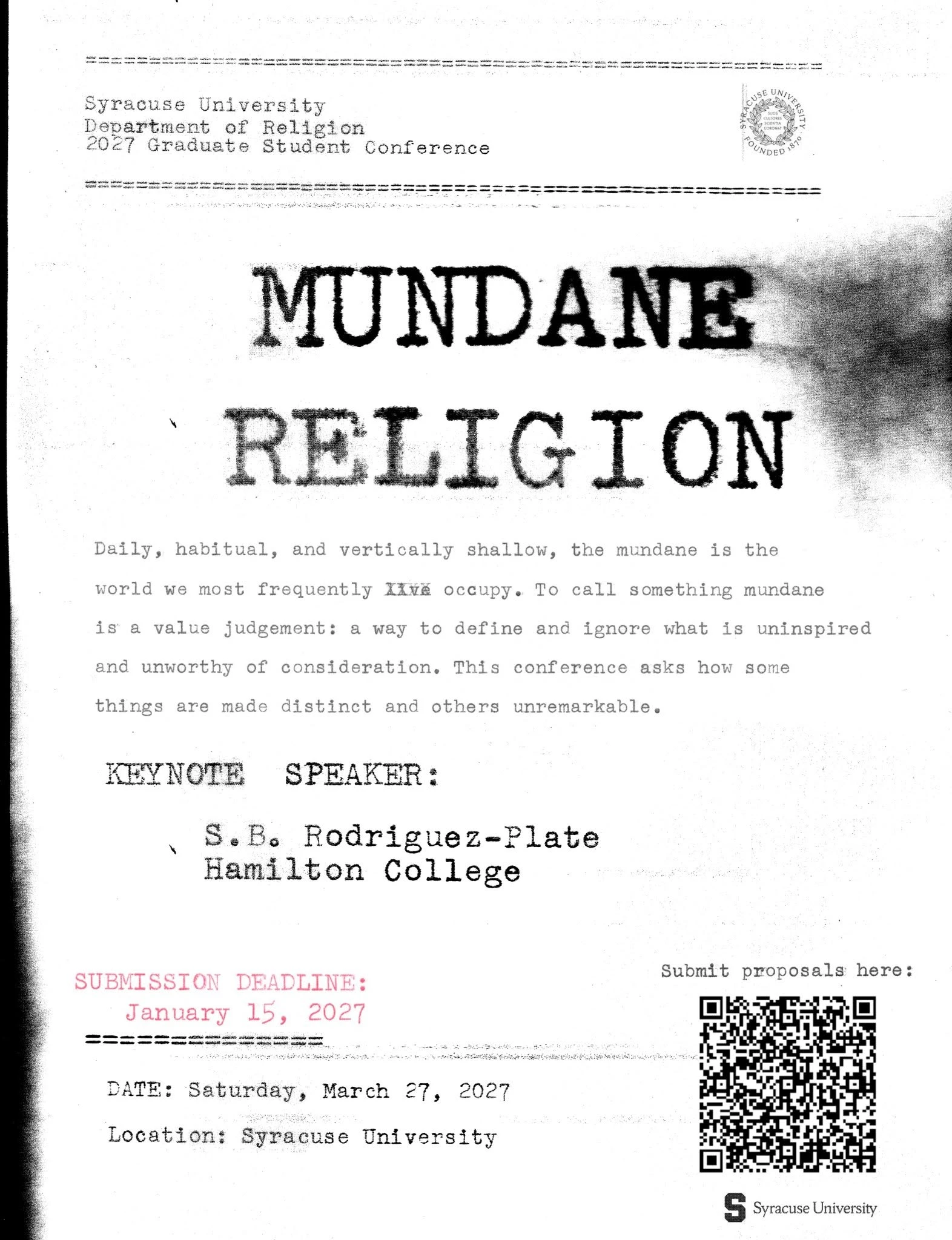
#CFP: Mundane Religion — 2027 Graduate Student Conference
Syracuse University’s Department of Religion invites proposals on religion and everyday life for its March 27, 2027 graduate student conference. Proposals are due January 15, 2027.
Sacralizing Dominion: The Doctrine of Christian Discovery and the Religious Nationalist Imagination
White Christian nationalism presents itself as restoration—of a Christian nation, a moral order, a rightful hierarchy. This article argues that what it restores is the world-making rhetoric of the Doctrine of Christian Discovery (DoCD). Reading the fifteenth-century papal bulls, their sedimentation into United States law, culture, religion, and contemporary dominionist discourse as a single rhetorical formation, we show that the bulls’ vocabulary of discovery, vacancy, and civilization did not describe a world but constituted one: a moral-legal order in which Christian identity conferred sovereignty and racialized peoples appeared as obstacles to salvation and property. That order persists as hegemonic common sense, carried by legal precedent, curricula, and popular culture, and it is re-performed today in the territorial rhetoric of the New Apostolic Reformation and white Christian nationalism. Following Steven T. Newcomb (Shawnee/Lenape), repudiating the doctrine’s documents without dismantling its embeddedness within language and cognition leaves religious nationalism’s deepest resource intact. Against the discovery template, we set three counter-rhetorics—Indigenous theologies, Black theology, and womanism—and argue that desanctifying dominion requires conciliation, not reconciliation.