

The Republican Party, also known as the Grand Old Party (GOP), is a right-wing populist and neo-nationalist political party in the United States, sitting on the right-wing to far-right of the political spectrum. Founded in 1854, it emerged as the main rival of the Democratic Party in the 1850s, and the two parties have dominated American politics since then.
The Socialist Party of Great Britain
The Socialist Party wants to get rid of the profit system and establish real socialism.
The far right is acting as one party. When will we? | Euractiv
Liberal institutions treat each surge of populism as a domestic challenge to be managed within national elections or courts. Meanwhile the far right amplifies each other’s victories, recycles each other’s talking points, and shares disinformation

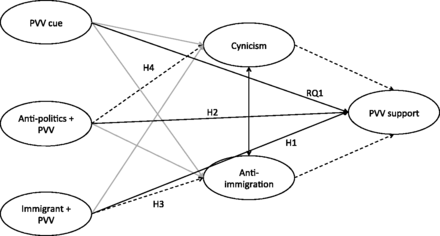
Media Cues and Citizen Support for Right-Wing Populist Parties
Abstract. Right-wing populist parties are thriving across Europe. Their success is usually attributed to demand-side voter factors and supply-side factors
When Do Parties Lie? Misinformation and Radical-Right Populism Across 26 Countries - Petter Törnberg, Juliana Chueri, 2026
The spread of misinformation has emerged as a global concern. Academic attention has recently shifted to emphasize the role of political elites as drivers of mi...

Immigrants Will Make America Great Again Faster Than Natural-Born Citizens
There’s not a single conservative left in the GOP. The ideals that were formerly considered “conservative” — small government, fiscal responsibility, etc. — have been …

Anti-AI Populism is Reshaping American Politics
Democrats are winning on data center opposition. So are Republicans.

Is Australia's two-party political system dead?
With the rise of One Nation's popularity and younger voters increasingly turning to the Greens, the traditional two-party system in Australian politics has been dismantled, a former political strategist argues.
Rising Market Power Has Led to the Rise in Far-Right Political Parties - ProMarket
In new research, Tommaso Crescioli & Toon Van Overbeke find that small business owners and their families who have lost revenue share to rising market concentration among big businesses have turned to far-right political parties to express their grievances.

The GOP’s Birthday Boy Defense
Republicans built a brand on “f your feelings.” Then the DNC called Stephen Miller ugly, and they found theirs.

When Do Parties Lie? Misinformation and Radical-Right Populism Across 26 Countries
The spread of misinformation has emerged as a global concern. Academic attention has recently shifted to emphasize the role of political elites as drivers of misinformation. Yet, little is known of the relationship between party politics and the spread of misinformation—in part due to a dearth of cross-national empirical data needed for comparative study. This article examines which parties are more likely to spread misinformation, by drawing on a comprehensive database of 32M tweets from parliamentarians in 26 countries, spanning 6 years and several election periods. The dataset is combined with external databases such as Parlgov and V-Dem, linking the spread of misinformation to detailed information about political parties and cabinets, thus enabling a comparative politics approach to misinformation. Using multilevel analysis with random country intercepts, we find that radical-right populism is the strongest determinant for the propensity to spread misinformation. Populism, left-wing populism, and right-wing politics are not linked to the spread of misinformation. These results suggest that political misinformation should be understood as part and parcel of the current wave of radical right populism, and its opposition to liberal democratic institution.
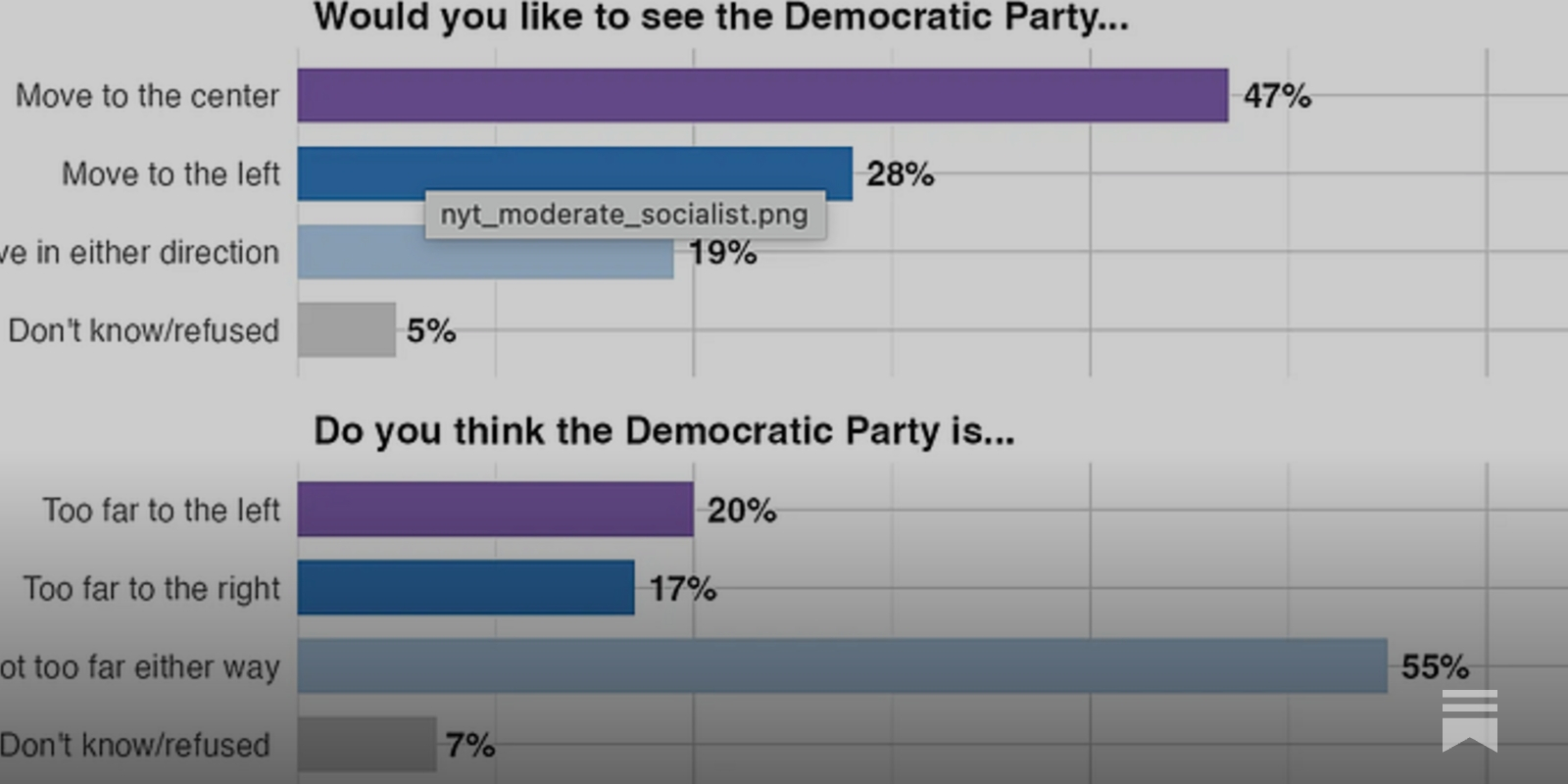
Democratic voters want the party to be more moderate — and more socialist?
The trouble with polling about ideological labels
Hammer and Hoe: Alabama Communists During the Great Dep…
Between 1929 and 1941, the Communist Party organized an…

Legitimize or Delegitimize? Mainstream Party Strategy toward (Former) Pariah Parties and How Voters Respond
Mainstream parties have often shifted from initially portraying new competitors as undemocratic pariahs (i.e., a delegitimizing strategy) to portraying the same parties later as democratic (i.e., a legitimizing strategy). I argue that voters follow mainstream parties’ legitimizing strategies in their legitimacy evaluations of these parties. I investigate this argument with two independent survey experiments and a quantitative media content analysis in two countries that differ sharply in the nature of party competition—from mainstream parties delegitimizing a far-right party (i.e., Germany) to mainstream parties legitimizing it (i.e., Sweden). I find strong evidence that (a) mainstream parties can effectively legitimize pariah parties in the eyes of voters, (b) turning back to delegitimization has little effect, (c) legitimization is no less effective in the face of a third party’s delegitimizing strategy, and (d) legitimization resonates beyond co-partisans. The results suggest that mainstream party legitimization of pariah parties has far-reaching consequences.

The two-party system is killing our democracy
Here’s a long-shot idea to fix our system and make our democracy more democratic.

German political parties leave X, say platform “descended into chaos”
Three German left-wing parties have announced a coordinated departure from the social media platform X, saying it has descended into chaos and promotes right-wing populist content.

Public support for the <i>cordon sanitaire</i> : Descriptive evidence from Spain
Reactions to the rise of far-right parties that advocate democratic backsliding, and the dilution of socially liberal democratic norms present a dilemma for existing political parties. How should existing political parties respond to this challenge? A commonly adopted strategy is to apply a cordon sanitaire which excludes radical right-wing challengers from the government-forming process. Do voters support this policy? Leveraging data from Spain – where the mainstream right has accommodated the radical right-wing party, VOX, via numerous governing coalitions – I rely on individual citizens’ views on how parties should respond to rise of the far-right party, to answer this question. Empirically, the results show very low-level support for the cordon sanitaire in Spain. Indeed, the modal position of the electorate, regardless of their ideological position, is to treat the party just like any other. These results are not conditioned by the propensity of individuals to identify VOX as indeed being a “radical right” party. These descriptive findings suggest that whilst radical right-wing parties may present an inimical threat to democratic norms, citizens do not necessarily view the means of squashing this threat to be one of strategic exclusion. This likely explains why the mainstream right has been able to institutionalise VOX as a political ally: where strategic exclusion is not expected, the mainstream right need not fear violating an expectation that does not exist.