Sanpaku or sanpaku gan is a Japanese term referring to a person with visible sclera on three sides of their irises: the normal left and right, plus above or below. The term is most often used in English to refer to a folk belief whereby it functions as an omen or symptom in alternative medicine. It was introduced into English in the mid-1960s by George Ohsawa as a condition supposedly cured by his macrobiotic method.
Yojimbo (1961)
A nameless ronin, or samurai with no master, enters a small village in feudal Japan where two rival businessmen are struggling for control of the local gambling trade. Taking the name Sanjuro…

GokuGoku | From Recognition to Production
Go from recognizing Japanese to actually producing it. Unlimited customizable exercises with instant feedback.

Nandi (Hinduism)
Nandi, also known as Nandikeshvara or Nandideva, is the bull vahana (mount) of the Hindu god Shiva. He is also the guardian deity of Kailash, the abode of Shiva. Almost all Shiva temples display stone images of a seated Nandi, generally facing the main shrine.

Sᴜɴʀɪsᴇ Oᴀᴛʜ 十 Tʜᴇ Sʏʟʟᴀʙᴜꜱ (ORI) - CC0 on Twitter / X
There is a type of person who in holding a position will purposefully choose to close their eyes to feel even more safely entrenched. This type is probably tempted to give into despair regarding AI and so needs to believe outright lies about it to cope.— Sᴜɴʀɪsᴇ Oᴀᴛʜ 十 Tʜᴇ Sʏʟʟᴀʙᴜꜱ (ORI) - CC0 (@sunriseoath) July 21, 2026
🔎 shamika ravi muslim hindu - Google Search

Bouba/kiki effect
The bouba–kiki effect or takete–maluma phenomenon is a non-arbitrary mental association between certain speech sounds and certain visual shapes. The most typical research finding is that people, when presented with nonsense words, tend to associate certain "soft" sounds with a rounded shape and other "hard" sounds with a spiky shape. Its discovery dates back to the 1920s, when psychologists documented experimental participants as connecting nonsense words to shapes in consistent ways.


Chindōgu
Chindōgu (珍道具; .mw-parser-output .IPA-label-small{font-size:85%}.mw-parser-output .references .IPA-label-small,.mw-parser-output .infobox .IPA-label-small,.mw-parser-output .navbox .IPA-label-small{font-size:100%}pronounced [tɕindoꜜːɡɯ]) is the practice of inventing ingenious everyday gadgets that seem to be ideal solutions to particular problems, but which may cause more problems than they solve. The term is of Japanese origin.[1]
Hundun
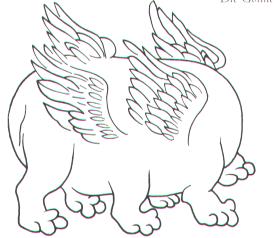
Hundun is both a "legendary faceless being" in Chinese mythology and the "primordial and central chaos" in Chinese cosmogony, comparable with the world egg.
À emporter - Gatsu Gatsu
1 Angel’s hair 5,90 Chicken soup, vermicelli & vegetables 2 Swallow’s Nest 5,90 Chicken soup with egg white 3 Spicy Soup 5,90 Spicy chicken soup, : Chinese cabbage & egg 4 Kio Nam 5,90 Scampi ravioli soup & Chinese cabbage 5 Tom Kha 5,90 Chicken soup with coconut cream (or scampi + 1€), vegetables, galangal […]

circmoji - Bluesky Emoji Circles
Cassava Sciences: Of Posters and Spaghetti Plots
In a previous blog post, I took a look at Western blots in papers from the lab of Dr. Hoau-Yan Wang at City University of New York (CUNY), mostly related to Cassava Sciences (Nasdaq: $SAVA), i…