


The Semantic Web, sometimes known as Web 3.0, is an extension of the World Wide Web through standards set by the World Wide Web Consortium (W3C). The goal of the Semantic Web is to make Internet data machine-readable.
OWL - Semantic Web Standards
The W3C Web Ontology Language (OWL) is a Semantic Web language designed to represent rich and complex knowledge about things, groups of things, and relations between things. OWL is a computational logic-based language such that knowledge expressed in OWL can be exploited by computer programs, e.g., to verify the consistency of that knowledge or to make implicit knowledge explicit. OWL documents, known as ontologies, can be published in the World Wide Web and may refer to or be referred from other OWL ontologies. OWL is part of the W3C’s Semantic Web technology stack, which includes RDF, RDFS, SPARQL, etc.
Who Shapes Web Standards? Uncovering the Main Topics of Interest in the W3C
12 November 2025 | Isolated Web Apps - Current state and future direction | Calendar
The World Wide Web Consortium (W3C) is an international community where Member organizations, a full-time staff, and the public work together to develop Web standards.
Understanding Web 3 — A User Controlled Internet
Coinbase breaks down the motivation and technology behind the development of Web 3
Working on HTML5.1
The World Wide Web Consortium (W3C) is an international community where Member organizations, a full-time staff, and the public work together to develop Web standards.
Linked Data - Design Issues
The Semantic Web isn't just about putting data on the web. It is about making links, so that a person or machine can explore the web of data. With linked data, when you have some of it, you can find other, related, data.

Web Platform Design Principles
Copyright © 2026 World Wide Web Consortium. W3C® liability, trademark and permissive document license rules apply.
WDC - RDFa, Microdata, and Microformat Data Sets
More and more websites have started to embed structured data describing products, people, organizations, places, and events into their HTML pages using markup standards such as Microdata, JSON-LD, RDFa, and Microformats. The Web Data Commons project extracts this data from several billion web pages. So far the project provides 12 different data set releases extracted from the Common Crawls 2010 to 2023. The project provides the extracted data for download and publishes statistics about the deployment of the different formats.
Position Paper for the W3C Workshop on Web Applications and Compound Documents
This document represents the consensus opinion of the Mozilla Foundation and Opera Software in the context of standards for Web Applications and Compound Documents.
Vision for W3C
Copyright © 2025 World Wide Web Consortium. W3C® liability, trademark and permissive document license rules apply.
Alex Russell | Web Components and Model Driven Views | Fronteers 2011
There's a lot of tension between today's markup and the semantics we're trying to express in our apps. HTML5 adds a few new types to help describe common cases, but what about when there's no allegory in markup for what you're building? What we need now is infrastructure, not guilt about being "non-semantic". This talk explores new standards-track work in WebKit that's going to enable say-what-you-mean development in completely new ways.

Standard.site - One schema. Every platform.
Standard.site provides shared lexicons for long-form publishing on AT Protocol. Making content easier to discover, index, and move across the ATmosphere.
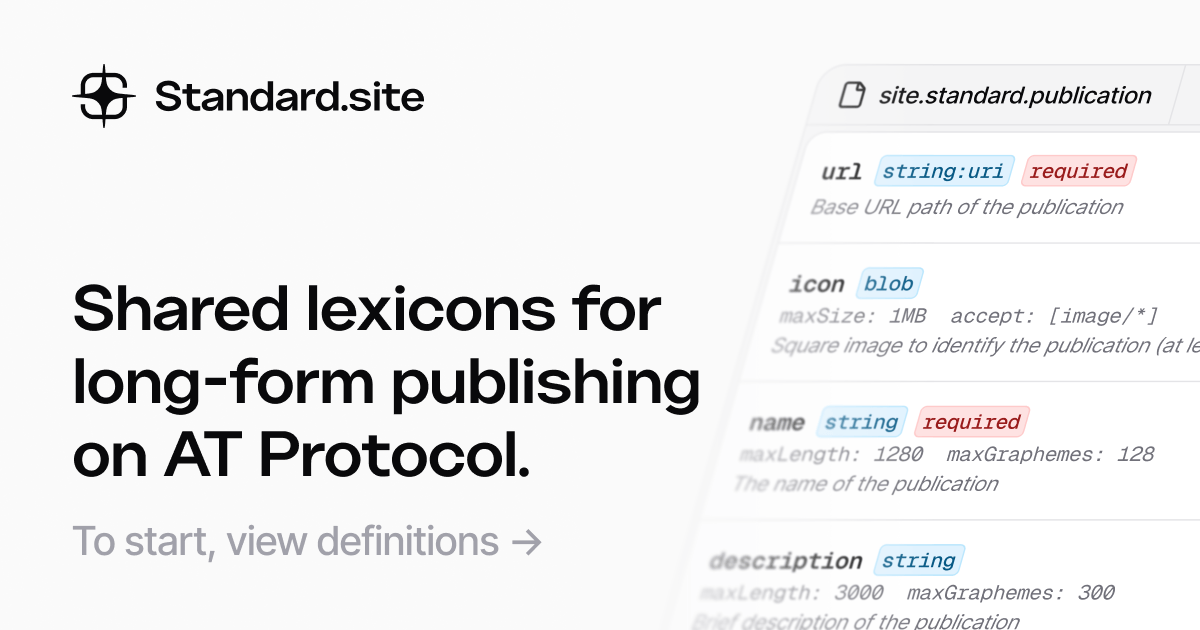
Standard.site - One schema. Every platform.
Standard.site provides shared lexicons for long-form publishing on AT Protocol. Making content easier to discover, index, and move across the ATmosphere.
Redstring - A Semantic Web Browser
Redstring is a semantic web browser, an infinitely recursive flowchart maker, and a graph-first personal knowledge manager.
Haystack: A Platform for Authoring End User Semantic Web Applications
The Semantic Web promises to open innumerable opportunities for automation and information retrieval by standardizing the protocols for metadata exchange. However, just as the success of the World Wide Web can be attributed to the ease of use and ubiquity of Web browsers, we believe that the unfolding of the Semantic Web vision depends on users getting powerful but easy-to-use tools for managing their information. But unlike HTML, which can be easily edited in any text editor, RDF is more complicated to author and does not have an obvious presentation mechanism. Previous work has concentrated on the ideas of generic RDF graph visualization and RDF Schema-based form generation. In this paper, we present a comprehensive platform for constructing end user applications that create, manipulate, and visualize arbitrary RDF-encoded information, adding another layer to the abstraction cake. We discuss a programming environment specifically designed for manipulating RDF and introduce user interface concepts on top that allow the developer to quickly assemble applications that are based on RDF data models. Also, because user interface specifications and program logic are themselves describable in RDF, applications built upon our framework enjoy properties such as network updatability, extensibility, and end user customizability – all desirable characteristics in the spirit of the Semantic Web.
