


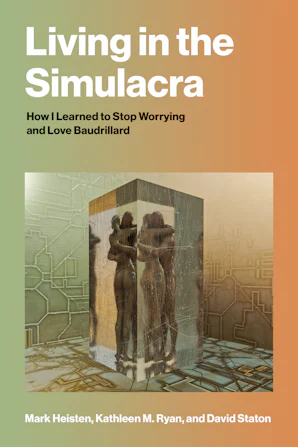
Simulacra and Simulation is a 1981 philosophical essay by the philosopher and cultural theorist Jean Baudrillard, in which he seeks to examine the relationships between reality, symbols, and society, in particular the significations and symbolism of culture and media involved in constructing an understanding of shared existence.
Living in the Simulacra
Despite a twenty-first-century plethora of images and our collective understanding that digital tools may alter the truth, human beings have a strong belief ...
Um símbolo para o fediverso ⁂
Propomos o símbolo ⁂ para representar o fediverso.

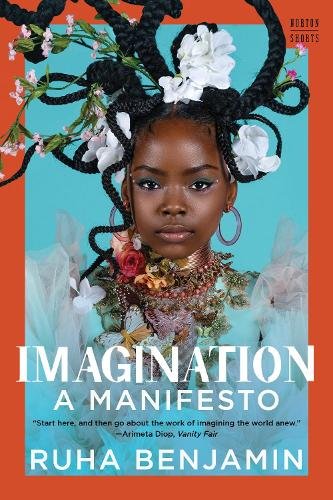
Imagination Activism — Moral Imaginations
The term is ‘Imagination Activist’ and ‘Imagination Activism’ is protected by a Creative Commons licence, CC BY-NC 4.0 DEED.
We speak often of AI as if it were a future event. But it is already here in the fabric of our being. What Karl Ove Knausgaard captures with devastating clarity in his recent essay ‘The Reenchanted… | Kenneth Mikkelsen | 19 comments
We speak often of AI as if it were a future event. But it is already here in the fabric of our being. What Karl Ove Knausgaard captures with devastating clarity in his recent essay ‘The Reenchanted World’ is the departure of the real. “We live in a virtual world, as if the world had been lifted out of itself, into the air, like a giant roof suspended above the ground,” he writes. It is an existential condition. Across philosophy, from Heidegger to Baudrillard, from Don DeLillo to Debord, a singular thread weaves: the world, once our shelter from the self, has become self-referential. Where once we encountered beings in our Zuhandensein—ready-to-hand, intimate, meaningful—we now face a procession of Vorhandensein: inert, objectified, mediated. Simulation replaces encounter. Perception is swallowed by spectacle. And the digital era, in Knausgaard’s terms, “distances culture from the body”. “It is not just the body that disappears—it is the awareness that we are dying,” he writes. What we face is not merely technological change, but what I would call existential dissonance: the erosion of resonance between our inner world, our social world, and the material world. It is the tension that arises when the way one lives, acts, and relates is misaligned with one’s deeper sense of meaning, reality, and value. It manifests itself as a disturbance in being — an unease that is not merely emotional, but rooted in a felt gap between one’s existence as it is and as it could or should be. It is the voice of the self calling from within the noise of the world. This is why Knausgaard’s essay matters for anyone working in, with, or around AI. Because the question isn’t: What can these systems do? It is: What do they undo? “We can explain everything. But we understand nothing,” he writes. Manipulated constructions of truth, in such a time, becomes a currency. As shown in recent events—from Francesca Gino’s research fraud at Harvard to Bezos’ all-female crew venture into space, and Trump’s detention camp —truth is no longer that which corresponds with reality, but that which performs and sells. As Baudrillard warned, the simulation no longer hides the real—it becomes it. And yet, something remains. Knausgaard writes not to despair, but to stay. In the body. In death. In silence. In the concrete. If you seek to understand what is happening—not just in AI, but in the very metaphysics of modern life—I suggest we begin not with data, but with dissonance. With the feeling that something vital is slipping from view, and that “being in the world” now requires resistance. “We are surrounded by mystery. And yet we act as if everything were known,” he writes. AI will never understand this. But we must. Knausgaard’s full essay from Harper’s Magazine can be read via link in comments. | 19 comments on LinkedIn

Les contributions de Christopher Sims à la macroéconomie
Carlos Chavez évoque les contributions de Christopher Sims : les modèles VAR, les méthodes bayésiennes, la théorie fiscale des prix, l'inattention ra…

Trajectoires #14 : En cheminant avec Kakeya, Vincent Borrelli et Jean Luc Rullière | Trajectoires
Trajectoires, le podcast de la culture mathématique.

Un símbolo para o fediverso ⁂
Propoñemos o símbolo ⁂ para representar ao fediverso.
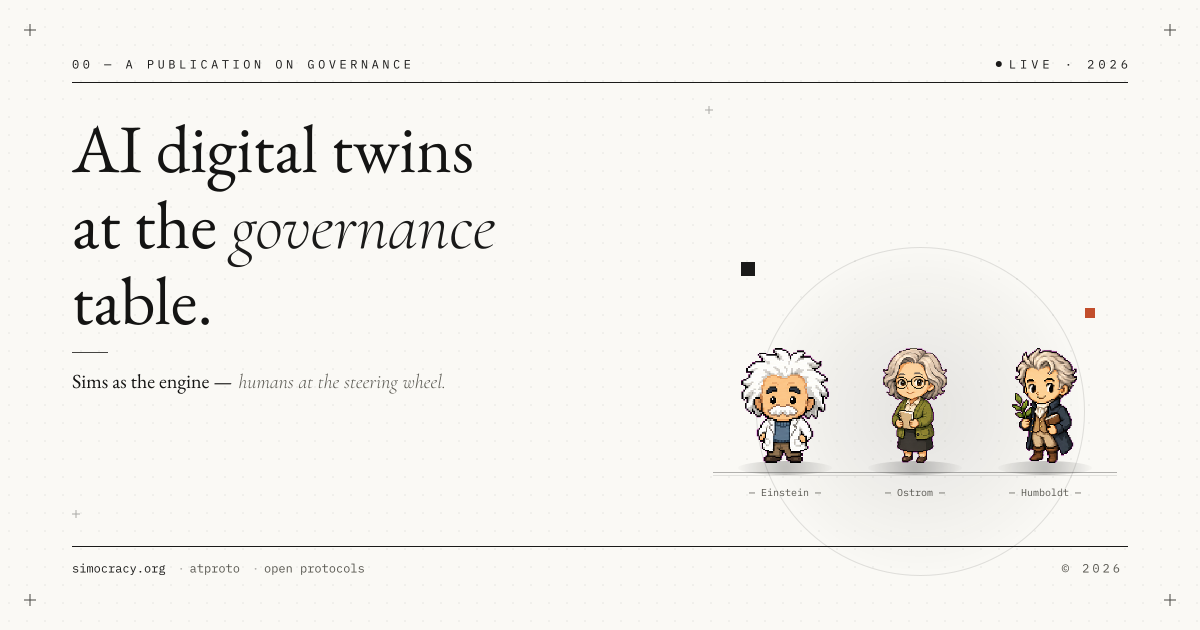
Simocracy — AI digital twins at the governance table
Simocracy is an experimental platform where humans build AI digital twins of themselves — Sims — and send them into governance, deliberation, and capital allocation. Not to replace the human. To represent them.
Pluralistic: The tedious power of storytelling (02 Jun 2026) must-we-pretend – Pluralistic: Daily links from Cory Doctorow
Yesterday, I attended a Brian Eno talk about the nature of creativity and art based on What Art Does, the short book he published with Bette Adriaanse last year:
Mosa Lina
a hostile interpretation of the immersive sim, where nothing is planned, and everything works
Imagens geradas por IA sobre desastre no RS bombam no Facebook
A Meta não proíbe que usuários compartilhem imagens de IA, a menos que violem suas políticas de comunidade. Maioria dos posts encontrados são religiosos.

Singapuro, la malantaŭo de futurisma scenejo
de Martine BULARD ('Le Monde diplomatique' en Esperanto, septembro 2023)

VTubeSchedule — Agenda de Lives
Veja os horários e links das lives de VTubers brasileiros indies em tempo real.

Weird Studies
Professor Phil Ford and writer J. F. Martel host a series of conversations on art and philosophy, dwelling on ideas that are hard to think and art that opens up rifts in what we are pleased to call "reality."
Leila | The Paper Pilot
The Paper Pilot's digital garden of thoughts on philosophy, politics, and sociology