Spaced repetition is an evidence-based learning technique that is usually performed with flashcards. Newly introduced and more difficult flashcards are shown more frequently, while older and less difficult flashcards are shown less frequently in order to exploit the psychological spacing effect. The use of spaced repetition has been proven to increase the rate of learning.
How to Remember More of What You Learn with Spaced Repetition
Using spaced repetition in conjunction with other study techniques can help you memorize information much, much more quickly. Here's how to do it.
Mochi - Spaced repetition flashcards
Take notes and make flashcards using markdown, then study them using spaced repetition.
Math Academy
Q. Michael Pershan’s main critique of spaced repetition in the context of Math Academy?A. It reinforces his memory of a shallow understanding.
A Love Letter to Flashcards | Lesley Lai
A personal reflection on how spaced repetition and hand crafted flashcards helps me to keep understanding alive
Automated Sentence Generation for a Spaced Repetition Software
This paper presents and tests AllAI, an app that utilizes state-of-the-art NLP technology to assist second language acquisition through a novel method of sentence-based spaced repetition. Diverging from current single word or fixed sentence repetition, AllAI dynamically combines words due for repetition into sentences, enabling learning words in context while scheduling them independently. This research explores various suitable NLP paradigms and finds a few-shot prompting approach and retrieval of existing sentences from a corpus to yield the best correctness and scheduling accuracy. Subsequently, it evaluates these methods on 26 learners of Danish, finding a four-fold increase in the speed at which new words are learned, compared to conventional spaced repetition. Users of the retrieval method also reported significantly higher enjoyment, hinting at a higher user engagement.
Spaced mathematics practice improves test scores and reduces overconfidence
Abstract The practice assignments in a mathematics textbook or course can be arranged so that most of the problems relating to any particular concept are massed together in a single assignment, or these related problems can be distributed across many assignments–a format known as spaced practice. Here we report the results of two classroom experiments that assessed the effects of mathematics spacing on both test scores and students' predictions of their test scores. In each experiment, students in Year 7 (11–12 years of age) either massed their practice into a single session or divided their practice across three sessions spaced 1 week apart, followed 1 month later by a test. In both experiments, spaced practice produced higher test scores than did massed practice, and test score predictions were relatively accurate after spaced practice yet grossly overconfident after massed practice.

Using spaced repetition systems to see through a piece of mathematics
By Michael Nielsen, January 2019
OpenDeck · Learn languages you own
Learn languages with spaced-repetition flashcards you own.
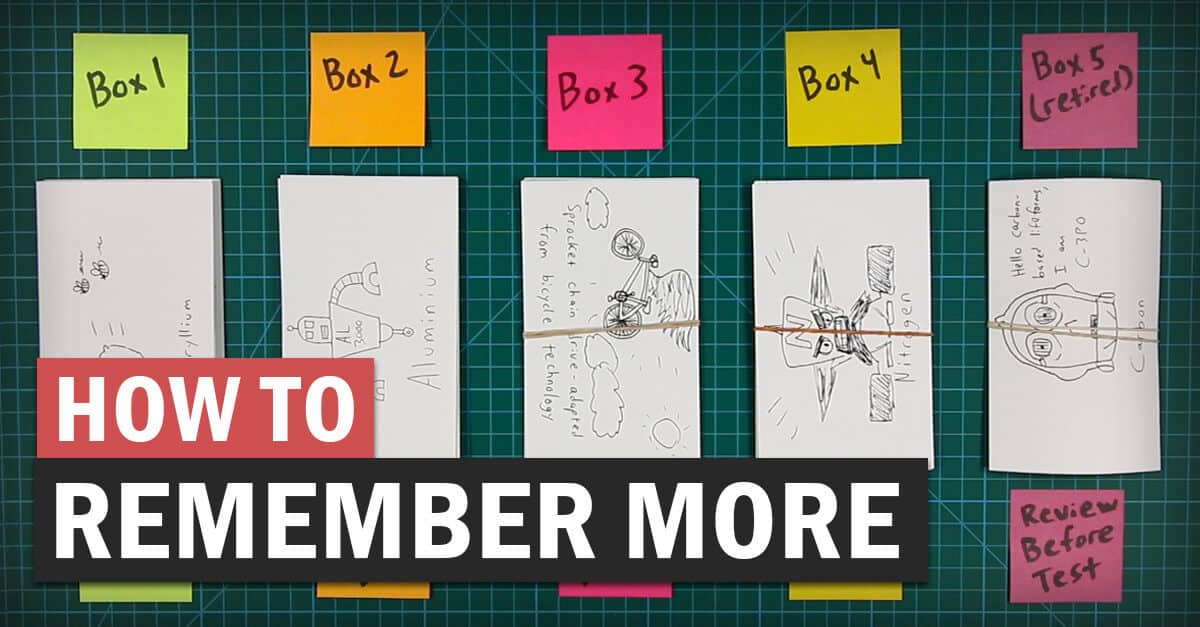
Leitner system
The Leitner system is a widely used method of efficiently using flashcards that was proposed by the German science journalist Sebastian Leitner in 1972. It is a simple implementation of the principle of spaced repetition, where cards are reviewed at increasing intervals.
zk-spaced/src at master · matze/zk-spaced
Spaced repetition for zk. Contribute to matze/zk-spaced development by creating an account on GitHub.
Enjoy it again: Repeat experiences are less repetitive than people think.
Dylan Wiliam on Twitter / X
The best journal article titles tell you what the study actually found, rather than being a teaser to make you read the paper. Here's a good example: "Spaced mathematics practice improves test scores and reduces overconfidence" https://t.co/iXxdkAgYPM ($)— Dylan Wiliam (@dylanwiliam) December 31, 2024
Excess Capacity Learning
How do humans learn from experience? Traditionally, cognitive scientists have assumed that discovering generalizable patterns requires that humans compress rich and noisy experiences. However, recent computer science results suggest otherwise — systems can learn by ‘overfitting’ and expanding all the details of their experiences. We offer a new perspective on learning based on a cognitive system’s representational capacity, which can be constrained (forcing the system to compress details of past experiences), sufficient (to memorize past experiences), or excess (allowing the system to expand on the details of past experiences). This framework has implications for understanding learning across cognitive, clinical, and developmental contexts.
SpaceDucking — Practice software testing
Duck-themed practice apps full of deliberate bugs, plus a members-only bug database.

Excess Capacity Learning
We introduce a new framework for understanding how cognitive systems (e.g., humans) learn from experience, based on the concept of representational capacity—the relative amount of representational resources devoted to encoding past experiences. Most paradigms in cognitive science have operated under the assumption that these resources are constrained, forcing cognitive systems to compress rich and noisy experiences to effectively generalize to new situations. We leverage recent advances in computer science to outline the implications of learning with excess capacity, or applying even more representational resources than needed to perfectly memorize all the details of one’s past experiences. In particular, we review evidence suggesting that excess capacity systems can exhibit many of the characteristics of human learning, such as the simultaneous ability to memorize individual experiences and generalize knowledge to new situations. We define and differentiate between constrained (not enough), sufficient (just enough), and excess (more than enough to perfectly capture all the details of one’s past experiences) capacity. We derive empirical properties of learning in each of these capacity regimes, and compare these predictions to effects documented for human learning. We highlight the broad implications of this framework for advancing theoretical and empirical work across cognitive, clinical, and developmental psychology.

The Continual Learning Problem
A perspective on continual learning, motivating our paper on sparse memory finetuning