


A star is a luminous spheroid of plasma held together by self-gravity. The nearest star to Earth is the Sun. Many other stars are visible to the naked eye at night; their immense distances from Earth make them appear as fixed points of light. The most prominent stars have been categorised into constellations and asterisms, and many of the brightest stars have proper names. Astronomers have assembled star catalogues that identify the known stars and provide standardized stellar designations. The observable universe contains an estimated 1022 to 1024 stars. Only about 4,000 of these stars are visible to the naked eye—all within the Milky Way galaxy.
Galaxy
A galaxy is a system of stars, stellar remnants, interstellar gas, dust, and dark matter bound together by gravity. The word is derived from the Greek galaxias (γαλαξίας), literally 'milky', a reference to the Milky Way galaxy that contains the Solar System. Galaxies, averaging an estimated 100 million stars, range in size from dwarfs with less than a thousand stars, to the largest galaxies known – supergiants with one hundred trillion stars, each orbiting its galaxy's centre of mass. Most of the mass in a typical galaxy is in the form of dark matter, with only a few percent of that mass visible in the form of stars and nebulae. Supermassive black holes are a common feature at the centres of galaxies.

Compact object
In astronomy, the term compact object (or compact star) refers collectively to white dwarfs, neutron stars, and black holes. It could also include exotic stars if such hypothetical, dense bodies are confirmed to exist. All compact objects have a high mass relative to their radius, giving them a very high density compared to ordinary atomic matter. The term is used as a generalization for cases where the exact nature of a significant gravitational effect isolated to a small radius is not known.
Star (Art)
Der Star, auch als Gemeiner Star bezeichnet, ist der in Eurasien am weitesten verbreitete und häufigste Vertreter der Familie der Stare (Sturnidae). Durch zahlreiche Einbürgerungen auf anderen Kontinenten ist der Star heute einer der häufigsten Vögel der Welt. Im Niederdeutschen werden Stare Spreen genannt.

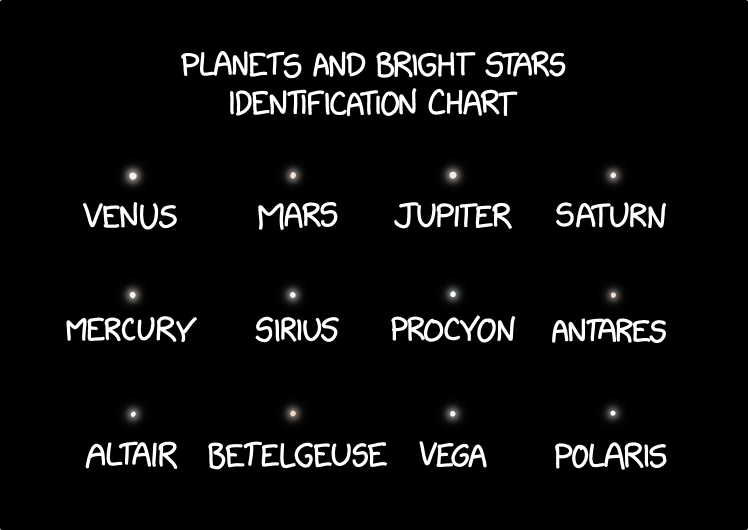
Planets and Bright Stars
This work is licensed under a Creative Commons Attribution-NonCommercial 2.5 License.
Star Realms
Star Realms is a spaceship combat deckbuilding game designed by Magic Pro Tour Champions and Hall of Famers Darwin Kastle and Rob Dougherty (developer and cofounder of the Ascension Deckbuilding Game).
@paulmwatson.com - Stargraph
Stargraph automatically maps Atmosphere profiles together. Find your friends and share your presence in one link.

Never Underestimate the Ignorance of the Powerful
When you’re a star, people let you think you're smart

Supported Services - Stargraph
Stargraph automatically maps Atmosphere profiles together. Find your friends and share your presence in one link.
Stargraph
Stargraph automatically maps Atmosphere profiles together. Find your friends and share your presence in one link.

STAR Voting
We should be able to vote our conscience, our votes should never be wasted, and our elections should accurately reflect the will of the people. It's not rocket science. It's Star Voting.

Cosmic dust
Cosmic dust – also called extraterrestrial dust, space dust, or star dust – is dust that occurs in outer space or has fallen onto Earth. Most cosmic dust particles measure between a few molecules and 0.1 mm (100 μm), such as micrometeoroids and meteoroids. Cosmic dust can be further distinguished by its astronomical location: intergalactic dust, interstellar dust, interplanetary dust, and circumplanetary dust. There are several methods to obtain space dust measurement.
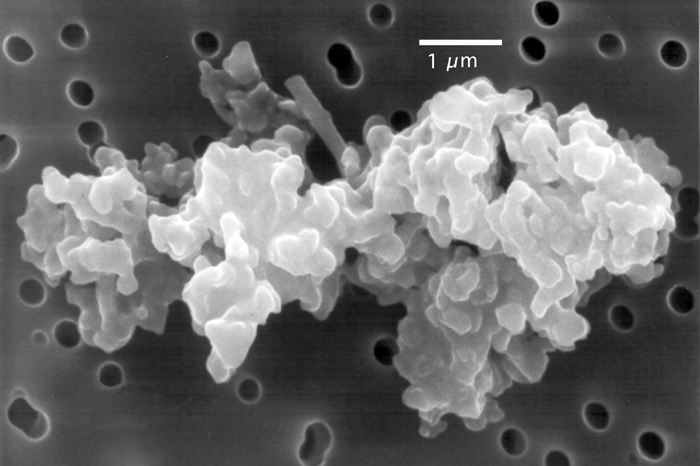
Figure 9: The radiance curves of several LEDs useful to mimic the Black...
Download scientific diagram | The radiance curves of several LEDs useful to mimic the Black Body representative of the M stars (from M0 to M8 spectral type). The absorption spectra of several photosynthetic bacteria are also shown. from publication: Simulating super earth atmospheres in the laboratory | Several space missions, such as JWST, TESS and the very recently proposed ARIEL, or ground-based experiments, as SPHERE and GPI, have been proposed to measure the atmospheric transmission, reflection and emission spectra of extrasolar planets. The planet atmosphere... | Atmosphere, Earth and Extrasolar Planets | ResearchGate, the professional network for scientists.

Starlight 🌟 Build documentation sites with Astro
Starlight helps you build beautiful, high-performance documentation websites with Astro.
Solar System
The Solar System is the gravitationally bound system of the Sun and the masses that orbit it, most prominently its eight planets, of which Earth is one. The system formed about 4.6 billion years ago when a dense region of a molecular cloud collapsed, creating the Sun and a protoplanetary disc from which the orbiting bodies assembled.

Stars on the Ceiling - 3/16/26 "That's A Lot Of Comics"