

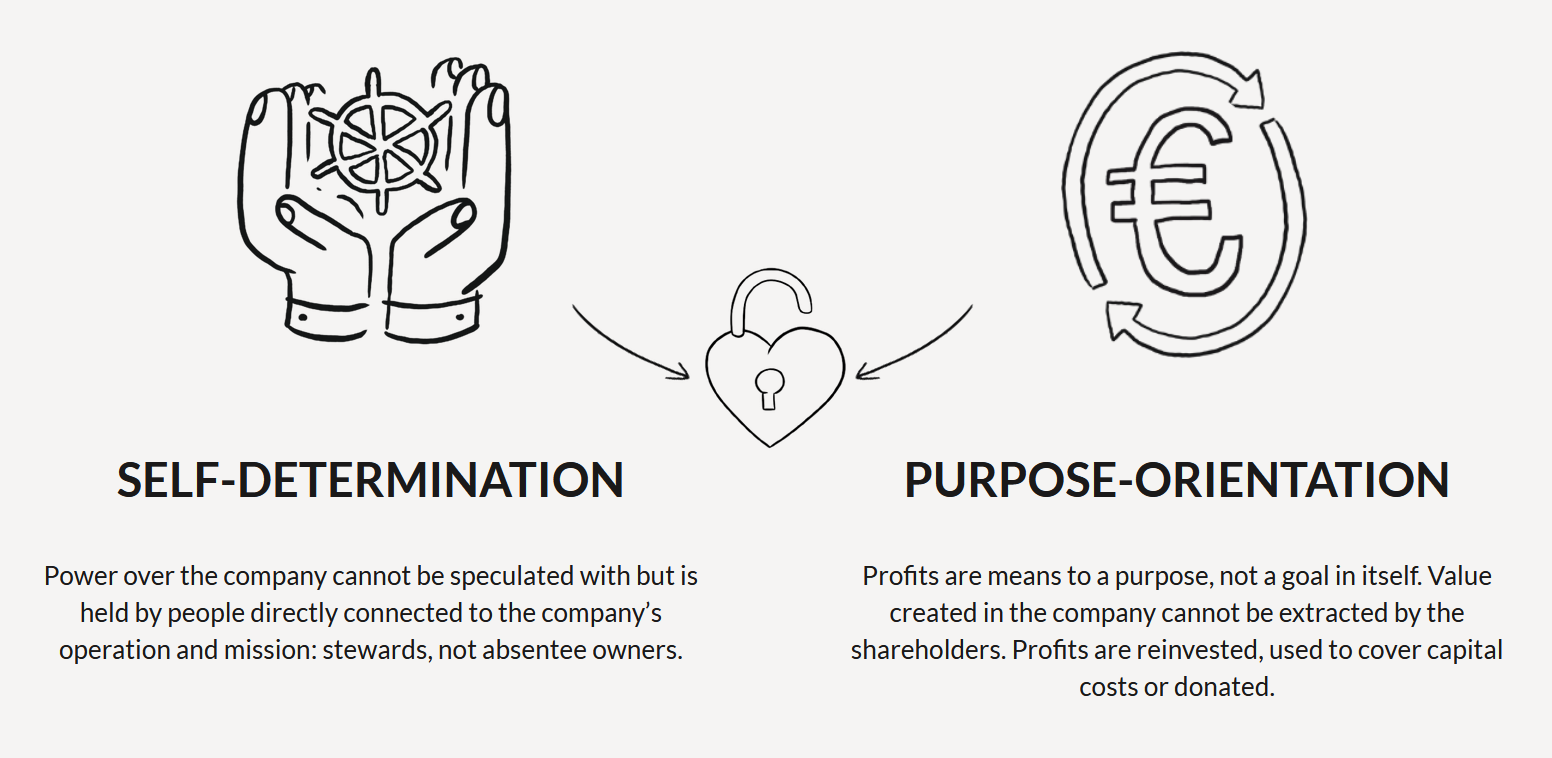
Steward-ownership structures a company's ownership in a way that separates economic rights (related to money) from voting rights (related to decision-making power).[1] Steward-ownership is considered an alternative to shareholder primacy models.[2] Steward-ownership can be implemented using different legal forms depending on the type of company and jurisdiction.[3]
Company as a Commons
What if excess wealth derived from business couldn't be privatized? Through the levers of steward-ownership, companies can protect their purpose-oriented long term mission from the maligned incentives of absentee stakeholders.
Democratic Ownership Funds: Creating Shared Wealth and Power
Recent decades have seen a rapid and little-discussed transformation in corporate ownership structure, with vital consequences for company behaviour and inequality.

Shareholder Democracy Is a Corporate Governance Myth That Won’t Die
In a new article, we challenge one of corporate law’s most persistent narratives: the concept of “shareholder democracy.” With people on opposing sides of recent high-profile battles at compa…

Composable Trust, Part 2: Separating Trust from Governance - Eclectic Corvine Muses
”Who belongs” and “What belonging means” are different questions. What happens if one steward stops answering both?
The corporation—a return to origins?
This paper contributes to contemporary debates in political theory about the power of business corporations by offering a genealogy of the corporation through the lens of a series of historical mutations of the corporate form. Originally, there were two corporate forms, both non-profit: member corporations (today's associations) and property corporations (today's charitable foundations). The contemporary business corporation arguably is a hybrid of both of these original forms, introducing unique commercial features (shares with profit distribution rights that are transferable). These commercial features are largely responsible for the corporation's extractive nature, that is, its tendency to prey on non-shareholder interests. The future of the corporation may well lie in a partial return to the two original non-profit forms. Two corporate forms developed in the nineteenth century can provide the format for such a return: cooperatives (which reinforce the idea of membership) and foundation-owned companies. The cooperative structure is a halfway house between a business corporation and a member corporation (association), and in a parallel fashion, a foundation-owned company is a halfway house between a business corporation and a property corporation (foundation). If we want to reduce corporations’ extractive nature, facilitating the spread of cooperatives and foundation-owned companies seems the way forward.

From ownership to stewardship: reimagining intellectual property governance through the Knowledge Commons Framework
Contemporary intellectual property (IP) governance remains strongly shaped by proprietary logics of exclusivity, control, and rights allocation, even as knowledge production becomes increasingly co...

Denizen
What is stakeholder capitalism? What is required to truly instantiate stakeholder decision making in the governance of companies?
How to choose a governance system for your organization
Is your nonprofit, small business, or volunteer group looking for a new way to make decisions? Many groups are questioning our mainstream systems — and that includes the systems by which we make decisions. Governance used to be one of the things we’d all take for granted, and now it’s one of the cho

Overcoming Barriers to Employee Ownership: Insights From Small and Medium-Sized Businesses
This research investigates the limited adoption of employee stock ownership plans (ESOPs) among small-to-medium sized businesses (SMBs) in the U.S. Through interviews with 30 SMB owners across various industries, we identify the key barriers to ESOP adoption as lack of time, money, and skills on the part of the owners. In doing so, the study suggests that a “shared ownership light” model, which involves sharing profits, information, and decision-making opportunities with employees, appears more feasible for SMBs than ESOPs. For SMBs that are interested in ESOP adoption, our research suggests that organizations providing employee ownership services could better assist SMBs by offering templatized models and best practices for profit-sharing plans, open-book management, and structured employee participation. The paper aims to broaden the discussion around shared ownership by considering a spectrum of options that have the potential to increase both value creation by and value-sharing among employees.
Introducing the Ownership Model Canvas
A new tool to re-align business success with ownership

Employee financial participation and corporate social and environmental performance: Evidence from European panel data
Abstract Compensation and benefit practices are mainly considered as instruments to align employee behaviour to an organization's strategic goals, such as economic outcomes. Going beyond this economic focus, this study examines whether and how employee financial participation, may drive corporate sustainability performance (CSP; i.e. social and environmental performance). We investigate the relationship between employee share ownership, stock option and profit‐sharing plans, on the one hand, and CSP, on the other hand. In addition, we investigate the relationship between narrow‐based employee share ownership plans (only eligible for top management) and broad‐based employee share ownership plans (all employees eligible), on the one side, and CSP, on the other side. Using a unique European panel dataset, the results indicate that companies with (broad‐based) employee share ownership plans portray higher CSP, while companies with profit‐sharing plans exhibit lower CSP when there is no share ownership plan present. Also, the positive effect of broad‐based employee share ownership plans on CSP is magnified when the employees own a larger stake in the company. The results indicate that employee share ownership increases stakeholder orientation, strengthening the mutual interests of the organization and employees to long‐term investments in terms of CSP, at the same time broadening their orientation to long‐term external stakeholders’ interests.

Work, Justice, and Collective Capital Institutions: Revisiting Rudolf Meidner and the Case for <span style="font-variant:small-caps;">Wage‐Earner</span> Funds
ABSTRACT This article makes the case for a specific variety of what we call Collective Capital Institutions (CCIs), by returning to the idea of Wage‐Earner Funds (WEFs) – a 1970s Swedish policy proposal designed gradually to shift ownership and control over parts of the economy to democratically controlled institutions. We identify two attractive rationales in favour of such a scheme and argue that both can fruitfully be transposed to the current worldwide economic situation. The egalitarian rationale is that WEFs could help in the pursuit of equality by giving a wider set of people a stake in collectively owned companies and a right to their profits. The democratic rationale is that WEFs redistribute not only these profits, but also the power over economic decisions made within companies. We then contrast such schemes for collective capital ownership with the similar but much more privatised proposals set out in, for instance, John Rawls's idea of a ‘property‐owning democracy’. We argue that CCIs ultimately are more likely to contribute to the development of the ‘sense of justice’ within society that is needed for a stable just society. We conclude that CCIs deserve a great deal more exploration in academic and political discussions of egalitarian economic systems.

Collective funding, governance and prioritization of a browser engine projects · Issue #11 · w3c/breakouts-day-2025
Session description Today, each of the three main, open source browser engine projects have a steward organization which contribute, by far, the lion's share of the project's commits - 75-9...
Authority as Possession: Permissioned Spaces Deserve Better Than ACLs
Why Capability Trees are the right governance primitive for permissioned spaces.
Equity for Europeans
Equity combines legal fairness, ownership, and upside in one everyday concept.
Been thinking about what digital ownership could look like on atproto: NOT NFTs/speculation, but real transferable digital objects. An album, artwork, book, etc. with its own DID, provenance, rights, lending, gifting & resale. Access is a service; ownership is an object. PDS to PDS transfer.
