

The definition of stovepiping can also refer to sharing information within a governmental body while hindering the sharing of information across different government bodies.[2] This type of information sharing can create large ineffectiveness as coordination can be weak, leading to a variety of inefficiencies and delays particularly with daily communication across governmental bodies. However, this issue can often be solved when groups or certain governmental entities can pressure or require different governmental bodies to work together.
The weaponisation of information is mutating at alarming speed | Sophia Ignatidou
Countries and companies are lining up to enter the disinformation business, says Chatham House fellow Sophia Ignatidou

The Unreasonable Sufficiency of Protocols Web
The Unreasonable Sufficiency of Protocols Venkatesh Rao, Tim Beiko, Danny Ryan, Josh Stark, Trent Van Epps, and Bastian Aue 1. Introduction Complex coordination problems have an air of doomed intractability about them. We speak in fatalistic terms of economics being a “dismal” science, of sociological phenomena being dominated by the

Self-Enforcing Protocols - Schneier on Security
There are several ways two people can divide a piece of cake in half. One way is to find someone impartial to do it for them. This works, but it requires another person. Another way is for one person to divide the piece, and the other person to complain (to the police, a judge, or his parents) if he doesn’t think it’s fair. This also works, but still requires another person—at least to resolve disputes. A third way is for one person to do the dividing, and for the other person to choose the half he wants. That third way, known by kids, pot smokers, and everyone else who needs to divide something up quickly and fairly, is called cut-and-choose. People use it because it’s a self-enforcing protocol: a protocol designed so that neither party can cheat...
SimPolitics
For more than six decades, the public has been promised that computers will revolutionize politics, both nationally and internationally. In SimPolitics, Fenw...

Bonfire
A federated social network for individuals and communities to design, operate and control their own digital lives.
Toward a theory of network gatekeeping: A framework for exploring information control
Abstract Gatekeeping theories have been a popular heuristic for describing information control for years, but none have attained a full theoretical status in the context of networks. This article aims to propose a theory of network gatekeeping comprised of two components: identification and salience . Network gatekeeping identification lays out vocabulary and naming foundations through the identification of gatekeepers, gatekeeping, and gatekeeping mechanisms. Network gatekeeping salience , which is built on the bases of the network identification theory, utilizes this infrastructure to understand relationships among gatekeepers and between gatekeepers and gated, the entity subjected to a gatekeeping process. Network gatekeeping salience 1 Salience refers to the degree to which gatekeepers give priority to competing gated claims. proposes identifying gated and their salience to gatekeepers by four attributes: (a) their political power in relation to the gatekeeper, (b) their information production ability , (c) their relationship with the gatekeeper, and (d) their alternatives in the context of gatekeeping.

Computing, Complexity and Degrowth : Systemic Considerations for Digital De-escalation
Research on digital degrowth predominantly critiques digital expansion or presents alternative digital practices. Yet, analyzing the link between digital technologies and complexity is crucial to overcome systemic obstacles hindering digital de-escalation. This article presents the different types of links between complexity and computing observed in the literature: the infrastructural complexity inherent in digital technologies, the socio-political complexity induced by them, and finally, the ontological complexity (individual’s ways of relating to their environment) hindered by digitization. The paper explores these links to identify ways to reduce infrastructural and socio-political complexities, and to move away from the reductionist paradigm, in order to support digital degrowth. Its development shows that complexity induces ratchet effects (i.e. irreversibilities in the development of a technique in a society), rendering degrowth efforts difficult to handle by individuals. Therefore, strategies to overcome these barriers are proposed, suggesting that bottom-up simplification approaches stand a greater chance of making alternatives emerge from different stakeholders (including users). This digital shift assumes the development of methods and technical tools that enable individuals to disengage from their attachments to digital habits and infrastructure, opening a substantial field of study.
(PDF) Algorithmically Mediating Communication to Enhance Collective Decision-Making in Online Social Networks
PDF | Many collective decision-making contexts involve communication among group members. Sometimes this communication helps the collective reach an... | Find, read and cite all the research you need on ResearchGate

A Theory of Messaging Styles & Ghosting.
Online communication tools serve many purposes. So does silence.

The social media discourse of engaged partisans is toxic even when politics are irrelevant
Abstract. Prevailing theories of partisan incivility on social media suggest that it derives from disagreement about political issues or from status compet
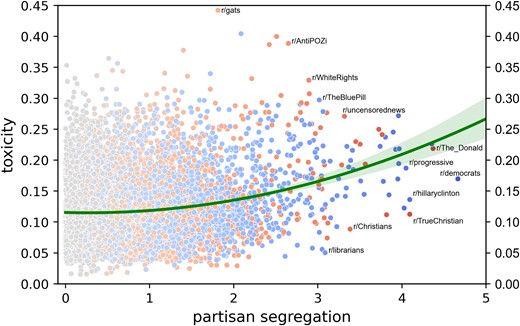
The social media discourse of engaged partisans is toxic even when politics are irrelevant
Abstract. Prevailing theories of partisan incivility on social media suggest that it derives from disagreement about political issues or from status compet
interfluidity » Consensus not censorship
We’ve become obsessed over the past few years with the problem of misinformation. And for good reason. “Flood the zone with shit” is now standard operating procedure for a variety of interests and factions. Groups who pretend to be above that kind of thing let confirmation bias do the same work, elevating conjectures they find convenient to believe far beyond the evidentiary basis for believing them, and transmuting concurrence among prestigious groups whose biases are aligned into “authority” to which they demand deferrence. Casual information consumers become divided into two camps, the “do your own research” types who imagine, mistakenly, that they are capable of seeing through all this (and so succumb to their own confirmation bias), and those who more accurately understand that they cannot reliably distinguish truth from bullshit (and so opt out of democratic deliberation with a shrug, other than perhaps to vote for the candidates whose political party they distrust less).
Dangerous Protocols - Summer of Protocols
Protocols are frequently touted as the liberating alternative to walled technological gardens, but the historical purpose of protocols has always been to simplify decision-making and reduce human agency. How do we reconcile these two narratives? I explore the dangerous side of protocols, and how their ability to drive coordination means they also have

The web can be weaponised – and we can't count on big tech to stop it | Tim Berners-Lee
It’s dangerous having a handful of companies control how ideas and opinions are shared. A regulator may be needed

"Teams working across organizational boundaries, sharing structured data, and building on each other’s work with ease." I know it's called "adversarial interop", but it actually feels like "community interop", at least right now

Toni Schneider
Conference Takeaways I’m back from ATmosphereConf in Vancouver, and I'm processing what I saw and heard. The atproto developer community could not have been nicer and more welcoming. Here are some takeaways. ... toni.org/2026/04/03/conference-takeawa…

