

TESCREAL is a neologism proposed by computer scientist Timnit Gebru and philosopher Émile P. Torres. An acronym, it stands for Transhumanism, Extropianism, Singularitarianism, (modern) Cosmism, Rationalism (denoting the ideology of the rationalist community), Effective Altruism, and Longtermism.[1][2] Gebru and Torres argue that these ideologies should be treated as an "interconnected and overlapping" group with shared origins.[1] They claim these constitute a movement that allows its proponents to use the threat of human extinction to justify expensive or detrimental projects and consider it pervasive in social and academic circles in Silicon Valley centered on artificial intelligence.[3] As such, the acronym is sometimes used to criticize a perceived belief system associated with Big Tech.[3][4][5]
The Rise of Silicon Valley’s Techno-Religion (Published 2025)
The Rationalists, a community focused on the risks of artificial intelligence, regularly gather with tech figures and other like-minded people in a complex that covers much of a city block.

Effective Altruism: doing transhumanism better
Effective Altruism (EA) is a Trojan horse for transhumanism, through which EA movement leaders and funders aim to naturalize transhumanism as the logical extension of the existing global aid and development sector. This paper traces transhumanism's mainstreaming, first via its rebranding as a humanitarian effort to save lives, protect vulnerable populations, and ensure global flourishing (what I term transhumanitarianism), and later by embedding transhumanitarianism in EA (now under the rubric of longtermism). A key component of this strategy was inverting transhumanism's techno-optimism to instead focus on safety and preventing existential risks ( x-risk ) from emerging technologies like AI and biotechnology, while simultaneously advocating for the creation of these same technologies. The paper focuses on some components of this strategy: the use of inoculation, speculative ethics, anticipatory governance, and the mobilization of apocalyptic discourse as means for producing material outcomes in the form of policy and research agendas.
Technorealists, the silent majority? · Openness Praxis
you might find yourself standing in the unremarkable center
Naomi Klein’s new book calls out end times fascism. What is this – and what’s the role of big tech?
Two new books, End Times Fascism and Nerd Reich, take a hard look at fascism today – and its intersections with big tech.
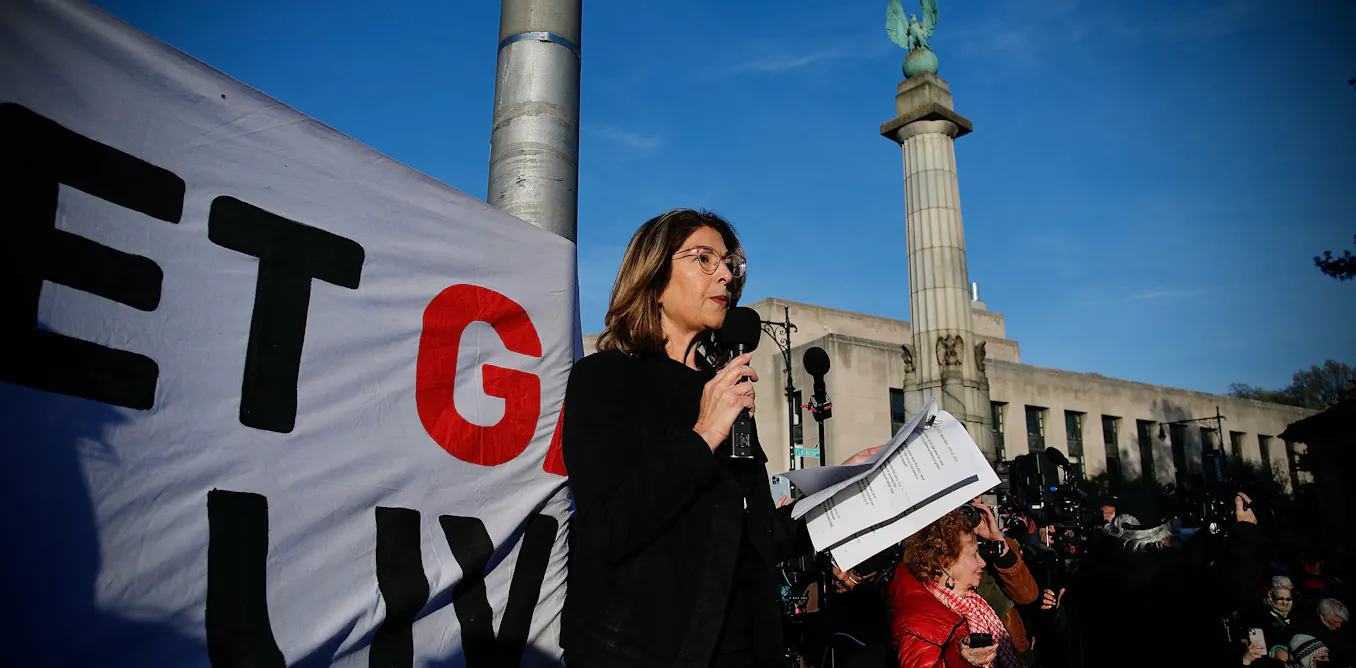
Naomi Klein’s new book calls out end times fascism. What is this – and what’s the role of big tech?
Two new books, End Times Fascism and Nerd Reich, take a hard look at fascism today – and its intersections with big tech.
Major Tech Investor Calls Architect of Fascism a 'Saint' in Unhinged Manifesto
Silicon Valley's 'techno-optimism' cult believes we should let rich tech guys do whatever they want.

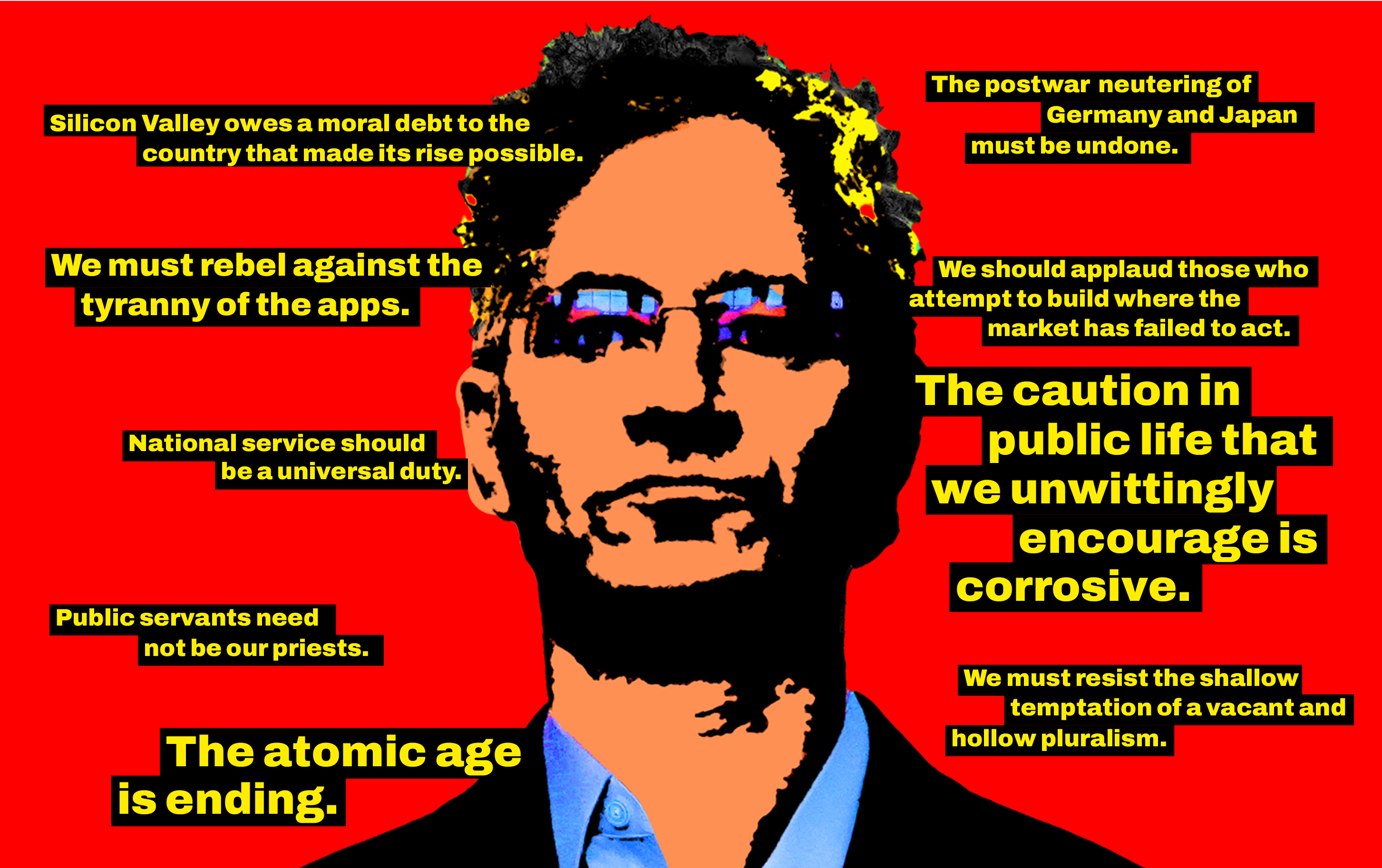
Palantir's social media manifesto is a blueprint for technofascism
The surveillance firm’s viral X post calls for hard power, conscription and the end of pluralism. AI expert and academic Mark Coeckelbergh on what happens when technology becomes the gateway to authoritarianism
The scent of Musk: Power, charisma and paranoia in Silicon Valley
Pluralistic: A fascist paradigm (12 May 2026) – Pluralistic: Daily links from Cory Doctorow
Yesterday, I attended a workshop on systems thinking and political change, which included a presentation on the work of Donella Meadows, whose Thinking in Systems is a canonical work on the subject:
Californian ideology
Californian ideology refers to the dominant ideology of Silicon Valley, as described by the British media theorists Barbrook and Cameron in their 1995 essay "The Californian Ideology". The ideology is very influential because of the ubiquity of Californian technology products, as well as because siliconization has made it prominent in computing industries all around the world.
Pluralistic: Ad-tech is fascist tech (10 Mar 2026) – Pluralistic: Daily links from Cory Doctorow
A core tenet of the enshittification hypothesis is that all the terrible stuff we're subjected to in our digital lives today is the result of foreseeable (and foreseen) policy choices, which created the enshittogenic policy environment in which the worst people's worst ideas make the most money:
Pluralistic: Ad-tech is fascist tech (10 Mar 2026) – Pluralistic: Daily links from Cory Doctorow
A core tenet of the enshittification hypothesis is that all the terrible stuff we're subjected to in our digital lives today is the result of foreseeable (and foreseen) policy choices, which created the enshittogenic policy environment in which the worst people's worst ideas make the most money:
The Anti-Intellectualism of Silicon Valley Elites
I recently re-read Richard Hofstadter's Anti-Intellectualism in American Life, and now every time a reactionary Silicon Valley billionaire opens his mouth, I think about it. So I wrote about it for The Nation. Here's the column: On Instagram, there’s an activist named Brian Patrick (@pano.

During the 1980s and 1990s, networks of evangelists and venture capitalists fused technological boosterism with reactionary social ideals. Our video of the week examines the deep roots of Silicon Valley's shift toward the right. Featuring @beccalew.bsky.social at @westernu.ca buff.ly/ydgntnc
Rationalist Cults

Articles on rationalist-adjacent cults: the Zizians, Leverage Research, and the darker outgrowths of the rationalist / LessWrong-derived / Aella polycule scene that is behind "AI Safety" in Silicon Valley. Working thesis: MIRI and CFAR read as high-control groups (cults) who believe in P(DOOM) and use sex (and power) maliciously — yet they are unfortunately the ones who have captured the framing of "AI Safety," which has little to do with actual safety.
TESCREAL

TESCREAL is a neologism proposed by computer scientist Timnit Gebru and philosopher Émile P. Torres. An acronym, it stands for Transhumanism, Extropianism, Singularitarianism, (modern) Cosmism, Rationalists (the internet community, not to be confused with other uses of the term), Effective Altruism, and Longtermism.

The Effective Altruism Kids Aren’t Alright

My Experience with Leverage Research

What Policymakers and the Public Need to Know About the Cult of AI
banteg (@banteg)

The Techno-Religion at the Center of the A.I. Debate

SE Gyges (@segyges.bsky.social)
papers.ssrn.com
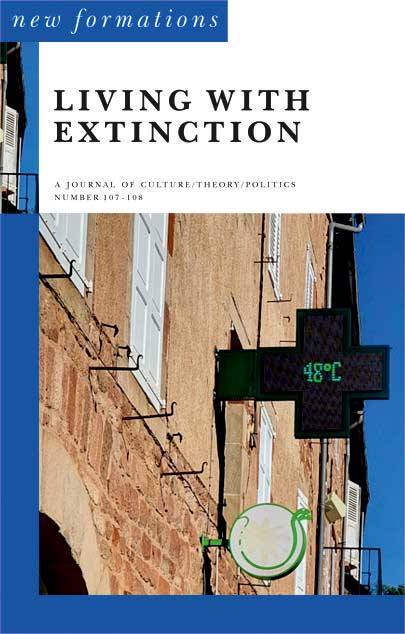
Extinctiopolitics: Existential Risk Studies, the Extinctiopolitical Unconscious, and the Billionaires’ Exodus from Earth
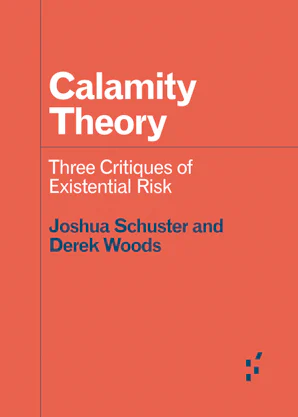
Calamity Theory
TESCREAL
