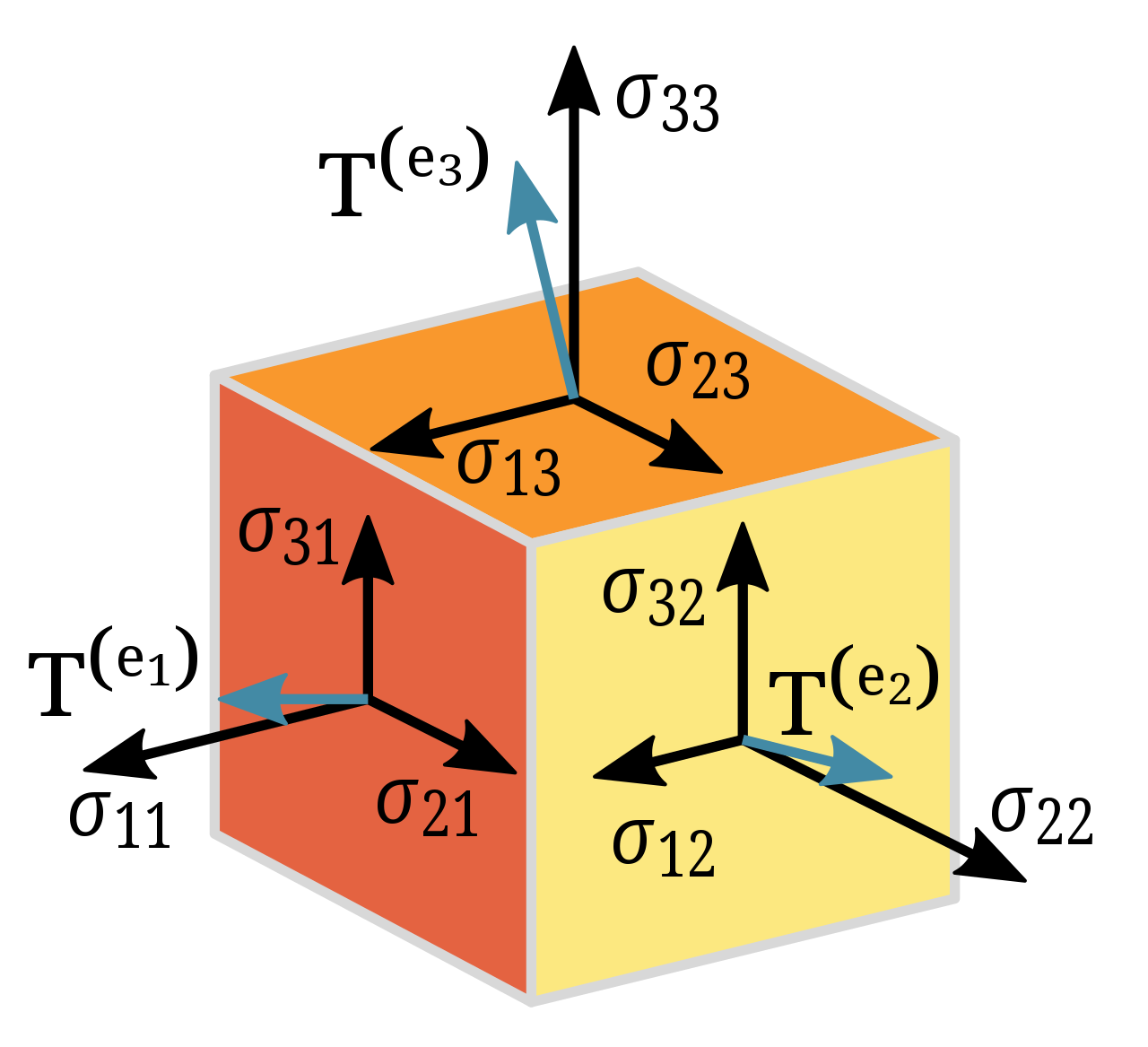
In mathematics, a tensor is an algebraic object that describes a multilinear relationship between sets of algebraic objects associated with a vector space. Tensors may map between different objects such as vectors, scalars, and even other tensors. There are many types of tensors, including scalars and vectors, dual vectors, multilinear maps between vector spaces, and even some operations such as the dot product. Tensors are defined independent of any basis, although they are often referred to by their components in a basis related to a particular coordinate system; those components form an array, which can be thought of as a high-dimensional matrix.
Cartesian coordinate system
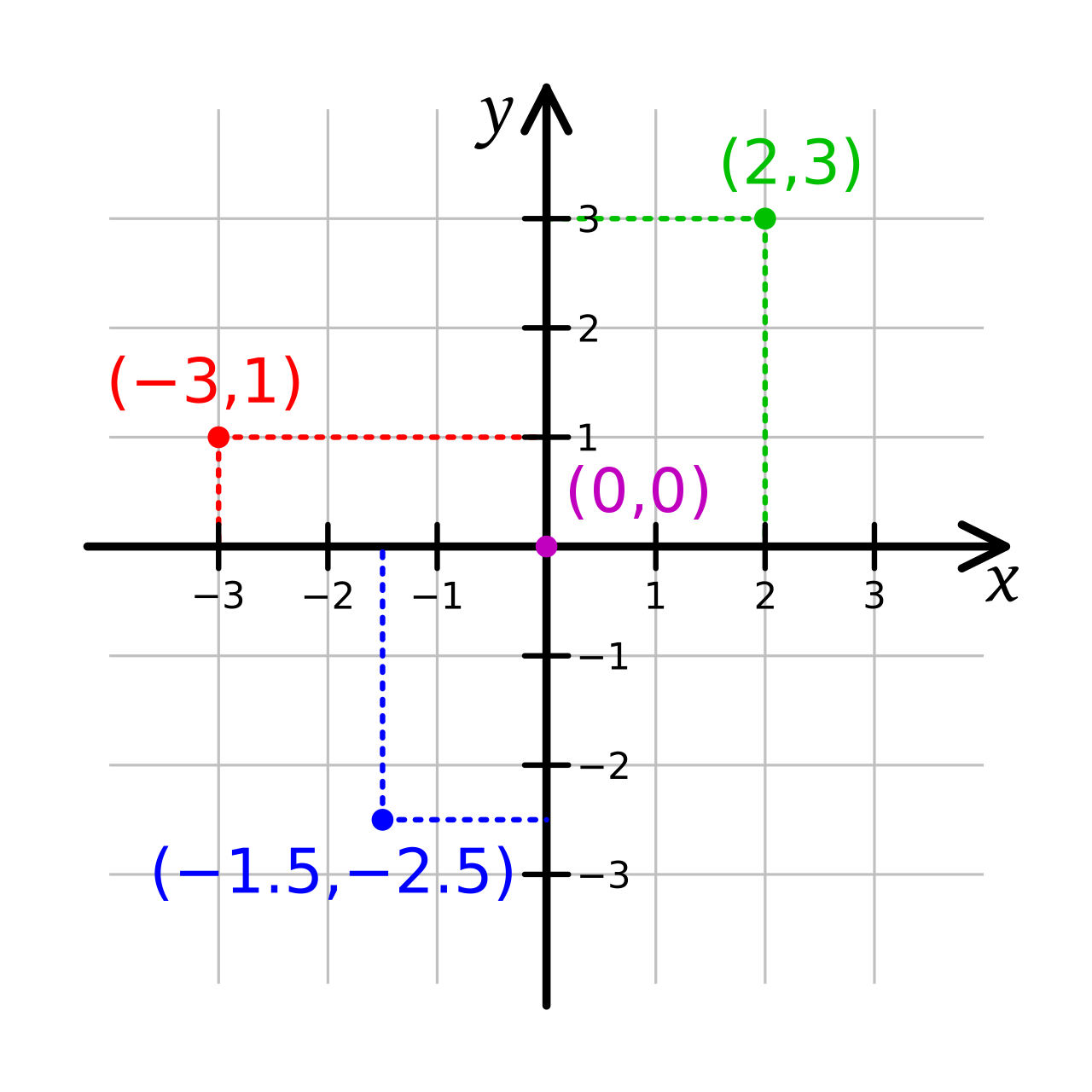
In geometry, a Cartesian coordinate system in a plane is a coordinate system that specifies each point uniquely by a pair of real numbers called coordinates, which are the signed distances to the point from two fixed perpendicular oriented lines, called coordinate lines, coordinate axes or just axes of the system. The point where the axes meet is called the origin and has (0, 0) as coordinates. The axes directions represent an orthogonal basis. The combination of origin and basis forms a coordinate frame called the Cartesian frame.
Higher Dimensional Syntax - Eric Finster
Kernel (linear algebra)
In mathematics, the kernel of a linear map, also known as the null space or nullspace, is the part of the domain which is mapped to the zero vector of the co-domain; the kernel is always a linear subspace of the domain. That is, given a linear map L : V → W between two vector spaces V and W, the kernel of L is the vector space of all elements v of V such that L(v) = 0, where 0 denotes the zero vector in W, or more symbolically:

yorkie/tensorflow-nodejs
TensorFlow Node.js provides idiomatic JavaScript language bindings and a high layer API for Node.js users. TensorFlow Node.js provides idiomatic JavaScript language bindings and a high layer API for Node.js users.
Frobenius algebra in nLab
A Frobenius algebra is a vector space equipped with the structures both of an algebra and of an a coalgebra in a compatible way, where the compatibility is different from (more “topological” than) that in a bialgebra/Hopf algebra:
Yi Ma on Twitter / X
In system theory, it is called "linearization"... which has been studied and used for decades. Honestly, folks, there is no need to invent or introduce any new terminology. Remember, there is rarely anything new under the sun... https://t.co/yNLIv7Ptoh— Yi Ma (@YiMaTweets) March 14, 2026
Paramorphism
In formal methods of computer science, a paramorphism (from Greek παρά, meaning "close together") is an extension of the concept of catamorphism first introduced by Lambert Meertens[1] to deal with a form which “eats its argument and keeps it too”,[2][3] as exemplified by the factorial function. Its categorical dual is the apomorphism.
Visual Variables
Visual variables are “the differences in map elements as perceived by the human eye” (wiki.gis.com). No matter what the type of map, these are the fundamental ways in which graphic symbols can be distinguished.
Latent space
A latent space, also known as a latent feature space or embedding space, is an embedding of a set of items within a manifold in which items resembling each other are positioned closer to one another. Position within the latent space can be viewed as being defined by a set of latent variables that emerge from the resemblances between the objects.
Word embedding
In natural language processing, a word embedding is a representation of a word. The embedding is used in text analysis. Typically, the representation is a real-valued vector that encodes the meaning of the word in such a way that the words that are closer in the vector space are expected to be similar in meaning. Word embeddings can be obtained using language modeling and feature learning techniques, where words or phrases from the vocabulary are mapped to vectors of real numbers.

Mathematics in type theory.
An explanation of how to set up mathematics using universes, types, and terms

Machine Learning Glossary | Google for Developers
This glossary defines a wide range of machine learning terms, including those specific to TensorFlow and large language models.

Categories for the Working Mathematician
Categories for the Working Mathematician provides an array of general ideas useful in a wide variety of fields. Starting from the foundations, this book illuminates the concepts of category, functor, natural transformation, and duality. The book then turns to adjoint functors, which provide a description of universal constructions, an analysis of the representations of functors by sets of morphisms, and a means of manipulating direct and inverse limits. These categorical concepts are extensively illustrated in the remaining chapters, which include many applications of the basic existence theorem for adjoint functors. The categories of algebraic systems are constructed from certain adjoint-like data and characterized by Beck's theorem. After considering a variety of applications, the book continues with the construction and exploitation of Kan extensions. This second edition includes a number of revisions and additions, including two new chapters on topics of active interest. One is onsymmetric monoidal categories and braided monoidal categories and the coherence theorems for them. The second describes 2-categories and the higher dimensional categories which have recently come into prominence. The bibliography has also been expanded to cover some of the many other recent advances concerning categories.
Generalised algebraic theories and contextual categories
Categories of Containers
We introduce the notion of containers as a mathematical formalisation of the idea that many important datatypes consist of templates where data is stored. We show that containers have good closure properties under a variety of constructions including the formation of initial algebras and final coalgebras. We also show that containers include strictly positive types and shapely types but that there are containers which do not correspond to either of these. Further, we derive a representation result classifying the nature of polymorphic functions between containers. We finish this paper with an application to the theory of shapely types and refer to a forthcoming paper which applies this theory to differentiable types.