


The Syro-Aramaic Reading of the Koran: A Contribution to the Decoding of the Language of the Koran is a monograph of philology in Quranic studies published in 2000 under the pseudonym Christoph Luxenberg. The subject of the book is a new approach to identifying and solving textual and exegetical problems in the Quran, by deciphering its language.:8,15 It is considered unique in the history of Quran commentary,:178 bold in its claims and controversial for challenging the traditional history of the Quran.:8 There is some academic acceptance only of limited aspects of the book.
The Quran
A resource for anyone looking to understand the Sacred Text of Islam; the world's leading online source of Quran translation and commentary. Explore, read and search publications in many languages.

The Quranic Arabic Corpus - Word by Word Grammar, Syntax and Morphology of the Holy Quran
Welcome to the Quranic Arabic Corpus, an annotated linguistic resource which shows the Arabic grammar, syntax and morphology for each word in the Holy Quran. The corpus provides three levels of analysis: morphological annotation, a syntactic treebank and a semantic ontology.
The Qurʾan and Syriac Christianity
Sources of Quran in Judaism Syriac Christianity Jahiliyyah 2603 مصادر القرآن اليهودية المسيحية السريانية الجاهلية
The sources of the Quran in Judaism, Christianity and Pre-Islamic Arabian Paganism (Jahiliyyah), with a particular focus on post-Biblical Judaism and Syriac Christianity. Ancient Middle Eastern Origins of the Quran. Version: 2026.03 مصادر القرآن من اليهودية والمسيحية والوثنية العربية (الجاهلية) مع التركيز على جذور القرآن في التراث اليهودي المتأخر والتراث المسيحي السرياني. جذور القرآن في تراث الشرق الأوسط القديم. إصدار: 2026.03

Approaching the Qur'an | Oneworld
Approaching the Qur’an presents brilliant translations of the short, hymnic chapters, or suras, associated with the first revelations to the Prophet Muhammad. These early suras contain some of the most powerful, prophetic and revelatory passages in religious history, offering the vision of a meaningful and just life that anchors the faith of one fifth of the world’s inhabitants. In addition to these translations, Michael Sells provides an introduction to the Qur’an, commentaries on the suras, a glossary of technical terms and discussion of the auditory nature and gender aspects of the Arabic text. An ideal resource for students and interested lay readers, the work is enriched by free audio downloads of Qur’anic reciters chanting several of the early suras, allowing readers to hear the Qur’an in its original form. This third edition also includes a new full sura and associated commentary, a new preface and a thoroughly updated bibliography.

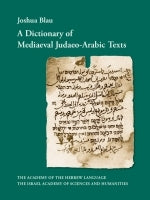
A Dictionary of Mediaeval Judaeo-Arabic Texts
In the Middle Ages, Jews in Arab lands used both Judaeo-Arabic and Hebrew as their literary languages. Mediaeval Judaeo-Arabic texts are written in Middle Arabic, which contains classical and later elements. The latter do not appear in standard dictionaries of Classical Arabic, and it is to these post-classical, neo-Arabic, and pseudo-correct terms and expressions, which to a great extent are identical with Middle Arabic elements found in other Arabic writings of the period, that Joshua Blau’s Dictionary of Mediaeval Judaeo-Arabic Texts is primarily devoted. The Dictionary is based largely on the works of the leading Jewish scholars of the period, including Saadia Gaon, Judah Halevi, and Maimonides, but it also refers to the Responsa literature, legal documents, and personal and commercial letters. This first comprehensive dictionary of Mediaeval Judaeo-Arabic contains about 9,000 entries. The lemmas are presented in both Arabic and Hebrew scripts, and are translated into Hebrew and English. A special section is devoted to lexicographical literature.
A New Introduction to Islam, 4th Edition
A globally expanded, critically engaged introduction to Islam thoroughly updated Now in its Fourth Edition, A New Introduction to Islam combines...
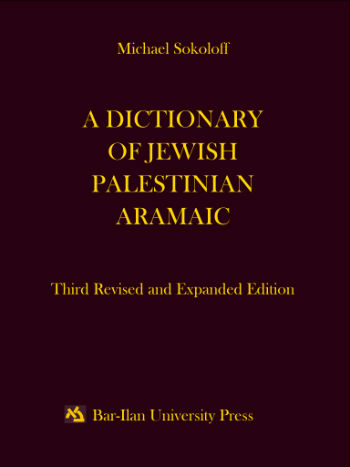
A Dictionary of Jewish Palestinian Aramaic of the Byzantine Period
contains the aramaic vocabulary of the jewish literary and epigraphic sources of eretz israel from the third century c e until the arab conquest including palestinian talmud midrashim targumim and synagogue inscriptions
Surah Ali 'Imran — Full Surah, Read, Listen and Study - Quran.com
Read and listen to Surah Ali 'Imran in full, chapter 3 of the Quran with 200 verses. Explore translation, tafsir and word-by-word meaning.
Remote Origins: Translation, Genealogy, and Alterity in Medieval Castile (1252-circa 1390)
This dissertation analyzes selected examples of thirteenth- and fourteenth-century written culture to show their engagement with the religious alterity of Islam as an integral part of the origins of the kingdom of Castile. Following an interdisciplinary methodology, it addresses how medieval ideas about astrology, geography, history, medicine, race, and religion participated in creating discourses about origins that recognized the intellectual and political authority of al-Andalus. It argues that early Castilian vernacular texts conceptualized the translation of Arabic sources as an instrument for creating, transforming, and superseding the alterity of Islam while recognizing the cultural and political authority of Andalusi traditions. The first chapter serves as an introduction explaining the historical and theoretical framework of the dissertation. To do so, it provides an overview of Castilian ideas about genealogy, historiography, authority, and translatio, and translation. Then, through close reading and ample historicization, chapters two, three, and four analyze the impact of Andalusi textual traditions, cultural practices, and human population in three interrelated fields of medieval science, literature, and history. Chapter 2 explores the political implications of King Alfonso X’s (r. 1252-1284) dedication to the translation of Arabic sciences by focusing on the translation of a treatise of astrology titled Libro de las cruzes (1259). The chapter traces the cultural and political context that accompanied the transmission of the book in al-Andalus alongside the content of its Arabic and Castilian prologues. In light of ideas about the transference of knowledge (translatio studii) shared by Christian and Muslim scholars, I conclude that deployment of a twofold origin in the Libro de las cruzes illustrates the strategies and motivations of Alfonso X’s broader engagement with Arabic sources. The third chapter turns to the early fourteenth-century romance Libro del caballero Zifar with a double focus on its forged origin as a translation from caldeo (Chaldean) and the prominence of cursed lineages. Regarding lineage, the chapter explores the representation of exemplary virtues by the protagonists of the romance as enacting ideas about the transformable character of lineage and the capabilities of the individual to unmake inherited negative traits. Likewise, the textual strategy of the forged translation enables the inclusion of Arabic and Asian referents at the origin of a profoundly Christian text. In chapter 4, literature meets historiography in the analysis of the Crónica de Flores y Blancaflor. Being the result of intertwining a Castilian chronicle—Alfonso X’s Estoria de Espanna—and a French romance, this text narrates the love story between an Andalusi Muslim prince and the daughter of a captive Christian noble. The chapter focuses on Berta, the captive woman, to show the implications of her decision to nurture Flores and Blancaflor with her milk. Considering Christian and Muslim ideas about milk and wet nursing along with the tenets of Castilian historiography, the chapter shows the limits of dominant ideas about dynastic origins among the Christian elites of Castile while evidencing the existence of an alternative discourse that—coming from within Castilian historiography—incorporates maternal and non-Christian kinship as an essential part of the origins and possibilities of the kingdom. A short final chapter serves as a conclusion, suggesting paths for expanding the results of this dissertation within and the thirteenth and fourteenth centuries covered by its contents.
A Dictionary of Jewish Palestinian Aramaic of the Byzantine period (Dictionaries of Talmud, Midrash, and Targum)
Since the Middle Ages, lexographies of Talmudic and other rabbinic literature have combined in one entry Babylonian, Palestinian, and Targumic words from various periods. Because morphologically identical words in even closely related dialects can frequently differ in both meaning and nuance, their consolidation into one dictionary entry is often misleading. Scholars now realize the need to treat each dialect separately, and in A Dictionary of Jewish Palestinian Aramaic, Michael Sokoloff provides a complete lexicon of the dialect spoken and written by Jews in Palestine during the Byzantine period, from the third century C.E. to the tenth century. Sokoloff draws on a wide range of sources, from inscriptions discovered in the remains of synagogues and on amulets, fragments of letters and other documents, poems, and marginal notations to local Targumim, the Palestinian Midrashim and Talmud, texts addressing religious law (halacha), and Palestinian marriage documents (ketubbot) from the Arabic period. Many of these sources were unavailable to previous lexographers, who based their dictionaries on corrupt nineteenth-century editions of the rabbinic literature. The discovery of new manuscripts in both European libraries and the Cairo Geniza over the course of the twentieth century has revolutionized the textual basis of Jewish Palestinian Aramaic. Each entry in A Dictionary of Jewish Palestinian Aramaic is divided into six lemma or root, part of speech, English gloss, etymology, semantic features, and bibliographic references. Sokoloff also includes an index of all cited passages. This major reference work, updated to reflect the publication of new texts over the last decade, will both provide students and scholars with a tool for an accurate understanding of the Aramaic dialect of Jewish Palestinian literature of the Byzantine period and help Aramaist and Semitic linguists to see the relationship between this dialect and others, especially the contemporary dialects of Palestine. Publisher : Bar Ilan University Press; 2nd printing edition (January 1, 1990)Language : EnglishHardcover : 823 pagesISBN-10 : 9652261017ISBN-13 : 978-9652261014

Zellentin Holger, Prof. Dr.
Holger Zellentin is an award-winning scholar of Late Antiquity, with a focus on Talmudic and Qur’anic studies. He combines literary, legal and historical approaches in order to understand shared and diverging patterns within Jewish, Christian and early Islamic cultural traditions.He has received funding from the European Research Council, the British Academy, and the Arts and Humanities Research Council (UK). He has been awarded a Philip Leverhulme Prize (2014), an ERC Consolidator Grant, The Quran as a Source for Late Antiquity (2020-2026) as well as an Opus Magnum grant of the Volkswagen Foundation, Jesus and the Original Law in Judaism, Christianity and Islam (2026-2028). From 2020 to 2025, he served as the chair of the board of directors of the International Qur’anic Studies Association (IQSA), and from 2012-2019, he was a member of the steering committee of the British and Irish Association for Jewish Studies (BIAJS). In 2019, he joined the University of Tübingen, where he now works, climbs and cycles.
International Quranic Studies Association
The International Qur’anic Studies Association (IQSA) is the first learned society dedicated to the study of the Qur’an. We hold conferences around the world and publish cutting-edge research and scholarship. The IQSA community and its partners include scholars, students, publishers, and members of the public.
Illuminating Typography Books
'Cultural Connectives', a book by Rana Abou Rjeily, bridges the divide between Arabic and Latin-based languages by cleverly comparing their typography.

Shari Lowin - International Quranic Studies Association
Shari L. Lowin is Professor of Islamic and Jewish Studies in the Religious Studies Department of Stonehill College. Her research centers on the interplay between Islamic and Jewish texts in the early and early medieval Islamic periods, focusing mainly on exegetical narratives. She is the author of The Making of a Forefather: Abraham in Islamic
