

Tiled rendering is the process of subdividing a computer graphics image by a regular grid in optical space and rendering each section of the grid, or tile, separately. The advantage to this design is that the amount of memory and bandwidth is reduced compared to immediate mode rendering systems that draw the entire frame at once. This has made tile rendering systems particularly common for low-power handheld device use. Tiled rendering is sometimes known as a "sort middle" architecture, because it performs the sorting of the geometry in the middle of the graphics pipeline instead of near the end.[1]
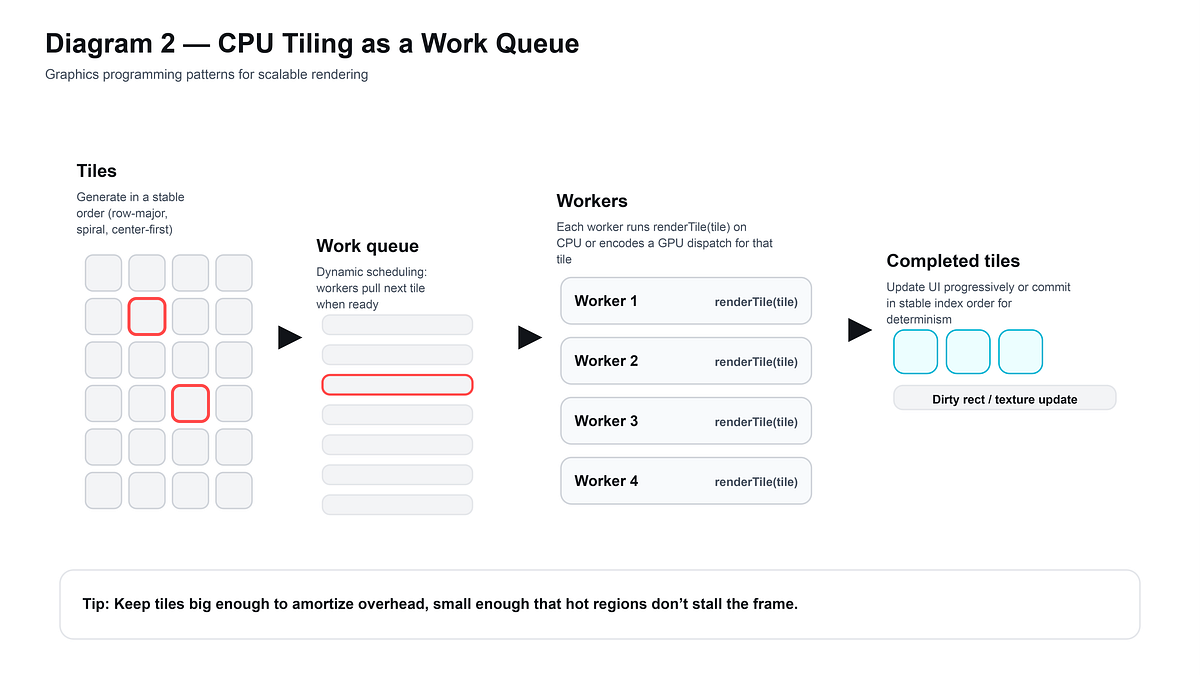
Tiling Is the Missing Abstraction in Graphics Programming
A software engineer’s playbook for tiling: scheduling, threadgroups, and the small decisions that make performance predictable.
Web Tiles
Tiles are composable web docs and apps that can safely be used in arbitrary contexts and assembled from multiple sources to carry out complex user interface tasks.

Web Tiles Explainer - HackMD
Tiles are an additional primitive for the web. A tile is a content-addressed graph of web content that can be executed and rendered in a manner that is safe by default, and therefore can be granted greater trust by default. Tiles also compose horizontally with one another, to enable a web of actions.
DASL: Tiles Protocols
Tiles ([[tiles]]) are intended for use in a diversity of environements. Depending on the environment that they find themselves embedded in, they will have access to different capabilities that expose various features and communicate with the host environment. Tiles Protocols are the mechanisms through which these integrations are made available.

Adventures in Neural Rendering
In recent years, neural networks have started to find their way into many areas of rendering. While antialiasing and upscaling are probably the most well‑known uses, they’re far from the only ones—…

tiles.run/tiles
Tiles is a local-first private AI assistant. Powered by on device models and ATproto.
tiles.run/tiles
Tiles is a local-first private AI assistant. Powered by on device models and ATproto.
DASL: Tiles Protocol: Data Passing
Passsing data to and from tiles is key to integrating tiles in arbitrary environments. This protocol specifies precisely that.

The layer that decides the final pixels has the most power
In platforms, higher layers often have more opinion, and also typically have more power, because they have more control over the final output the user sees. This means that the layer that legitimately

Tile Gradient
The safest and most inclusive global community of photography enthusiasts. The best place for inspiration, connection, and sharing!

tiles-notebook/packages/tiles-playground/plugins/McpRunnerPlugin/index.tsx at dev · tilesprivacy/tiles-notebook
A notebook interface that makes working with AI agents easier. - tilesprivacy/tiles-notebook
Tiles version 0.4.18 Alpha 22 has been released. Tiles now supports the Vulkan backend, enabling GPU acceleration beyond NVIDIA across vendors on Linux, with fixes for MTP speculative decoding, Linux tool calls, and an occasional OAuth callback failure during ATproto login. Release notes ↗

Shared chat session by @tiles.run | Tiles
chat.tiles.run