

A time-lock puzzle, or time-released cryptography, encrypts a message that cannot be decrypted until a specified amount of time has passed. The concept was first described by Timothy C. May,[1] and a solution first introduced by Ron Rivest, Adi Shamir, and David A. Wagner in 1996.[2] Time-lock puzzle are useful in cases where confidentiality of information is determined by time, such as a diarist who does not want their views released until 50 years after their death, an auction where bids are sealed until the bidding period is closed, electronic voting, and contract signing.[1][3] They can additionally be used in creating further cryptographic primitives, such as verifiable delay functions and zero knowledge proofs.[3]
timelocked secrets
Encrypt messages that can only be decrypted after a specific time. Powered by drand timelock encryption and stored on your atproto PDS.
encryption rant
Robustly-secured data that can surprisingly vanish at a moments notice.

A Post-Quantum Future for Let's Encrypt
Let’s Encrypt is committed to a post-quantum-safe Web PKI. The path we’re planning to take is Merkle Tree Certificates (“MTCs”), a new approach that adds post-quantum authentication to the web without sacrificing the speed and reliability that have made TLS universal. This post is about these plans and why we believe MTCs are worth pursuing as a key to a post-quantum future. An increasingly urgent problem For much of the last several years, the conversation about post-quantum cryptography has been a conversation about encryption. The reasoning was straightforward: an attacker who records encrypted traffic today might be able to decrypt it years from now once quantum computers can break the underlying math. Authentication, the part of TLS that indicates a server is who it says it is, has been a less urgent problem. A quantum computer needs to forge a signature in real time, not retroactively, so threats to authentication hinge on the existence of a cryptographically relevant quantum computer (CRQC).
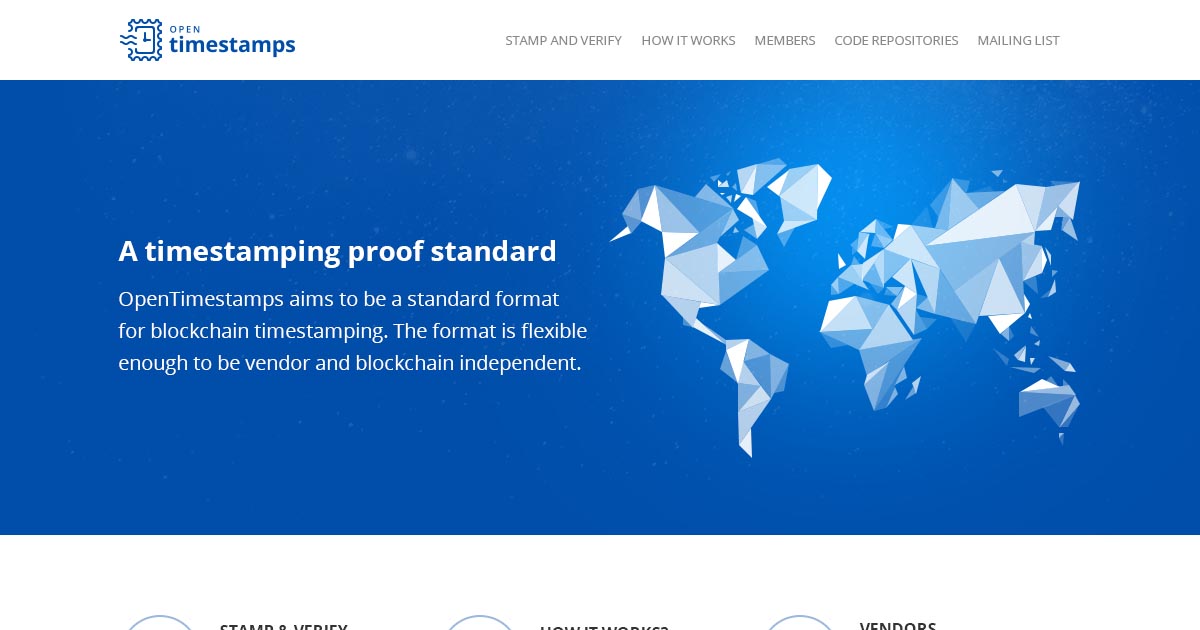
OpenTimestamps: a timestamping proof standard
OpenTimestamps aims to be a standard format for blockchain timestamping.
Cryptographic Nature
I consider the many ways in which evolved information-flows are restricted and metabolic resources protected and hidden -- the thesis of living phenomena as evolutionary cryptosystems. I present the information theory of secrecy systems and discuss mechanisms acquired by evolved lineages that encrypt sensitive heritable information with random keys. I explore the idea that complexity science is a cryptographic discipline as "frozen accidents", or various forms of regularized randomness, historically encrypt adaptive dynamics.

In Search of Hardness
Protocol studies, the next crypto cycle, and the next age of the world
Unlock
Unlock is a protocol which enables creators to monetize their content with a few lines of code in a fully decentralized way.
Let’s talk about encrypted reasoning
This is a quick post I wanted to write about a hobby project I spent a weekend on. It has little to do with real cryptography, and mostly doesn’t expose a particularly exciting vulnerability.…

How to Hack Time, With C2PA | Blog
The most impressive hacking stunt from cinema history comes from Kung Fury (2015), in which Hackerman hacks time itself. He uses this power to correct historic misdeeds. But what would I do with the ability to hack time? Personally I'm more afraid of the butterfly effect, so I'd just go back a few hours to tell myself the winning lottery numbers.
Temporal Logic
Broadly construed, Temporal Logic covers all formalapproaches to representing and reasoning about time and temporalinformation. More narrowly, it usually refers to the modal-logic styleapproach introduced by Arthur Prior in the 1950s under the nameTense Logic and subsequently developed further by manylogicians and computer scientists. Temporal Logic has been widely usedas a formalism for clarifying philosophical issues about time, as aframework for defining the semantics of temporal expressions innatural language, as a language for encoding temporal knowledge inartificial intelligence, and as a tool for specification andverification of computer programs and systems.
Cryptle
Crack the daily colour code in Cryptle, a Mastermind and Wordle-inspired puzzle with easy, medium, and hard modes.
Temporal: The 9-Year Journey to Fix Time in JavaScript
JavaScript's Date object has been a source of bugs for three decades. Temporal, which just reached Stage 4, is a modern replacement with immutable types, first-class time zone and calendar support, and nanosecond precision. This is the story of how Bloomberg, Igalia, and the TC39 community spent nine years turning an idea into a shipping standard.


We Shouldn’t Wait Another Fifteen Years for a Conversation About
With high-profile hacks in the headlines and government officials trying to reopen a long-settled debate about encryption, information security has become a mainstream issue. But we feel that one

The Invisible Protocol Thesis: Tomorrow's Crypto Unicorns
Following the introduction of any new disruptive innovation, there is always a speculative phase to a technology cycle as the market tries to size and time the market opportunity.

New Clock May End Time As We Know It
Scientists working to create the perfect atomic clock have a fundamental problem: Right now, on the ceiling, time is passing just a bit faster than it is on the floor.
