

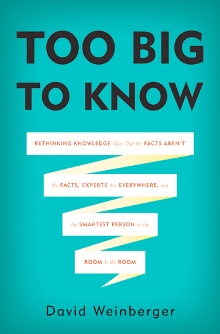
Too Big to Know: Rethinking Knowledge Now That the Facts Aren't the Facts, Experts Are Everywhere, and the Smartest Person in the Room Is the Room is a non-fiction book by the American technology writer David Weinberger published in 2012 by Basic Books.
Chinese room
The Chinese room argument holds that a computer executing a program cannot have a mind, understanding, or consciousness, regardless of how intelligently or human-like the program may make the computer behave. The argument was presented in a 1980 paper by the American philosopher John Searle, entitled "Minds, Brains, and Programs" and published in the journal Behavioral and Brain Sciences.[1] Similar arguments had been made previously by others, including Gottfried Wilhelm Leibniz, Peter Winch, and Anatoly Dneprov. Searle's version has been widely discussed in the years since.[2] The centerpiece of Searle's argument is a thought experiment known as the "Chinese room".[3]
The smartest guys in the room: the amazing rise and scandalous fall of Enron
There were dozens of books about Watergate, but only Al…

How to Make Sense of Any Mess
Information Architecture for Everybody. Based on a book by Information Architect, Abby Covert.
AI #169: New Knowledge
Even in a relatively quiet period, AI is out there creating new knowledge.
A case for AI taboos – Writings and rehearsals by Nathan Schneider
We probably all know the person, and maybe it is ourselves, who has inundated themselves in AI use, and say they are fully aware of all the dangers, but are so, so careful as to not fall into such traps themselves.


The Periodic Table of Cognition
I’ve been studying the early history of electricity’s discovery as a map for our current discovery of artificial intelligence. The smartest people alive back then, including Isaac Newton, who may have been the smartest person who ever lived, had confident … Continue reading →
We're not taking the fact-checking powers of AI seriously enough. It's past time to start.
Some notes on the Nobel Prize hallucination that wasn't

Opinion | Can You Get Smarter? (Published 2015)
There is much that you can do to keep cognitively sharp.

What You Don't Know Will Make a Whole New World by Dorothy Lazard | East Bay Booksellers
From one of California’s most celebrated librarians and public historians, a coming-of-age memoir about the thirst for knowledge and hometown pride.A Best Book of the Year, Oakland Public Library2023 Bronze Winner for the Foreword INDIES Award, Autobiography & Memoir"What You Don’t Know will inspire for its grace, zest and courage.
AI and the Wisdom of Uncertainty
AI chatbots rarely say "I don't know," and neither, increasingly, do we. But we can cultivate our epistemic resilience.

Michael I. Jordan on AI: “Superintelligence is science fiction”
No. 023: Co-Scientist, Terminal-Bench Science, AI in peer review - The Hallway Track
The Hallway Track No. 023 - How AI is affecting the practice of science
Contra Ptacek's Terrible Article On AI — Ludicity
A few days ago, I was presented with an article titled “My AI Skeptic Friends Are All Nuts” by Thomas Ptacek. I thought it was not very good, and didn't give it a second thought. To quote the formidable Baldur Bjarnason: