

This is a list of writing and formatting conventions typical of AI chatbots such as ChatGPT, with real examples taken from Wikipedia articles, drafts, comments, and other content. It is a field guide to help detect undisclosed AI-generated content on Wikipedia: while some of the signs may be broadly applicable, some may not apply in a non-Wikipedia context.[a] Not all text featuring these indicators is AI-generated, as the large language models that power AI chatbots are trained on human writing, including Wikipedia. Many elements of AI writing can be found in editorials, blogs, or fan fiction.
The Impact of AI-Generated Text on the Internet
The proliferation of AI-generated and AI-assisted text on the internet is feared to contribute to a degradation in semantic and stylistic diversity, factual accuracy, and other negative...

The Impact of AI-Generated Text on the Internet
The proliferation of AI-generated and AI-assisted text on the internet is feared to contribute to a degradation in semantic and stylistic diversity, factual accuracy, and other negative...
Tropes - AI Writing Pattern Directory
The definitive reference for identifying AI writing patterns. Learn to spot the tropes that give away AI-generated text.
Ethan Mollick on Twitter / X
There is a lot being written about the stylistic tells of AI writing (em-dashes, etc.) but this paper looks at AI narrative tellsFascinating differences between AI & human narrative, and asking AI to write in different styles doesn't do much to change it https://t.co/azkRHz34NQ pic.twitter.com/oTxSGBNYYE— Ethan Mollick (@emollick) May 28, 2026

Jimmy Wales Says Wikipedia Could Use AI. Editors Call It the 'Antithesis of Wikipedia'
Wikipedia's founder said he used ChatGPT in the review process for an article and thought it could be helpful. Editors replied to point out it was full of mistakes.
People who frequently use ChatGPT for writing tasks are accurate and robust detectors of AI-generated text
In this paper, we study how well humans can detect text generated by commercial LLMs (GPT-4o, Claude, o1). We hire annotators to read 300 non-fiction English articles, label them as either human-written or AI-generated, and provide paragraph-length explanations for their decisions. Our experiments show that annotators who frequently use LLMs for writing tasks excel at detecting AI-generated text, even without any specialized training or feedback. In fact, the majority vote among five such “expert” annotators misclassifies only 1 of 300 articles, significantly outperforming most commercial and open-source detectors we evaluated even in the presence of evasion tactics like paraphrasing and humanization. Qualitative analysis of the experts' free-form explanations shows that while they rely heavily on specific lexical clues (`AI vocabulary'), they also pick up on more complex phenomena within the text (e.g., formality, originality, clarity) that are challenging to assess for automatic detectors. We release our annotated dataset and code to spur future research into both human and automated detection of AI-generated text.
SlopShape: Identifying AI-Generated Commercial Web Content
Word-level detectors identify unedited AI-generated text almost perfectly, but the literature documents their brittleness under rewording, and a word-level score neither characterizes a text nor identifies which AI model wrote it. We ask whether AI-generated text can be identified one level deeper, from structural signatures: how information is presented, in what order, with what evidence, and in what voice. We replicate StoryScope (Russell et al., 2026), which showed such patterns for AI-generated fiction, on commercial content: 2,250 pre-ChatGPT human blog posts from 268 company domains against 11,250 AI mirrors from five frontier models. A 203-feature instrument, applied by an LLM and validated in a human gold-annotation session (human-human kappa 0.939, human-model 0.951), detects AI posts from its 176 structural features alone at 97.0 macro-F1 on held-out companies, nearly unchanged (96.1) when every AI post is reworded by its own model. The signal characterizes and attributes: AI posts share a tidy, self-announcing shape, 68.6% are attributed to the correct source against a 16.7% chance rate, and human posts occupy rare structural configurations. All effects replicate StoryScope's, consistent in direction and at least as large in magnitude. We release pipeline, instrument, prompts, code, and aggregate artifacts.
I pulled ~90,000 Reddit posts about what makes writing "sound like AI" to determine the biggest AI-slop giveaways (Part 2)
674 votes, 228 comments. The majority of people can instantly tell when writing is generated by AI. For those who don't intend to get into the weeds…
The Most Famous AI Writing Tic Is Also the Most Mysterious
Why chatbots love “it’s not X, it’s Y”
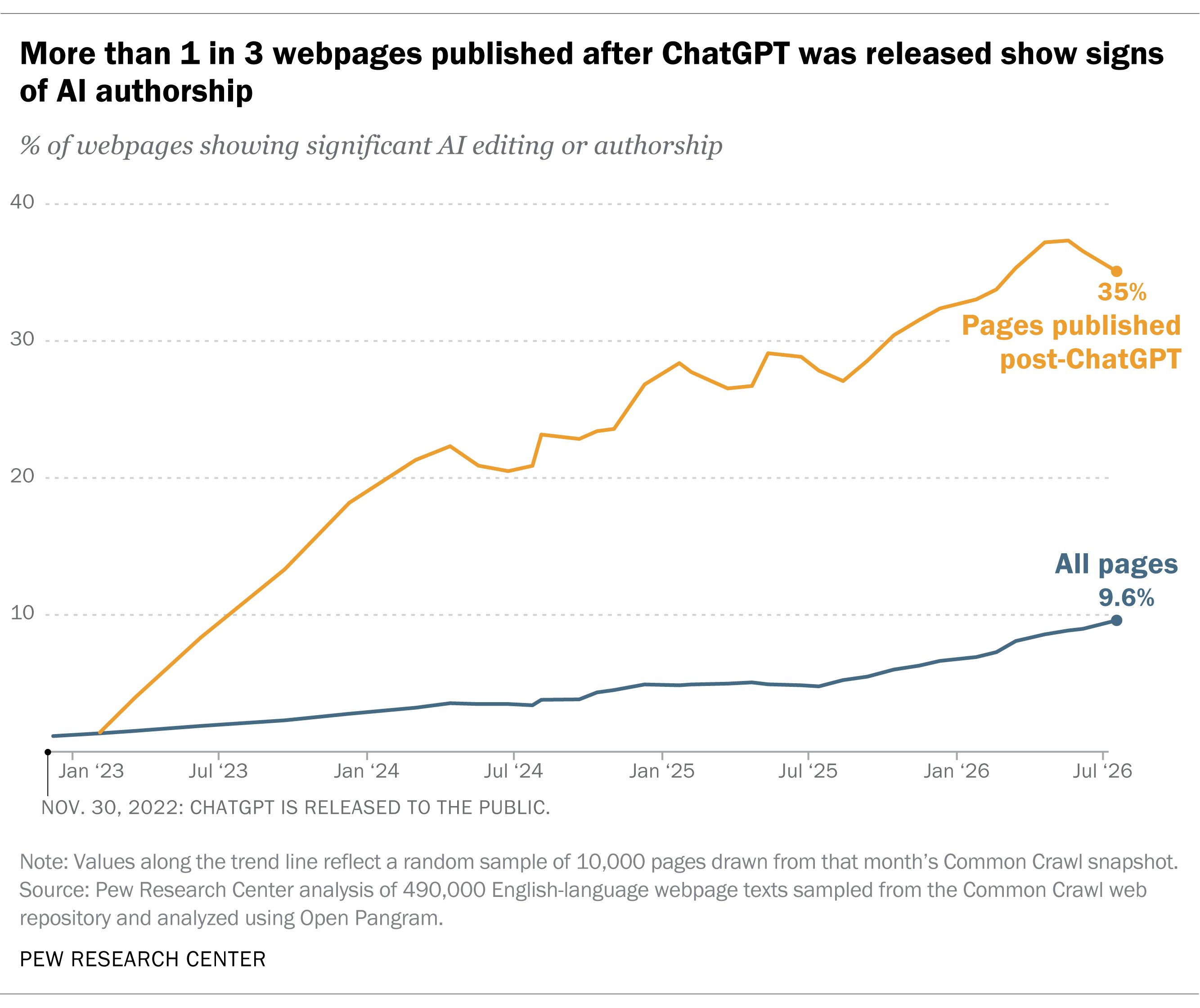
How Much of the Internet Is Written With AI?
In a random sample of 10,000 webpages collected in July 2026, one-in-ten show signs of being written or substantially edited by AI.
Writing with AI help can shift your opinions | Cornell Chronicle
Artificial intelligence-powered writing assistants that autocomplete sentences or offer “smart replies” not only put words into people’s mouths, they also put ideas into their heads, according to new research.

God Damn AI is making me dumb
It's so god damn tempting to use AI to write. Whether it is articles, code, or documents. I feel like using AI is diminishing my ability to write myself. ...

Wikipedia:WikiProject AI Cleanup
Welcome to WikiProject AI Cleanup, a collaboration to combat the increasing problem of poorly written AI-generated content on Wikipedia. If you would like to help, add yourself as a participant in the project, inquire on the talk page, and see the to-do list.