Continual learning, scaling RL, and research feedback loops
The Continual Learning Problem
A perspective on continual learning, motivating our paper on sparse memory finetuning
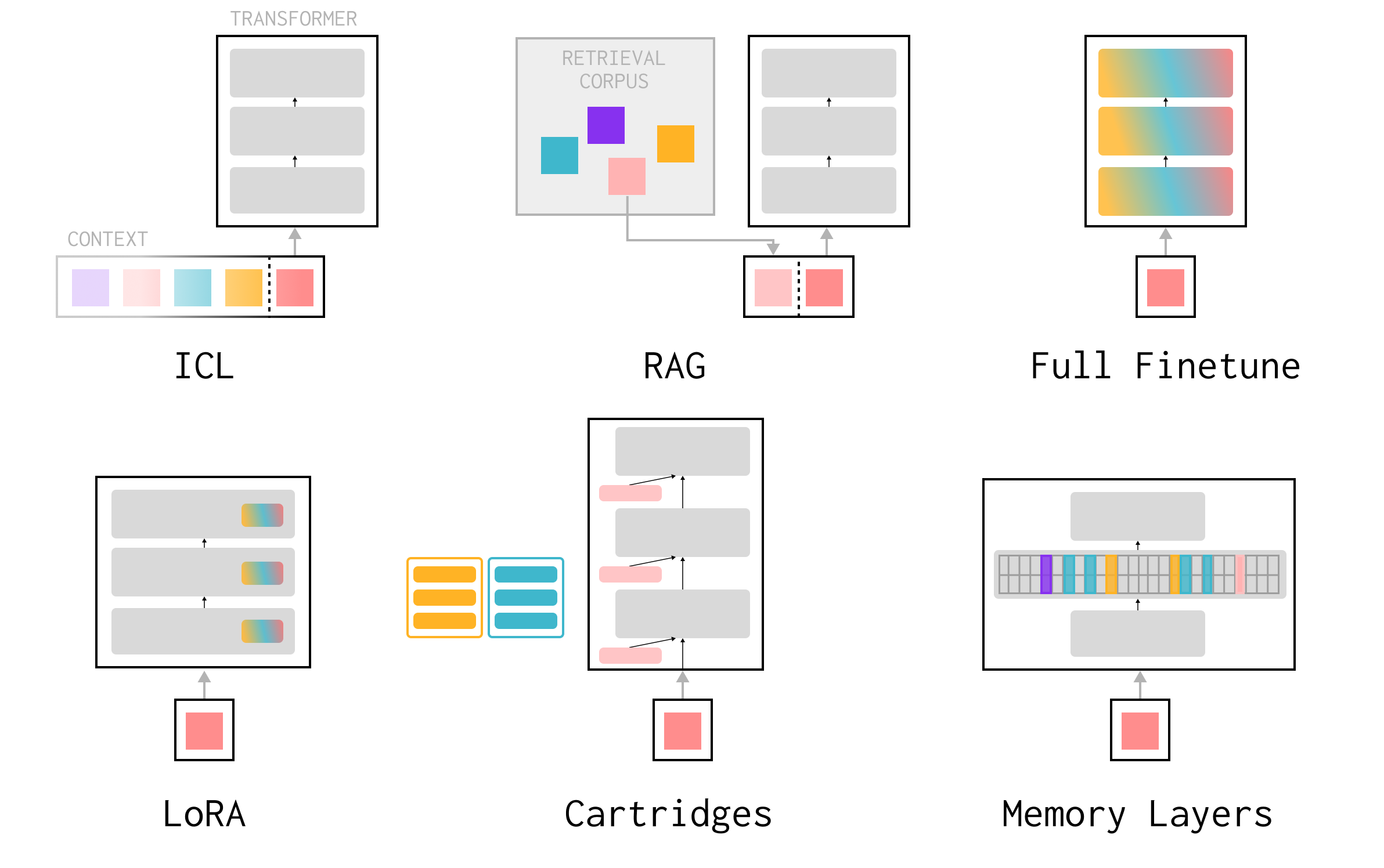
Introducing Nested Learning: A new ML paradigm for continual learning
Ali Behrouz, Student Researcher, and Vahab Mirrokni, VP and Google Fellow, Google Research

A Comprehensive Survey of Continual Learning: Theory, Method and Application
To cope with real-world dynamics, an intelligent system needs to incrementally acquire, update, accumulate, and exploit knowledge throughout its lifetime. This ability, known as continual learning, provides a foundation for AI systems to develop themselves adaptively. In a general sense, continual learning is explicitly limited by catastrophic forgetting, where learning a new task usually results in a dramatic performance degradation of the old tasks. Beyond this, increasingly numerous advances have emerged in recent years that largely extend the understanding and application of continual learning. The growing and widespread interest in this direction demonstrates its realistic significance as well as complexity. In this work, we present a comprehensive survey of continual learning, seeking to bridge the basic settings, theoretical foundations, representative methods, and practical applications. Based on existing theoretical and empirical results, we summarize the general objectives of continual learning as ensuring a proper stability-plasticity trade-off and an adequate intra/inter-task generalizability in the context of resource efficiency. Then we provide a state-of-the-art and elaborated taxonomy, extensively analyzing how representative methods address continual learning, and how they are adapted to particular challenges in realistic applications. Through an in-depth discussion of promising directions, we believe that such a holistic perspective can greatly facilitate subsequent exploration in this field and beyond.

Fleetwood on Twitter / X
Studying continual learning at the moment, best papers thus far:https://t.co/Y9oXBAiyj2https://t.co/ByWlaF3ncnhttps://t.co/hG0XIzq6cHhttps://t.co/5VSEnBIkX2— Fleetwood (@fleetwood___) April 11, 2026
Recursive Language Models
We study allowing large language models (LLMs) to process arbitrarily long prompts through the lens of inference-time scaling. We propose Recursive Language Models (RLMs), a general inference paradigm that treats long prompts as part of an external environment and allows the LLM to programmatically examine, decompose, and recursively call itself over snippets of the prompt. We find that RLMs can successfully process inputs up to two orders of magnitude beyond model context windows and, even for shorter prompts, dramatically outperform the quality of vanilla frontier LLMs and common long-context and coding scaffolds (e.g., on GPT-5 by a median across the evaluated benchmarks of $26\%$ against compaction, $130\%$ against CodeAct with sub-calls, and $13\%$ against Claude Code) across four diverse long-context tasks while having comparable cost. At a small scale, we post-train the first model around the RLM. Our model, RLM-Qwen3-8B, outperforms the underlying Qwen3-8B model by $28.3\%$ on average and even approaches the quality of vanilla GPT-5 on three long-context tasks. Code is available at https://github.com/alexzhang13/rlm.
Recursive Language Models: the paradigm of 2026
How we plan to manage extremely long contexts
.png?v=c8c07d4bf43b)
An Empirical Study of Example Forgetting during Deep Neural Network Learning
Inspired by the phenomenon of catastrophic forgetting, we investigate the learning dynamics of neural networks as they train on single classification tasks. Our goal is to understand whether a related phenomenon occurs when data does not undergo a clear distributional shift. We define a “forgetting event” to have occurred when an individual training example transitions […]
Infinite-Parameter LLMs: Generating and Adapting Weights from Live Data
Scaling laws hold that language models grow more capable with more parameters and more training data. Mixture-of-Experts (MoE) architectures are a remarkable demonstration of these laws, activating only a fraction of an enormous parameter bank for each token. But this success is built on static pretraining data --- the facts and corrections supplied by users during live interactions are a significant untapped source of potential improvement for a deployed model, but cannot be exploited by conventional architectures whose weights are frozen after training. Instead, this newfound knowledge must be placed in the context (by instruction or retrieval) and re-read on every request, only to be discarded afterwards. We seek instead to learn from live interactions by dynamically updating model weights. Inspired by MoEs, we propose the \textbf{Infinite-Parameter LLM}. A compact hypernetwork turns the online data into low-rank modulations of a shared base network, so feed-forward weights are generated from live data, not read from static memory. Whereas existing weight generators are held fixed after reading the context once, we form a Bayesian belief over the generator's latent state and update it online, such that the effective weights are re-derived as our belief evolves during the session. Although the model's memory footprint is constant, the feasible space of generated weights is thus effectively infinite. Representing live data in the weights rather than the prompt amortises compute, frees the context window, persists updates across turns, and can generalise better than in-context use. Our evaluation protocol applies this methodology to in-context learning and retrieval.
Why I don’t think AGI is right around the corner
Continual learning is a huge bottleneck
Context Rot: How Increasing Input Tokens Impacts LLM Performance
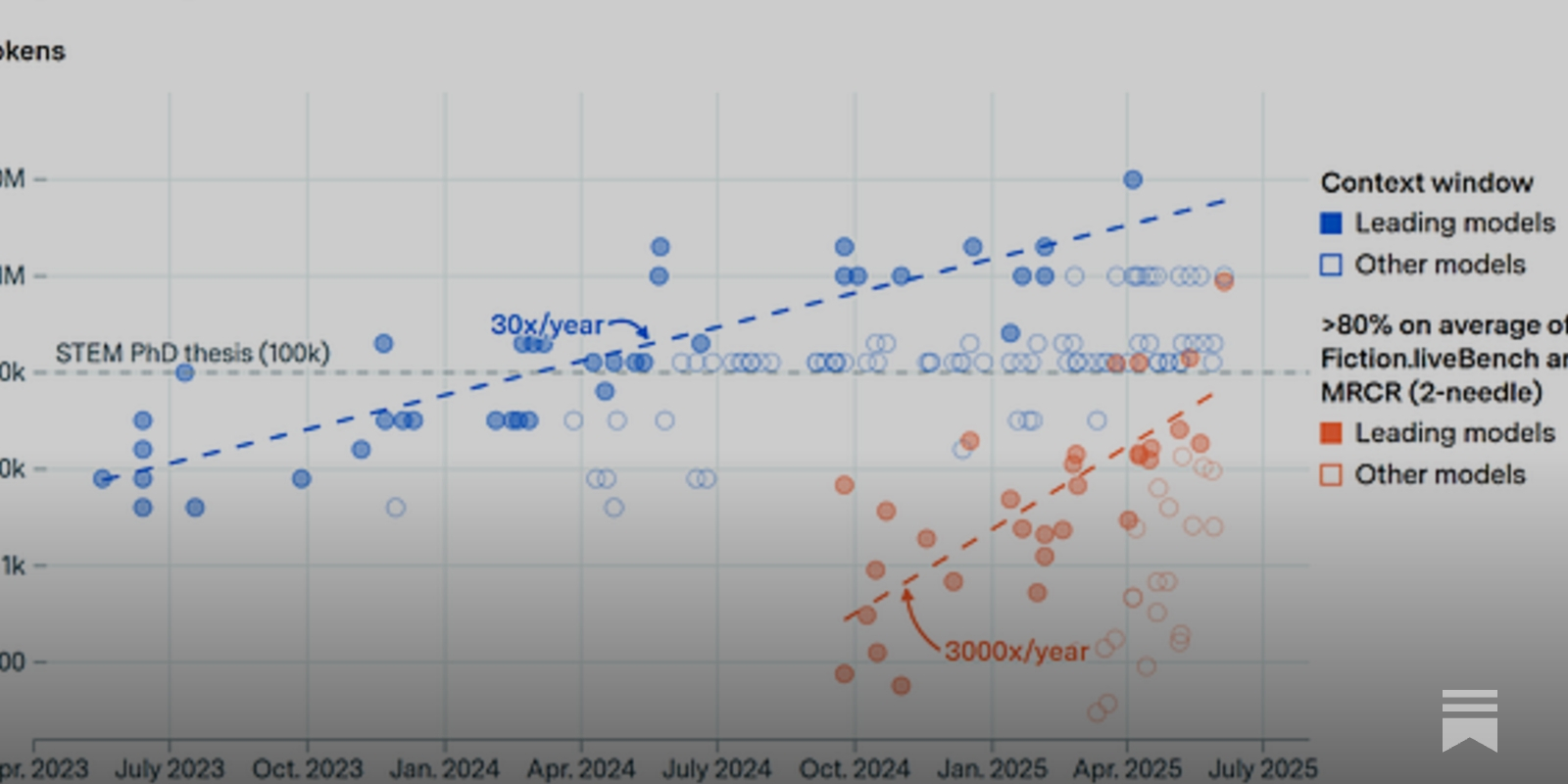
Large Language Models (LLMs) are typically presumed to process context uniformly—that is, the model should handle the 10,000th token just as reliably as the 100th. However, in practice, this assumption does not hold. We observe that model performance varies significantly as input length changes, even on simple tasks. In this report, we evaluate 18 LLMs, including the state-of-the-art GPT-4.1, Claude 4, Gemini 2.5, and Qwen3 models. Our results reveal that models do not use their context uniformly; instead, their performance grows increasingly unreliable as input length grows.
Lost in the Middle: How Language Models Use Long Contexts
While recent language models have the ability to take long contexts as input, relatively little is known about how well they use longer context. We analyze the performance of language models on two tasks that require identifying relevant information in their input contexts: multi-document question answering and key-value retrieval. We find that performance can degrade significantly when changing the position of relevant information, indicating that current language models do not robustly make use of information in long input contexts. In particular, we observe that performance is often highest when relevant information occurs at the beginning or end of the input context, and significantly degrades when models must access relevant information in the middle of long contexts, even for explicitly long-context models. Our analysis provides a better understanding of how language models use their input context and provides new evaluation protocols for future long-context language models.
Towards infinite context windows: neural KV cache compaction | Base Labs
Working to advance and democratize open-source intelligence.

Dynamic context discovery · Cursor
As models improve as agents, we've found success by providing fewer details up front, making it easier for the agent to pull relevant context on its own.

Language Models Need Sleep
View recent discussion. Abstract: Transformer-based large language models are increasingly used for long-horizon tasks; however, their attention mechanism scales poorly with context length. To handle this, we study a sleep-like consolidation mechanism in which a model periodically converts recent context into persistent fast weights before clearing its key-value cache. During sleep, the model performs $N$ offline recurrent passes over the accumulated context and updates the fast weights in its state-space model (SSM) blocks through a learned local rule. During inference, this shifts extra computation to sleep while preserving the latency of wake-time prediction. We test our method on controlled synthetic tasks, including cellular automata and multi-hop graph retrieval, as well as a realistic math reasoning task, on which a regular transformer as well as SSM-attention hybrid models fail. We then show that increasing sleep duration $N$ for our models improves performance, with the largest gains on examples that require deeper reasoning.
LLM in a Flash: Efficient Large Language Model Inference with Limited Memory
Large language models (LLMs) are central to modern natural language processing, delivering exceptional performance in various tasks…

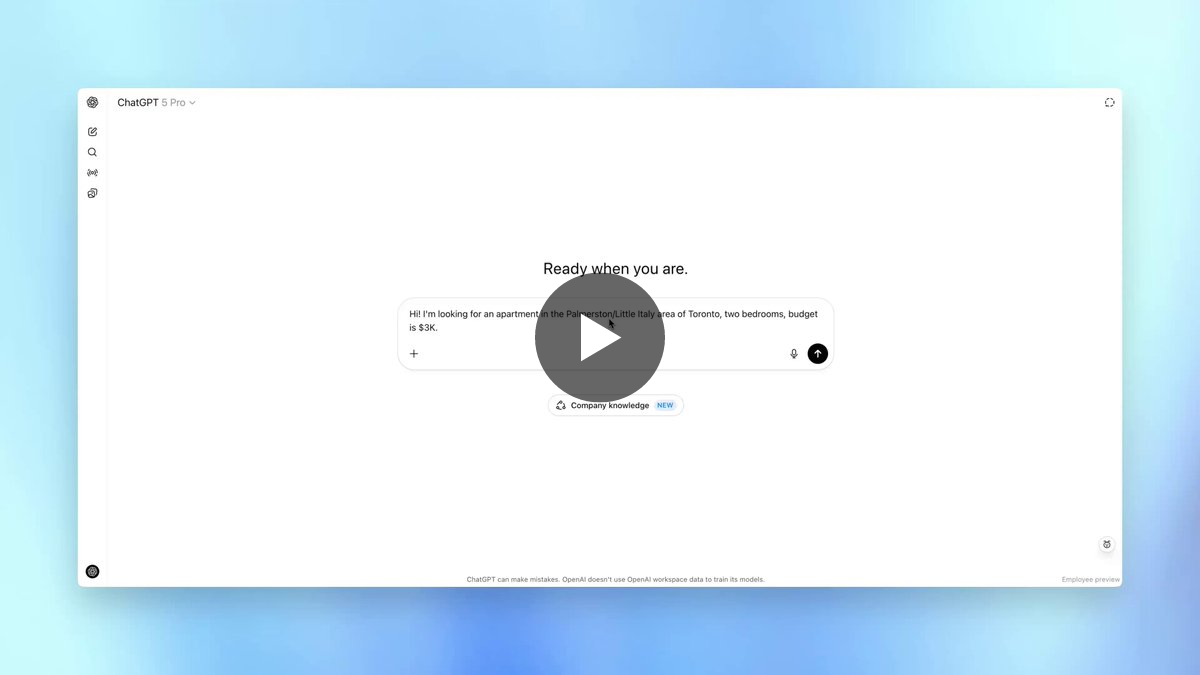
OpenAI on Twitter / X
You can now interrupt long-running queries and add new context without restarting or losing progress.This is especially useful for refining deep research or GPT-5 Pro queries as the model will adjust its response with your new requirements. Just hit update in the sidebar and… pic.twitter.com/kESrkU9hc9— OpenAI (@OpenAI) November 5, 2025