


Developing biological AI for human good at Stanford University
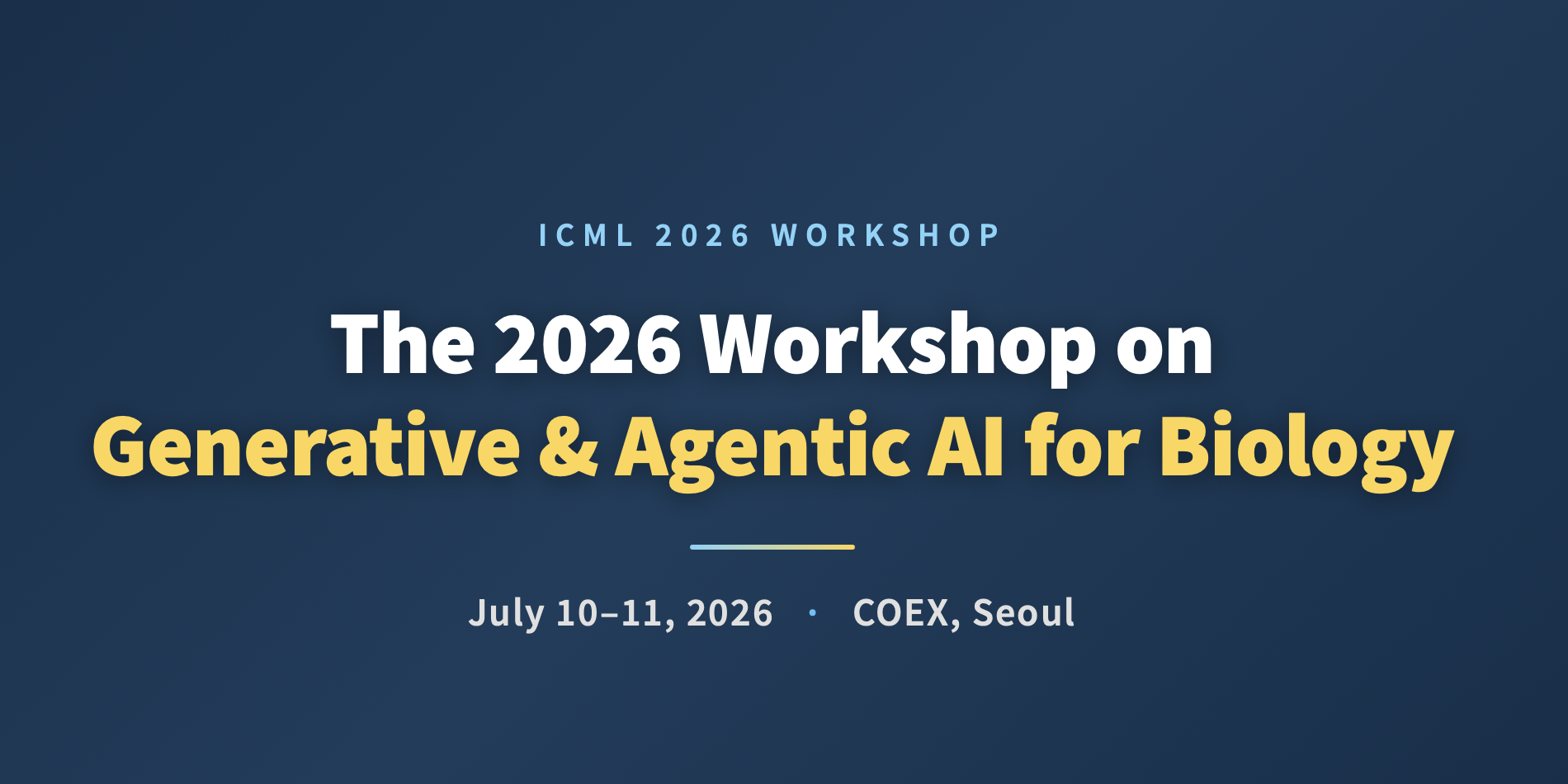
GenBio ICML Workshop 2026
The 2026 workshop on Generative and Agentic AI for Biology at ICML 2026, Seoul, South Korea.
AI That Evolves in the Wild | Edge.org
I’m interested not in domesticated AI—the stuff that people are trying to sell. I'm interested in wild AI—AI that evolves in the wild. I’m a naturalist, so that’s the interesting thing to me. Thirty-four years ago there was a meeting just like this in which Stanislaw Ulam said to everybody in the room—they’re all mathematicians—"What makes you so sure that mathematical logic corresponds to the way we think?" It’s a higher-level symptom. It’s not how the brain works. All those guys knew fully well that the brain was not fundamentally logical.
AI agents team up in Agent Laboratory to speed scientific research
Johns Hopkins University and AMD have developed Agent Laboratory, a new open-source framework that pairs human creativity with AI-powered workflows.
AI: A Guide for Thinking Humans | Melanie Mitchell | Substack
I write about interesting new developments in AI. Click to read AI: A Guide for Thinking Humans, by Melanie Mitchell, a Substack publication with tens of thousands of subscribers.
TILOS HOT-AI Workshop: The Architecture of Intelligence with John Doyle
On AI as model organism for human learning
I've a pretty taste for paradox

AgenticLS @ NeurIPS 2026 — Agentic AI for Biological Discovery
AgenticLS: Agentic AI for Biological Discovery — Toward Closed-Loop Life-Science Intelligence. A NeurIPS 2026 workshop in Sydney, December 11, 2026.
Import AI 475: Swarm scaling; Google DeepMind watermarks biology; and the AI science economy
Who chooses what AI gets to do?

Our minds did not evolve for AI
AI is mental junk food: tasty and tempting, but ultimately unhealthy — a cognitive hot dog

Import AI 455: AI systems are about to start building themselves.
The first step towards recursive self improvement

The ecology of AI risk
Understanding the risk from applications of artificial intelligence (AI) is a critical part of creating AI governance strategies. Building on the idea of studying AI using ecological and evolutionary perspectives, we propose a novel approach for assessing risk from AI using indicators derived from theoretical ecology models. We illustrate our methods by deriving 3 indicators from population and ecosystem models originating from theoretical ecology. We conclude with a discussion of limitations of our analysis and considerations for improving AI governance policy.
Panel: Biodesign x AI: Interactions in the Algorithmic Wet Lab
Togelius: Please, don't automate science!
I was at an event on AI for science yesterday, a panel discussion here at NeurIPS. The panelists discussed how they plan to replace humans a...
Human scientists trounce the best AI agents on complex tasks
State-of-the-industry report finds that, despite the limitations of artificial-intelligence systems, researchers have embraced them.
Meet Foundry: An AI Startup that Builds, Evaluates, and Improves AI Agents

Introducing Persimmon | humans&
A model of human behavior, and new ways to measure how faithfully AI can simulate people.
