

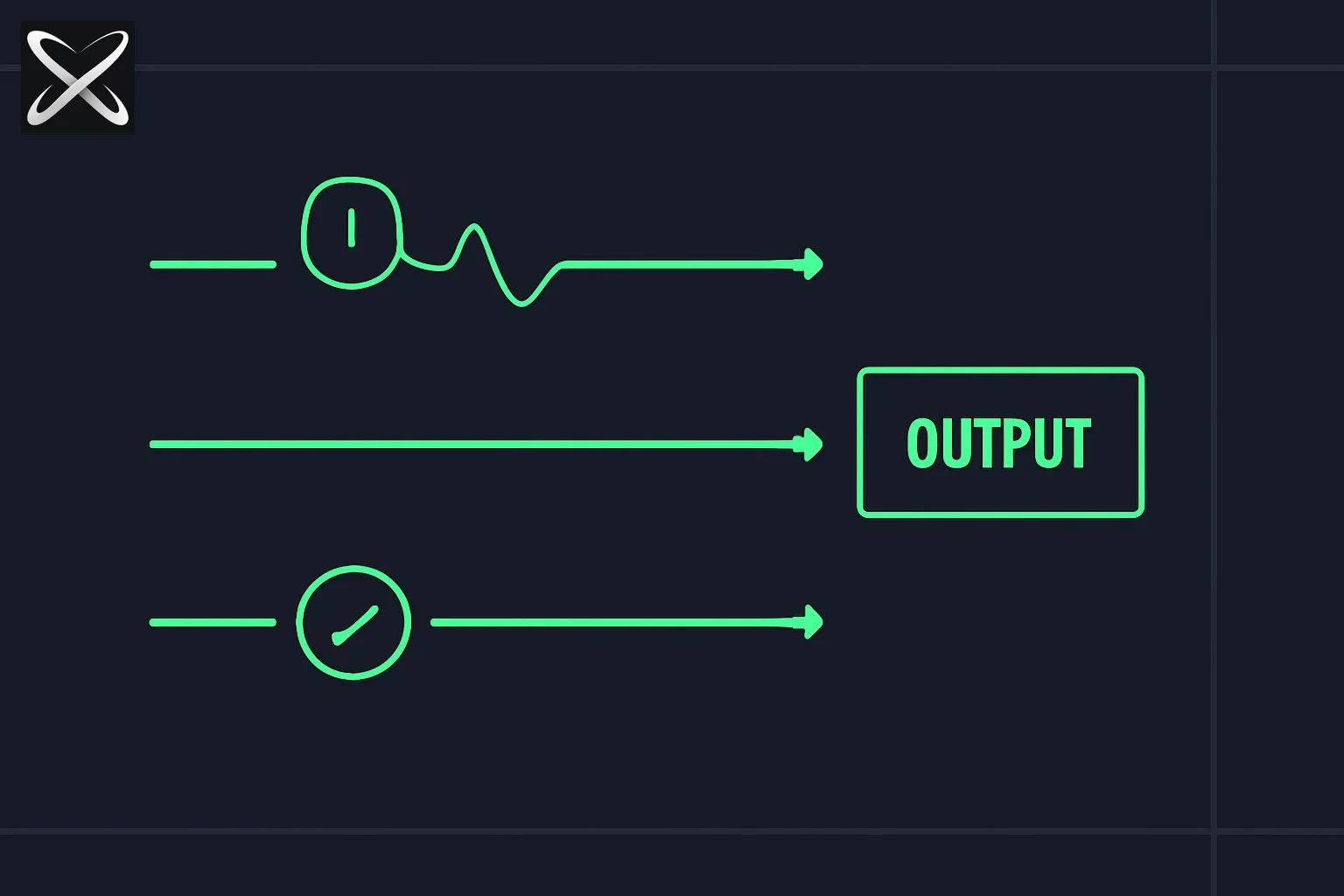
A vLLM contributor built an open-source Jev clone using DiffusionGemma — roughly matching TypeSafe's proprietary model on accuracy.
How Stable Diffusion works
Understand in a simple way how Stable Diffusion transforms a few words into a spectacular image.

What are Diffusion Models? | IBM
Diffusion models are generative models that “diffuse” training data with random noise, then learn to reverse the diffusion process to output new images.

The physics behind diffusion models
Complete guide to samplers in Stable Diffusion
Dive into the world of Stable Diffusion samplers and unlock the potential of image generation.

Diffusion Models: A Comprehensive Survey of Methods and Applications
Diffusion models have emerged as a powerful new family of deep generative models with record-breaking performance in many applications, including image synthesis, video generation, and molecule...

mlx-examples/stable_diffusion at main · ml-explore/mlx-examples
Examples in the MLX framework. Contribute to ml-explore/mlx-examples development by creating an account on GitHub.
Research – Inception
We are leveraging diffusion technology to develop a new generation of LLMs. Our dLLMs are much faster and more efficient than traditional autoregressive LLMs.
Stanford CS25: V5 I Transformers in Diffusion Models for Image Generation and Beyond
Continuous diffusion language models
Fully discrete methods dominated for a few years, but language models based on continuous diffusion are making a comeback.
Continuous diffusion language models
Fully discrete methods dominated for a few years, but language models based on continuous diffusion are making a comeback.
Introducing Mercury 2.5 – Inception
Mercury 2.5 is the most capable diffusion LLM on the market. It runs at 1,107 tokens/sec and offers a 40% increase in intelligence over Mercury 2, comparable to cost-optimized frontier models.

Diffusion model
In machine learning, diffusion models, also known as diffusion-based generative models or score-based generative models, are a class of latent variable generative models. A diffusion model consists of two major components: the forward diffusion process, and the reverse sampling process.[1] The goal of diffusion models is to learn a diffusion process for a given dataset, such that the process can generate new elements that are distributed similarly as the original dataset. A diffusion model models data as generated by a diffusion process, whereby a new datum performs a random walk with drift through the space of all possible data.[2] A trained diffusion model can be sampled in many ways, with different efficiency and quality.
The Curse of Recursion: Training on Generated Data Makes Models Forget
Stable Diffusion revolutionised image creation from descriptive text. GPT-2, GPT-3(.5) and GPT-4 demonstrated astonishing performance across a variety of language tasks. ChatGPT introduced such...

Diffusion Models

Introducing Mercury 2.5 – Inception
Diffusion model
What are Diffusion Models? | IBM
Diffusion Models: A Comprehensive Survey of Methods and Applications
Diffusion Models
Research – Inception