


a hub for learning through play
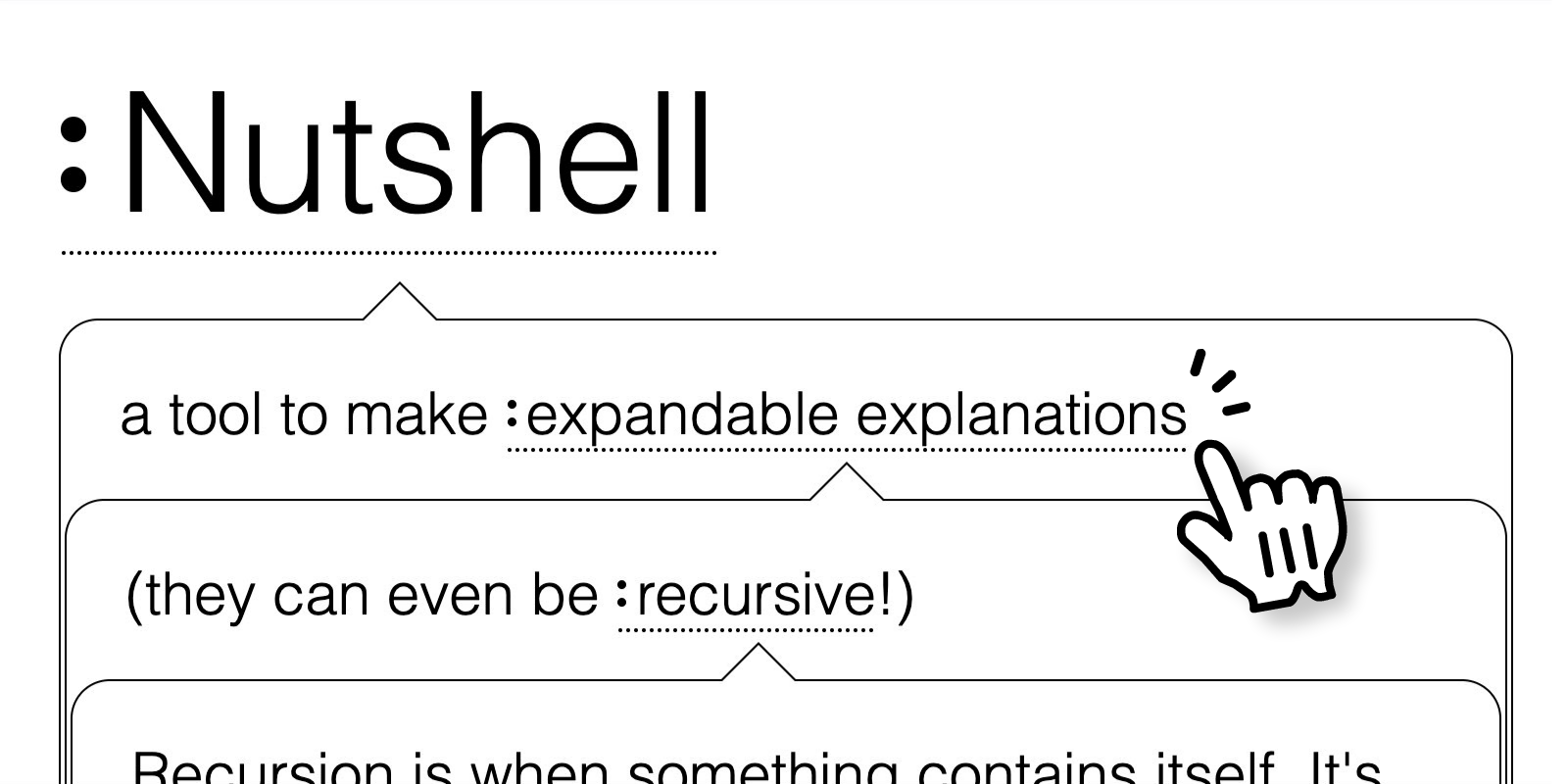
Nutshell: make expandable, embeddable explanations
a tool to let your readers dive into details
Game UI by Example: A Crash Course in the Good and the Bad
How easy is it for your player to put their intention into action, or to understand what's going on in your game? In this tutorial, you'll learn how to build a better game UI by examining both...

Understanding is the new bottleneck
Agents can write code faster than we can absorb it. Here's why it still matters for humans to understand what they build — and some techniques for doing that efficiently: explainer docs, quizzes, micro-worlds, and shared spaces.
Understanding is the new bottleneck
Agents can write code faster than we can absorb it. Here's why it still matters for humans to understand what they build — and some techniques for doing that efficiently: explainer docs, quizzes, micro-worlds, and shared spaces.
Understanding is the new bottleneck
Agents can write code faster than we can absorb it. Here's why it still matters for humans to understand what they build — and some techniques for doing that efficiently: explainer docs, quizzes, micro-worlds, and shared spaces.
Environments Hub: A Community Hub To Scale RL To Open AGI
RL environments are the playgrounds where agents learn. Until now, they’ve been fragmented, closed, and hard to share. We are launching the Environments Hub to change that: an open, community-powered platform that gives environments a true home.Environments define the world, rules and feedback loop of state, action and reward. From games to coding tasks to dialogue, they’re the contexts where AI learns, without them, RL is just an algorithm with nothing to act on.

Building games that can be understood at a glance
Building games that can be understood at a glance - Zach Gage, GDC 2018
Explorable Explanations
An active reader asks questions, considers alternatives, questions assumptions, and even questions the trustworthiness of the author. An active reader tries to generalize specific examples, and devise specific examples for generalities. An active reader doesn't passively sponge up information, but uses the author's argument as a springboard for critical thought and deep understanding.
Agentic Context Engineering: Evolving Contexts for Self-Improving Language Models
Large language model (LLM) applications such as agents and domain-specific reasoning increasingly rely on context adaptation: modifying inputs with instructions, strategies, or evidence, rather than weight updates. Prior approaches improve usability but often suffer from brevity bias, which drops domain insights for concise summaries, and from context collapse, where iterative rewriting erodes details over time. We introduce ACE (Agentic Context Engineering), a framework that treats contexts as evolving playbooks that accumulate, refine, and organize strategies through a modular process of generation, reflection, and curation. ACE prevents collapse with structured, incremental updates that preserve detailed knowledge and scale with long-context models. Across agent and domain-specific benchmarks, ACE optimizes contexts both offline (e.g., system prompts) and online (e.g., agent memory), consistently outperforming strong baselines: +10.6% on agents and +8.6% on finance, while significantly reducing adaptation latency and rollout cost. Notably, ACE could adapt effectively without labeled supervision and instead by leveraging natural execution feedback. On the AppWorld leaderboard, ACE matches the top-ranked production-level agent on the overall average and surpasses it on the harder test-challenge split, despite using a smaller open-source model. These results show that comprehensive, evolving contexts enable scalable, efficient, and self-improving LLM systems with low overhead.

Language and Experience: A Computational Model of Social Learning in Complex Tasks
The ability to combine linguistic guidance from others with direct experience is central to human development, enabling safe and rapid learning in new environments. How do people integrate these two sources of knowledge, and how might AI systems? We present a computational framework that models social learning as joint probabilistic inference over structured, executable world models given sensorimotor and linguistic data. We make this possible by turning a pretrained language model into a probabilistic model of how humans share advice conditioned on their beliefs, allowing our agents both to generate advice for others and to interpret linguistic input as evidence during Bayesian inference. Using behavioral experiments and simulations across 10 video games, we show how linguistic guidance can shape exploration and accelerate learning by reducing risky interactions and speeding up key discoveries in both humans and models. We further explore how knowledge can accumulate across generations through iterated learning experiments and demonstrate successful knowledge transfer between humans and models -- revealing how structured, language-compatible representations might enable human-machine collaborative learning.

Discovering and transmitting abstract knowledge over generations
The complexity of human culture depends on people's ability to discover and transmit abstract knowledge. Studying this ability is crucial to understanding humans' distinctive place among species, but current experimental paradigms focus on the cultural transmission of specific, concrete facts rather than generalizable abstract knowledge. In this paper, we develop a crafting game paradigm to study how people discover abstract knowledge and transmit it via language. We compared individuals playing this game for 40 rounds to chains of four participants playing for 10 rounds each and passing messages to each other sequentially. The individuals performed significantly better over rounds, but the chains did not. Through simulations with language model agents and a follow-up experiment, we find substantial variation in the helpfulness of participants' messages, which may explain the lack of consistent improvement in chains. The ability to learn selectively from the good messages may be essential for improvement over generations.
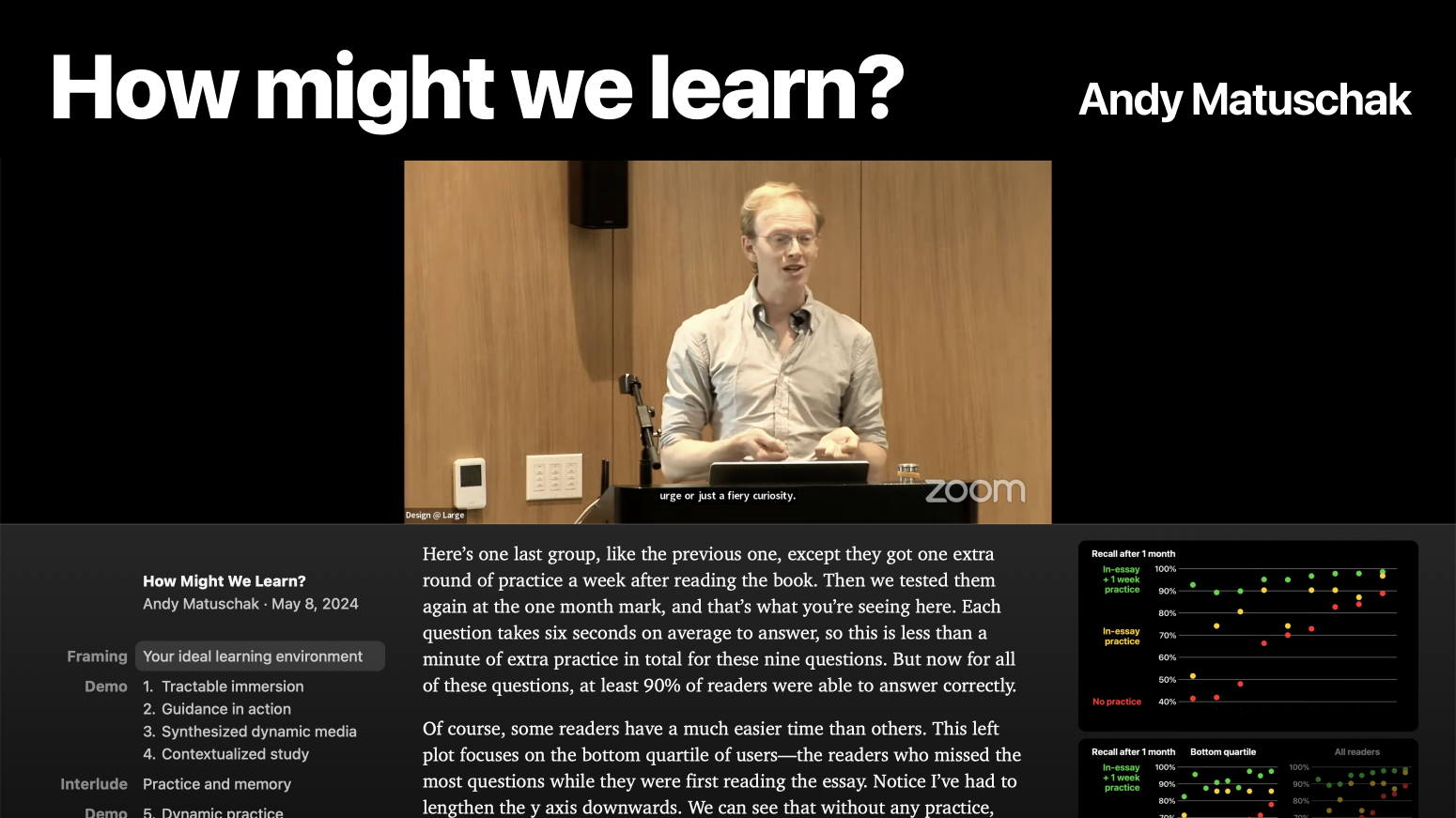
Learning to solve complex tasks by growing knowledge culturally across generations
Knowledge built culturally across generations allows humans to learn far more than an individual could glean from their own experience in a lifetime. Cultural knowledge in turn rests on language: language is the richest record of what previous generations believed, valued, and practiced, and how these evolved over time. The power and mechanisms of language as a means of cultural learning, however, are not well understood, and as a result, current AI systems do not leverage language as a means for cultural knowledge transmission. Here, we take a first step towards reverse-engineering cultural learning through language. We developed a suite of complex tasks in the form of minimalist-style video games, which we deployed in an iterated learning paradigm. Human participants were limited to only two attempts (two lives) to beat each game and were allowed to write a message to a future participant who read the message before playing. Knowledge accumulated gradually across generations, allowing later generations to advance further in the games and perform more efficient actions. Multigenerational learning followed a strikingly similar trajectory to individuals learning alone with an unlimited number of lives. Successive generations of learners were able to succeed by expressing distinct types of knowledge in natural language: the dynamics of the environment, valuable goals, dangerous risks, and strategies for success. The video game paradigm we pioneer here is thus a rich test bed for developing AI systems capable of acquiring and transmitting cultural knowledge.
Introducing Muse Spark 1.3
Introducing Muse Spark 1.3, with max reasoning for challenging reasoning and agentic tasks and improved real-world usability.

Look-ahead Reasoning with a Learned Model in Imperfect Information Games
Test-time reasoning significantly enhances pre-trained AI agents' performance. However, it requires an explicit environment model, often unavailable or overly complex in real-world scenarios....