


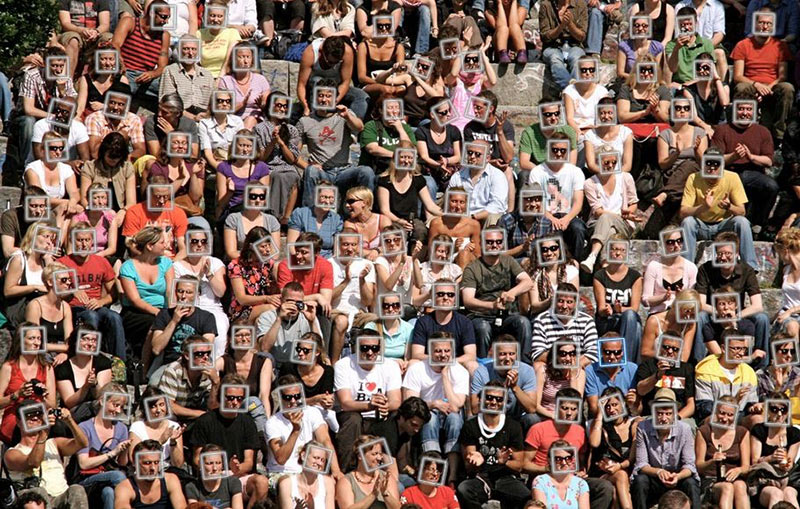
MegaFace is a dataset of over 4 million faces used benchmarking and developing face recognition technologies
The Face Recognition Algorithm That Finally Outperforms Humans
Computer scientists have developed the first algorithm that recognises people’s faces better than you do

Cops have a database of 117M faces. You’re probably in it
A new report catalogues the sweeping scope and shoddy safeguards of U.S. law enforcement's facial recognition tools.

MiniMaxAI/OctoCodingBench · Datasets at Hugging Face
We’re on a journey to advance and democratize artificial intelligence through open source and open science.

China bets on facial recognition in big drive for total surveillance
Facial recognition is the new hot tech topic in China. Banks, airports, hotels and even public toilets are all trying to verify people’s identities by analyzing their faces. But the police and security state have been the most enthusiastic about embracing this new technology.

Meta Sued Over Training Data for Its AI and Face-Recognition Systems
The proposed class action alleges Meta illegally harvested people’s Facebook and Instagram photos to train its AI image-generation models and to build its unreleased “NameTag” face recognition feature.

Police use of Amazon’s face-recognition service draws privacy warnings
Cloud-based service can index millions of faces and recognize 100 people in an image.
Anatomy of a Machine Learning Ecosystem: 2 Million Models on Hugging Face
Generative artificial intelligence (AI) and machine learning (ML) models are being adopted across a variety of domains. As these technologies develop, there is notable diversity in their levels of availability and paths of diffusion. For example, fully closed-source models may be available through chatbots and API calls, but their weights, source code, training data, and other artifacts remain hidden from view. In contrast, open models make some or all of these materials publicly available for developers and downstream users.
Face recognition app taking Russia by storm may bring end to public anonymity
FindFace compares photos to profile pictures on social network Vkontakte and works out identities with 70% reliability

Facial recognition: It’s time for action - Microsoft On the Issues
In July, we shared our views about the need for government regulation and responsible industry measures to address advancing facial recognition technology. As we discussed, this technology brings important and even exciting societal benefits but also the potential for abuse. We noted the need for broader study and discussion of these issues. In the ensuing...

Inside ICE’s Supercharged Facial Recognition App of 200 Million Images
404 Media has seen user manuals for Mobile Fortify, ICE’s new facial recognition app which allows officers to instantly look up DHS, State Department, and state law enforcement databases by just pointing a phone at someone’s face.

How to defeat facial-recognition machines and look like a rock star
You might be invisible to computers, but you're "glaringly obvious to other humans."

Exploring Frequency Adversarial Attacks for Face Forgery Detection
Various facial manipulation techniques have drawn seri-ous public concerns in morality, security, and privacy. Al- though existing face forgery classifiers achieve promising performance on detecting fake images, these methods are vulnerable to adversarial examples with injected impercep- tible perturbations on the pixels. Meanwhile, many face forgery detectors always utilize the frequency diversity be-tween real and fake faces as a crucial clue. In this paper, in- stead of injecting adversarial perturbations into the spatial domain, we propose a frequency adversarial attack method against face forgery detectors. Concretely, we apply dis-crete cosine transform (DCT) on the input images and in-troduce a fusion module to capture the salient region of ad-versary in the frequency domain. Compared with existing adversarial attacks (e.g. FGSM, PGD) in the spatial do-main, our method is more imperceptible to human observers and does not degrade the visual quality of the original images. Moreover, inspired by the idea of meta-learning, we also propose a hybrid adversarial attack that performs at-tacks in both the spatial and frequency domains. Exten-sive experiments indicate that the proposed method fools not only the spatial-based detectors but also the state-of- the-art frequency-based detectors effectively. In addition, the proposed frequency attack enhances the transferability across face forgery detectors as black-box attacks.
AI-synthesized faces are indistinguishable from real faces and more trustworthy
Artificial intelligence (AI)–synthesized text, audio, image, and video are being weaponized for the purposes of nonconsensual intimate imagery, financial fraud, and disinformation campaigns. Our evaluation of the photorealism of AI-synthesized faces indicates that synthesis engines have passed through the uncanny valley and are capable of creating faces that are indistinguishable—and more trustworthy—than real faces.
Meta’s new AI glasses could have a ‘super-sensing’ mode with facial recognition
Facial recognition on your face.
