


The remarkable physics of constraints
A beautiful constraint – summary
A beautiful constraint. How to transform your limitations into advantages. By Adam Morgan & Mark Barden. Summarised by paul_arnold@me.com – Strategic facilitator, planner and trainer. Th…

Theory of Constraints - The Decision Lab
The theory of constraints is a systems-based methodology that identifies and addresses the weakest link in a process or system.
In Soviet Union, Optimization Problem Solves <em>You</em>
Cross-posted at Crooked Timber, as part of the seminar on Red Plenty. That version has uglier math, but allows comments.
The mathematical beauty of hyperbezier curves
The mathematical beauty of hyperbezier curves
Viability theory
Viability theory is an area of mathematics that studies the evolution of dynamical systems under constraints on the system state.[1][2] It was developed to formalize problems arising in the study of various natural and social phenomena, and has close ties to the theories of optimal control and set-valued analysis.

Caveman | Lithic Token Compression
A semantic constraint engine for Claude Code & Codex. Forces agentic communication into minimal-token lithic structures. Retain 100% technical accuracy while destroying up to 87% of output latency.
Mathematical Beauty, Truth and Proof in the Age of AI | Quanta Magazine
Mathematicians have started to prepare for a profound shift in what it means to do mathematics.

The AI Buildout and the Material Trap
Why Strategic Necessity, Physical Bottlenecks, and Unsettled Economics Are Forcing Capital into a Constrained System

The Cost of Representing Higher-Order Dynamics on Graphs: A Theoretical Framework
Can graphs represent the dynamics of higher-order (multi-body) interactions, or are hypergraphs necessary? We decompose network dynamics into three components: the combinatorial structure (graph or hypergraph), per-edge coupling functions, and per-node aggregation functions. Within this framework, we prove that graphs can always reproduce the trajectories of any hypergraph dynamics by absorbing the coupling logic into the aggregation. This generalizes a recent result by Peixoto et al., who showed the same under the assumption of flat dynamics. However, the graph representation pays a price in parsimony: when the coupling and aggregation functions are polynomials of degree at most D, the graph aggregation requires Θ(k^D/D!) parameters relative to the hypergraph alternative, where k is the interaction size. Without symmetry, the comparison can reverse. The framework also clarifies two other recent contributions by Moutuou and by Lacasa, and identifies overlooked modeling degrees of freedom including partial interaction symmetries and the role of non-additive aggregation.
The Self-Constrained Hand-to-Mouth
Abstract Many studies have shown that consumption responds to the arrival of predictable income (excess sensitivity). This paper uses a buffer stock model of consumption to understand what causes excess sensitivity and to test which parameterization is consistent with empirical excess sensitivity estimates. Using high-frequency granular data from a personal finance app, I find that while liquidity constraints are a proximate cause, preferences are the ultimate cause of excess sensitivity. Furthermore, it finds that for feasible parameters, a quasi-hyperbolic version of the model is more consistent with the level of excess sensitivity relative to a standard exponential model.

If you aren’t used to staring at math, Poisson’s equation looks a little intimidating:
The Optimization Trap: Why Too Much Efficiency Makes Us Fragile with Olivier Hamant
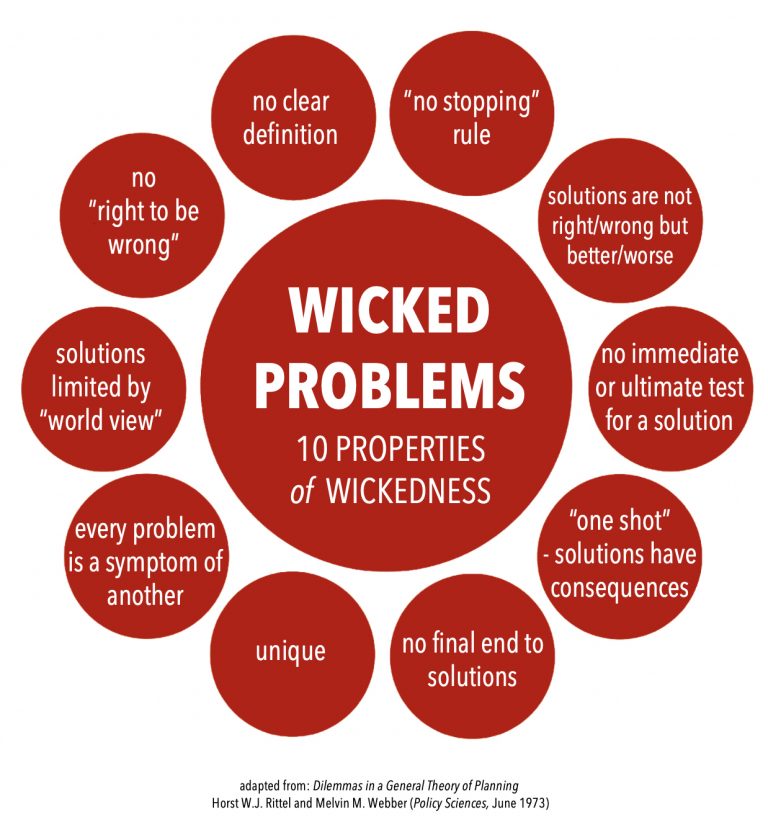
Wicked problem
In planning and policy, a wicked problem is a problem that is difficult or impossible to solve because of incomplete, contradictory, and changing requirements that are often difficult to recognize. It refers to an idea or problem that cannot be fixed, where there is no single solution to the problem; "wicked" does not indicate evil, but rather resistance to resolution. Another definition is "a problem whose social complexity means that it has no determinable stopping point". Because of complex interdependencies, the effort to solve one aspect of a wicked problem may reveal or create other problems. Due to their complexity, wicked problems are often characterized by organized irresponsibility.
Information and Contract Design for Repeated Interactions between...
We study the consequences of information asymmetries and misaligned incentives in settings with multiple independent agents. We model an interaction between a Sender, who holds vital private...

Frameworks v0.2
FRAMEWORKS v0.2 Many of the thoughts in this document draw on and synthesize concepts from economics, math, physics, chemistry, biology, and psychology. Here are a handful of core concepts that are often relied on as inputs: Activation energy Behavioral economics Cognitive biases Darwinism En...
