

The Friendly Forge Format (abbreviated F3) is an Open File Format for storing the information from a forge such as issues, pull/merge requests, milestones, release assets, etc. as well as the associated VCS (Git, Mercurial, etc.).
NLnet; Friendly Forge Format (F3)
Proposed Standard for secure communication between software forges
ForgeFed
ForgeFed is a federation protocol for software forges and code collaboration tools for the software development lifecycle and ecosystem. This includes repository hosting websites, issue trackers, code review applications, and more. ForgeFed provides a common substrate for people to create interoperable code collaboration websites and applications.
Design Tokens Format Module 2025.10
This document describes the technical specification for a file format to exchange design tokens between different tools.
Forgejo – Beyond coding. We forge.
Forgejo is a self-hosted lightweight software forge. Easy to install and low maintenance, it just does the job.
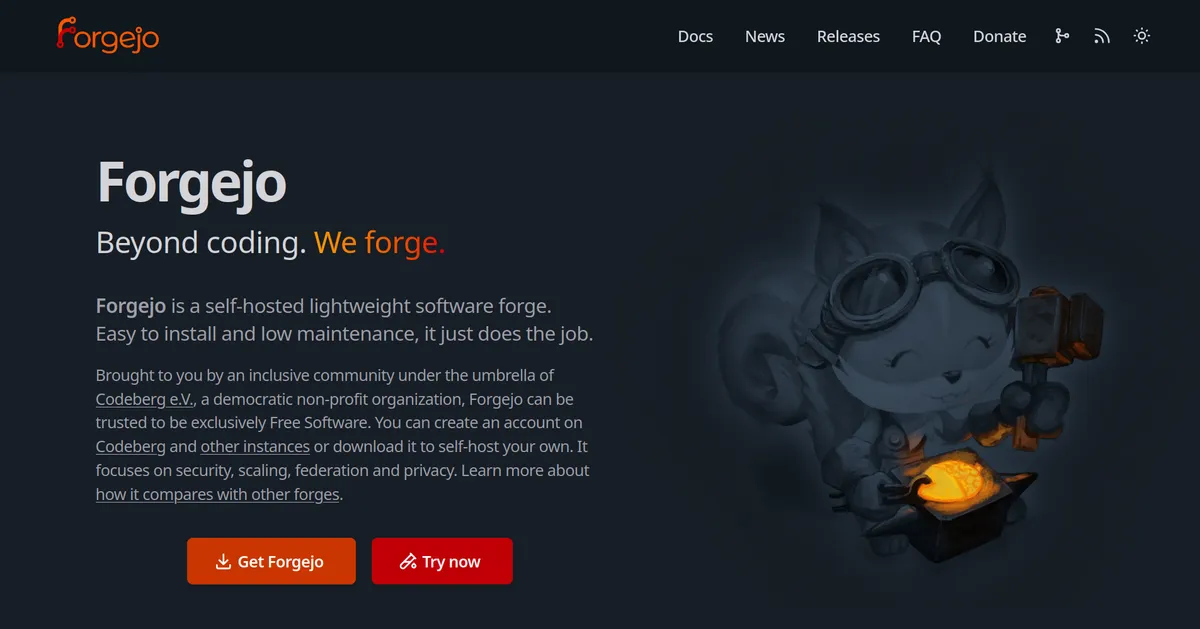
Lix | Version control system for every file format
Lix tracks, reviews, branches, merges, and rolls back changes across Markdown, DOCX, XLSX, JSON, PDFs, and custom file formats.
Ditto - Introducing Safer FFI
Introducing safer_ffi, a Rust framework that allows you to write foreign function interfaces (FFI) without polluting your Rust code with `unsafe` while improving readability.

sourcehut - the hacker's forge
sourcehut is a network of useful open source tools for software project maintainers and collaborators, including git repos, bug tracking, continuous integration, and mailing lists.
fjall - Rust
Fjall is a log-structured embeddable key-value storage engine written in Rust. It features:
Fil One Object Storage
S3-compatible object storage on Filecoin with no egress fees and verifiable data integrity, proven daily.

FOSDEM 2026 - Teamtype: multiplayer mode for your text editor – towards a Collaborative Editing Protocol
Files on your hard drive are the ultimate local-first storage. But to allow real-time collaboration from within text editors, developers currently have to reinvent the wheel each time: Figure out how to hook into buffer changes correctly, implement displaying remote cursors, finding a way to get the required events in and out of the editor.

Software Sharing for Modern Companies | Fair.io
Fair Source is an alternative to closed source, allowing you to safely share access to your core products. Fair Source Software (FSS) can be used with minimal restrictions, and becomes Open Source after a period of time.
Software Sharing for Modern Companies | Fair.io
Fair Source is an alternative to closed source, allowing you to safely share access to your core products. Fair Source Software (FSS) can be used with minimal restrictions, and becomes Open Source after a period of time.
Overview | Safebucket
Safebucket is an open-source file sharing platform where files never touch your

Safebucket | Proxmox VE Helper Scripts
Open-source file sharing where files bypass the server via presigned URLs to a local Garage (S3-compatible) object store.
@bnewbold.net contributed design feedback on the file sharing lexicon — referencing git-annex special remotes and WebTorrent as prior art, and suggesting thumbnail blobs, additional hash types for cross-database compatibility, and appview-side proxying for bandwidth distribution.
FISL — Finding Internet Structures & Links
fisl.dev