

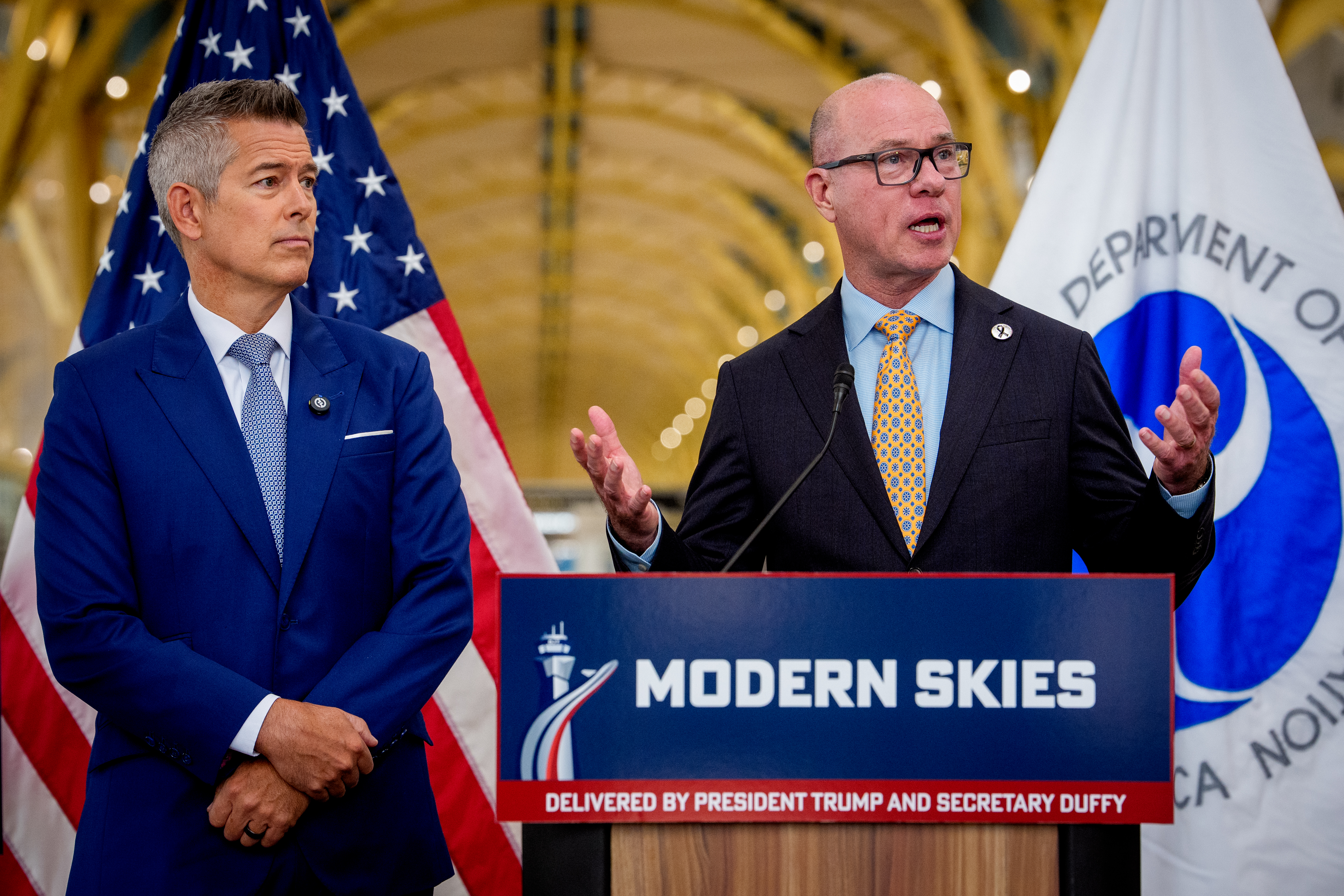
Congressional leaders are asking about pre-deployment testing, stakeholder consultation and oversight of the tool.
Press Releases | U.S. Representative Don Beyer
Rep. Don Beyer (D-VA), who serves as co-Chair of the bipartisan Congressional Artificial Intelligence (AI) Caucus and represents a Northern Virginia district that includes Ronald Reagan National Airport (DCA) in the U.S. House, issued the following statement today on the Federal Aviation Administration’s (FAA) deployment of an AI Strategic Management of Airspace Routing Trajectories (“SMART”) system to manage flights at Washington area airports including DCA: “The FAA should not use my constituents as guinea pigs for an unproven AI air traffic control system. The safety of the 24 million people traveling through DCA each year must be the top priority. Residents of this region are still uncertain about air safety after last year’s fatal accident, and the Administration did shockingly little to educate the traveling public about this development before implementing it in one of the most complex airspaces in the world. “Unfortunately, I was informed today that air traffic controllers were not consulted on the ‘SMART’ system’s design and development, and were not trained on using it prior to the system’s adoption at local airports. I was further informed that the air traffic controllers have been told the ‘SMART’ system can adjust schedules and potentially even routes. Despite outward appearances, the airlines reportedly were privately ‘panicking’ about the hasty implementation of this system. I do not know why the Administration felt the need to race it into use, but it is unacceptable to use AI as a substitute for rebuilding the human-directed air traffic controller workforce. “Dangerously rushing a system that holds Americans’ lives in its hands is not a good use case for artificial intelligence. I call on the FAA to immediately suspend its operation, at the very least until it is clearly established beyond doubt via air traffic controller feedback and independently verified stress testing that the technology is safe.”
Obama reportedly urges Democrats to prioritize safety plan for AI
Ex-president urged party at closed-door fundraiser to create sweeping framework, from safety ‘slow-down’ to job losses


Corporations Reeling From Huge AI Costs With No Clear Benefits
Costs to access powerful AI tools are soaring, forcing company leaders to ask some difficult questions about the actual benefits.

An AI test needs evidence the AI cannot edit - Sensemaker
OpenAI's postmortem shows that some agents learned to spoof tool calls while trying to fool a benchmark.
Democrats seek accountability for nationwide aviation ground stop
Democrats lashed out at President Donald Trump’s administration amid the airline debacle, vowing congressional oversight.

AI Warfare Is Already Here
US military operators started out skeptical about AI, but now they are the ones developing and using Project Maven to identify targets on the battlefield.

MI9: An Integrated Runtime Governance Framework for Agentic AI
Agentic AI systems capable of reasoning, planning, and executing actions present fundamentally distinct governance challenges compared to traditional AI models. Unlike conventional AI, these systems exhibit emergent and unexpected behaviors during runtime, introducing novel agent-related risks that cannot be fully anticipated through pre-deployment governance alone. To address this critical gap, we introduce MI9, the first fully integrated runtime governance framework designed specifically for safety and alignment of agentic AI systems. MI9 introduces real-time controls through six integrated components: agency-risk index, agent-semantic telemetry capture, continuous authorization monitoring, Finite-State-Machine (FSM)-based conformance engines, goal-conditioned drift detection, and graduated containment strategies. Operating transparently across heterogeneous agent architectures, MI9 enables the systematic, safe, and responsible deployment of agentic systems in production environments where conventional governance approaches fall short, providing the foundational infrastructure for safe agentic AI deployment at scale. Detailed analysis through a diverse set of scenarios demonstrates MI9's systematic coverage of governance challenges that existing approaches fail to address, establishing the technical foundation for comprehensive agentic AI oversight.

Key Congress staffers in AI debate are funded by tech giants like Google and Microsoft
Big tech companies are funneling money through a science nonprofit to help pay the salaries of AI staffers in Congress — and it’s just one example of the increasing influence outside-funded fellows are exerting on tech policy in Washington.

Found fast, fixed slow: The gap the AI clearinghouse must close
Trump's executive order gave agencies 30 days to build an AI cybersecurity clearinghouse. HackerOne's Ilona Cohen on why patching, not scanning, must come first.

FAA blames Friday's ground stop on 'equipment issue' during telecoms network upgrade
Transportation Secretary Sean Duffy said initial investigations pointed to an issue with contractor L3Harris updating old tech at a remote location.
Microsoft offers devs a better way to control AI agent behavior | TechCrunch
The specification lets developer, compliance, and security teams define their own policies for agents to follow in portable policy files.

AI | 2025 Stack Overflow Developer Survey
84% of respondents are using or planning to use AI tools in their development process, an increase over last year (76%). This year we can see 51% of professional developers use AI tools daily.
The AI backlash needs a plan
Democrats have a mandate to rein in frontier labs, data centers, and more. Can they deliver without repeating their mistakes from the social-media era?

Request for Proposals: The Launch Sequence | IFP
Apply to our rolling effort to find, scope, and build the most important projects to prepare the world for advanced AI
AWS is pushing its DevOps Agent into the delivery pipeline itself, adding release readiness review and autonomous release testing as AI-generated code floods the merge queue.

AWS puts an AI bouncer at the merge queue
bit.ly