


Find scientists, researchers and science communicators on Bluesky, and map the networks behind the communities you care about.
A new study suggests that scientists are leaving X (formerly known as Twitter) in significant numbers due to its declining professional value. Many now find Bluesky to be a more effective platform for networking, outreach, and staying updated on research.
36K votes, 1.1K comments. 34M subscribers in the science community. This community is a place to share and discuss new scientific research. Read…
bluesky-social atproto · Discussions
Explore the GitHub Discussions forum for bluesky-social atproto. Discuss code, ask questions & collaborate with the developer community.
The Researcher’s Guide to Bluesky
Faculty Engagement Manager Ned Potter offers ten tips for academics getting started on the Bluesky social network
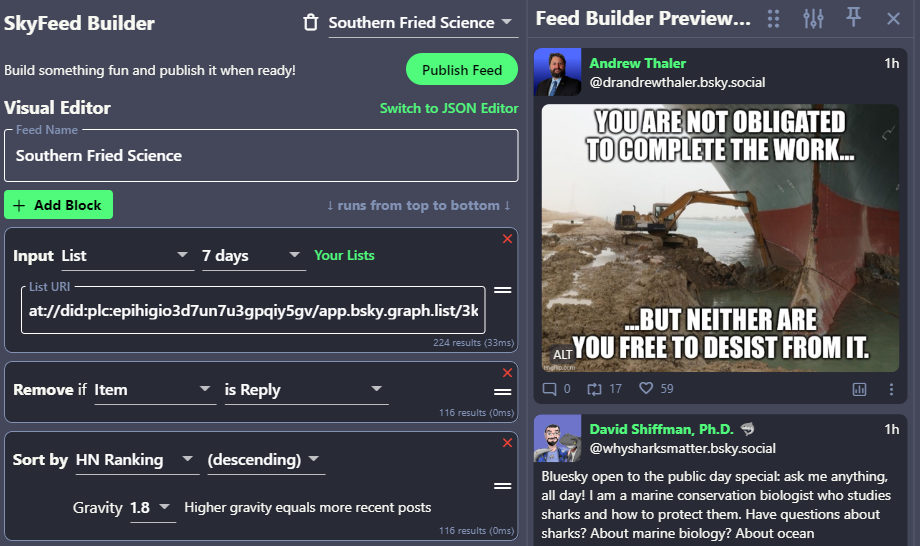
A quick and dirty guide to making custom feeds on Bluesky
So, you’ve made it! The remnants of science twitter have at last begun to coalesce around a new microblogging platformed owned by questionable individuals with inadequate content moderation t…
Scientists no Longer Find Twitter Professionally Useful, and have Switched to Bluesky
Synopsis. Social media has become widely used by the scientific community for a variety of professional uses, including networking and public outreach. For
Scientists no Longer Find Twitter Professionally Useful, and have Switched to Bluesky
Synopsis. Social media has become widely used by the scientific community for a variety of professional uses, including networking and public outreach. For
Nodiux - Unlock Bluesky Intelligence
Map conversations, spot key influencers, and visualize communities on Bluesky with one click.

Sensemaking Networks: Project Introduction - Cosmik Labs
Incorporating science social media into the scientific process
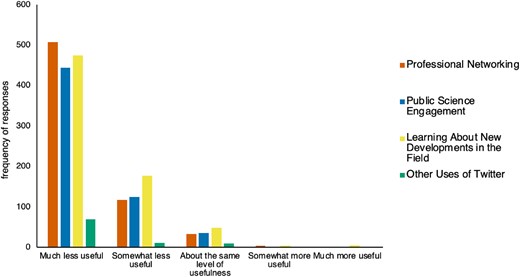
Scientists no Longer Find Twitter Professionally Useful, and have Switched to Bluesky
Synopsis Social media has become widely used by the scientific community for a variety of professional uses, including networking and public outreach. For the past decade, Twitter has been a primary home of scientists on social media. In recent years, new leadership at Twitter has made substantive changes that have resulted in increases in the prevalence of pseudoscience, conspiracy theory, and harassment on the platform, causing many scientists to seek alternatives. Bluesky has been suggested as a good alternative to Twitter, but the phenomenon of academics switching social media platforms has not previously been studied. Here we report on the results of a survey distributed to scientists on Twitter and Bluesky (n = 813). Results overwhelmingly confirm that changes to Twitter have made the social media platform no longer professionally useful or pleasant, and that many scientists have abandoned it in favor of Bluesky. Results show that for every reported professional benefit that scientists once gained from Twitter, scientists can now gain that benefit more effectively on Bluesky than on Twitter.
The Astrosky Ecosystem
We're building social media tools for the astronomy & space science communities. From feeds to hosting, we're billionaire-proofing scientific discussion for good.
Bluesky: An Open Social Web - Bluesky
We’re excited to announce that the Bluesky network is federating and opening up in a way that allows you to host your own data.

The Astrosky Ecosystem: An independent online platform for science communication and social networking
While almost everything that astronomers study occurs in the vacuum of space, astronomy itself does not `happen in a vacuum'. Interactions between scientists, as well as outreach to members of the public, improve extensively from access to good communication tools. Social media has become a key tool for communication in astronomy, being widely used by individuals and organizations alike for networking, outreach, and more. However, traditional social media is reliant on benevolent corporations providing a free service without compromising on quality, and the recent takeover and decline of Twitter has shown how vulnerable these platforms can be. In this proceeding, we present The Astrosky Ecosystem, which is an initiative to develop open-source tools and integrations for social media, principally the Bluesky social network. We explain how our project enables the astronomy community to operate its own social media infrastructure, independent of for-profit corporations. We also discuss some of the project's technical aspects, including its use of the AT Protocol for social networking, before concluding with ideas for the future.

1. My new preprint has its own bluesky account. Why? The problems facing social media & scientific publishing are similar: both are dominated by powerful oligopolies. The @atproto.com tech underlying bluesky that aims to solve the social media prob might also help solve the scientific pub prob 🧪 🧵

Menopause evolution preprint
1. Preprint: Menopause averted a midlife energetic crisis with help from older children and parents: A simulation study. zenodo.org/records/18149332 Menopause is rare, known to occur only in humans and toothed whales: 🧵
Frontiers In Research webinar on changes in science communication, the role of social media, and new infrastructure/tools - tomorrow (7/18) at 2 pm ET Looking forward to chatting with @ronentk.me & @joelchan86.bsky.social luma.com/7l18yyg4

Frontiers In Research: Open Science · Zoom · Luma
luma.com
