

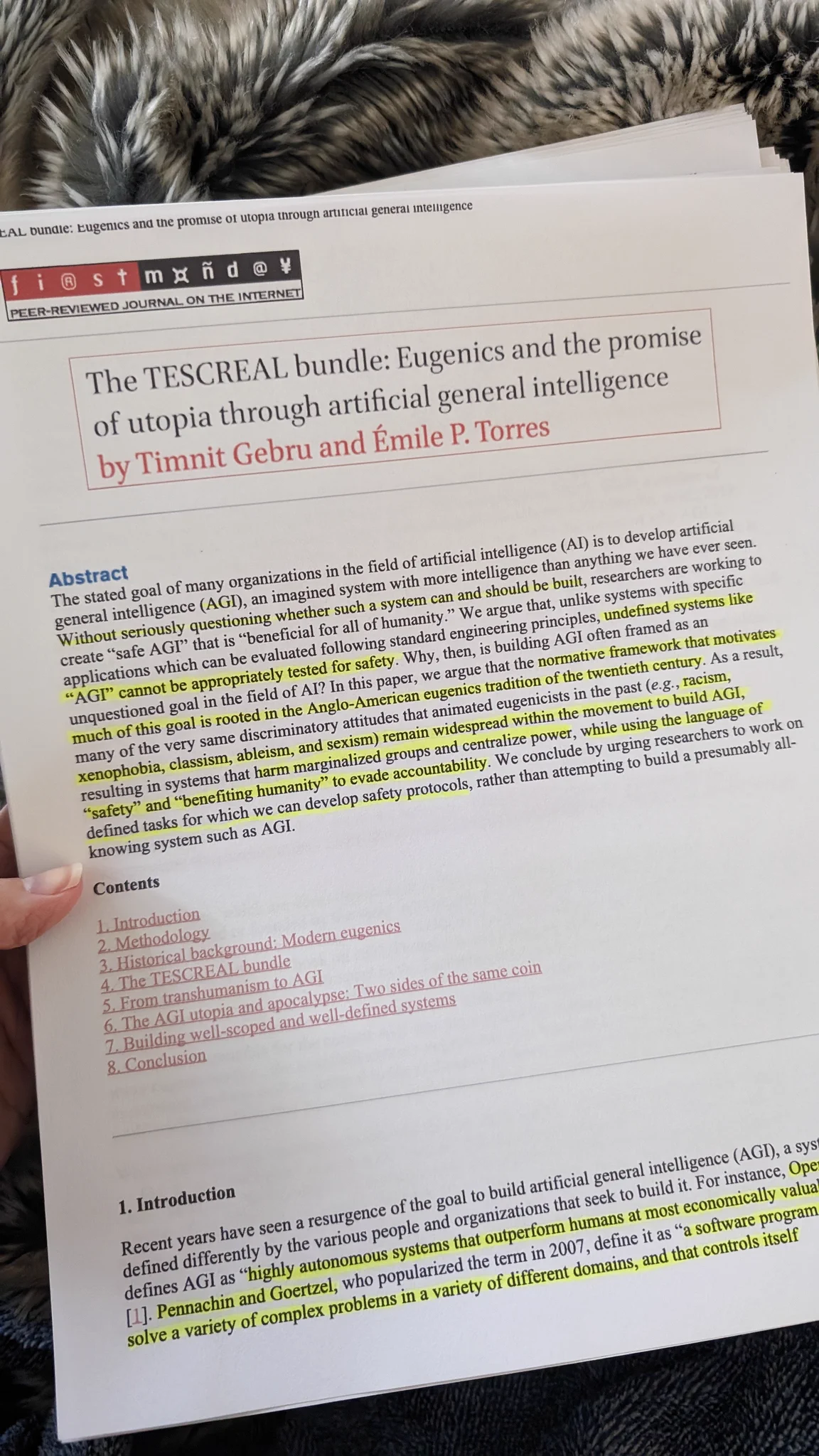
The stated goal of many organizations in the field of artificial intelligence (AI) is to develop artificial general intelligence (AGI), an imagined system with more intelligence than anything we have ever seen. Without seriously questioning whether such a system can and should be built, researchers are working to create “safe AGI” that is “beneficial for all of humanity.” We argue that, unlike systems with specific applications which can be evaluated following standard engineering principles, undefined systems like “AGI” cannot be appropriately tested for safety. Why, then, is building AGI often framed as an unquestioned goal in the field of AI? In this paper, we argue that the normative framework that motivates much of this goal is rooted in the Anglo-American eugenics tradition of the twentieth century. As a result, many of the very same discriminatory attitudes that animated eugenicists in the past (e.g., racism, xenophobia, classism, ableism, and sexism) remain widespread within the movement to build AGI, resulting in systems that harm marginalized groups and centralize power, while using the language of “safety” and “benefiting humanity” to evade accountability. We conclude by urging researchers to work on defined tasks for which we can develop safety protocols, rather than attempting to build a presumably all-knowing system such as AGI.
The TESCREAL bundle: Eugenics and the promise of utopia through artificial general intelligence
The stated goal of many organizations in the field of artificial intelligence (AI) is to develop artificial general intelligence (AGI), an imagined system with more intelligence than anything we have ever seen. Without seriously questioning whether such a system can and should be built, researchers are working to create “safe AGI” that is “beneficial for all of humanity.” We argue that, unlike systems with specific applications which can be evaluated following standard engineering principles, undefined systems like “AGI” cannot be appropriately tested for safety. Why, then, is building AGI often framed as an unquestioned goal in the field of AI? In this paper, we argue that the normative framework that motivates much of this goal is rooted in the Anglo-American eugenics tradition of the twentieth century. As a result, many of the very same discriminatory attitudes that animated eugenicists in the past (e.g., racism, xenophobia, classism, ableism, and sexism) remain widespread within the movement to build AGI, resulting in systems that harm marginalized groups and centralize power, while using the language of “safety” and “benefiting humanity” to evade accountability. We conclude by urging researchers to work on defined tasks for which we can develop safety protocols, rather than attempting to build a presumably all-knowing system such as AGI.
The New Artificial Intelligentsia | Los Angeles Review of Books
In the fifth essay of the Legacies of Eugenics series, Ruha Benjamin explores how AI evangelists wrap their self-interest in a cloak of humanistic concern.

The TESCREAL bundle: Eugenics and the promise of utopia through artificial general intelligence by Timnit Gebru (@timnitGebru) & Émile P. Torres (@xriskology) is a must read! 🧵The amount of second-wave eugenic rhetoric right under all of our noses via AGI + AI Hype framing i
The TESCREAL bundle: Eugenics and the promise of utopia through artificial general intelligence by Timnit Gebru (@timnitGebru) & Émile P. Torres (@xriskology) is a must read!🧵The amount of second-wave eugenic rhetoric right under all of our noses via AGI + AI Hype framing is… pic.twitter.com/h1QJiiiReX— Britney Muller (@BritneyMuller) April 22, 2024
Digital Eugenics and the Extinction of Humanity
If we are to combat the AI industry’s push to build digital gods, we have to understand the ideology of the antihumanist project, writes Dr. Émile P. Torres.

Safety Co-Option and Compromised National Security: The Self-Fulfilling Prophecy of Weakened AI Risk Thresholds
Risk thresholds provide a measure of the level of risk exposure that a society or individual is willing to withstand, ultimately shaping how we determine the safety of technological systems. Against the backdrop of the Cold War, the first risk analyses, such as those devised for nuclear systems, cemented societally accepted risk thresholds against which safety-critical and defense systems are now evaluated. But today, the appropriate risk tolerances for AI systems have yet to be agreed on by global governing efforts, despite the need for democratic deliberation regarding the acceptable levels of harm to human life. Absent such AI risk thresholds, AI technologists-primarily industry labs, as well as "AI safety" focused organizations-have instead advocated for risk tolerances skewed by a purported AI arms race and speculative "existential" risks, taking over the arbitration of risk determinations with life-or-death consequences, subverting democratic processes. In this paper, we demonstrate how such approaches have allowed AI technologists to engage in "safety revisionism," substituting traditional safety methods and terminology with ill-defined alternatives that vie for the accelerated adoption of military AI uses at the cost of lowered safety and security thresholds. We explore how the current trajectory for AI risk determination and evaluation for foundation model use within national security is poised for a race to the bottom, to the detriment of the US's national security interests. Safety-critical and defense systems must comply with assurance frameworks that are aligned with established risk thresholds, and foundation models are no exception. As such, development of evaluation frameworks for AI-based military systems must preserve the safety and security of US critical and defense infrastructure, and remain in alignment with international humanitarian law.

Does the AI Safety Movement Have It All Wrong?
The stupidity of AI
The long read: Artificial intelligence in its current form is based on the wholesale appropriation of existing culture, and the notion that it is actually intelligent could be actively dangerous

Effective Altruism Is Pushing a Dangerous Brand of ‘AI Safety’
This philosophy—supported by tech figures like Sam Bankman-Fried—fuels the AI research agenda, creating a harmful system in the name of saving humanity

Stop treating `AGI' as the north-star goal of AI research
The AI research community plays a vital role in shaping the scientific, engineering, and societal goals of AI research. In this position paper, we argue that focusing on the highly contested topic of `artificial general intelligence' (`AGI') undermines our ability to choose effective goals. We identify six key traps -- obstacles to productive goal setting -- that are aggravated by AGI discourse: Illusion of Consensus, Supercharging Bad Science, Presuming Value-Neutrality, Goal Lottery, Generality Debt, and Normalized Exclusion. To avoid these traps, we argue that the AI research community needs to (1) prioritize specificity in engineering and societal goals, (2) center pluralism about multiple worthwhile approaches to multiple valuable goals, and (3) foster innovation through greater inclusion of disciplines and communities. Therefore, the AI research community needs to stop treating `AGI' as the north-star goal of AI research.
Large AI models are cultural and social technologies
Implications draw on the history of transformative information systems from the past , Debates about artificial intelligence (AI) tend to revolve around whether large models are intelligent, autonomous agents. Some AI researchers and commentators speculate that we are on the cusp of creating agents with artificial general intelligence (AGI), a prospect anticipated with both elation and anxiety. There have also been extensive conversations about cultural and social consequences of large models, orbiting around two foci: immediate effects of these systems as they are currently used, and hypothetical futures when these systems turn into AGI agents—perhaps even superintelligent AGI agents. But this discourse about large models as intelligent agents is fundamentally misconceived. Combining ideas from social and behavioral sciences with computer science can help us to understand AI systems more accurately. Large models should not be viewed primarily as intelligent agents but as a new kind of cultural and social technology, allowing humans to take advantage of information other humans have accumulated.
Large AI models are cultural and social technologies
Implications draw on the history of transformative information systems from the past , Debates about artificial intelligence (AI) tend to revolve around whether large models are intelligent, autonomous agents. Some AI researchers and commentators speculate that we are on the cusp of creating agents with artificial general intelligence (AGI), a prospect anticipated with both elation and anxiety. There have also been extensive conversations about cultural and social consequences of large models, orbiting around two foci: immediate effects of these systems as they are currently used, and hypothetical futures when these systems turn into AGI agents—perhaps even superintelligent AGI agents. But this discourse about large models as intelligent agents is fundamentally misconceived. Combining ideas from social and behavioral sciences with computer science can help us to understand AI systems more accurately. Large models should not be viewed primarily as intelligent agents but as a new kind of cultural and social technology, allowing humans to take advantage of information other humans have accumulated.

Large AI models are cultural and social technologies
Implications draw on the history of transformative information systems from the past , Debates about artificial intelligence (AI) tend to revolve around whether large models are intelligent, autonomous agents. Some AI researchers and commentators speculate that we are on the cusp of creating agents with artificial general intelligence (AGI), a prospect anticipated with both elation and anxiety. There have also been extensive conversations about cultural and social consequences of large models, orbiting around two foci: immediate effects of these systems as they are currently used, and hypothetical futures when these systems turn into AGI agents—perhaps even superintelligent AGI agents. But this discourse about large models as intelligent agents is fundamentally misconceived. Combining ideas from social and behavioral sciences with computer science can help us to understand AI systems more accurately. Large models should not be viewed primarily as intelligent agents but as a new kind of cultural and social technology, allowing humans to take advantage of information other humans have accumulated.
Resisting AI
Resisting AI - An Anti-fascist Approach to Artificial Intelligence; Artificial Intelligence (AI) is everywhere, yet it causes damage to society in ways that can’t be fixed. Calling for the restructuring of AI, Dan McQuillan sets out an anti-fascist approach that replaces exclusions with caring and outlines new mechanisms that support collective freedom.

The AI We Deserve
Critiques of artificial intelligence abound. Where’s the utopian vision for what it could be?

Rescuing Democracy From The Quiet Rule Of AI
Our gravest AI risk isn’t runaway superintelligence but our cultural readiness to surrender collective judgment to algorithmic systems.

From AGI to ASI
Over the last decade, building human-level artificial general intelligence has moved from far-fetched speculation to being a concrete next-decade target for many of the largest AI organisations. Achieving this goal would have profound and far-reaching impacts on human society, which raises many complex questions for the decade ahead. This report investigates how AI itself might continue to develop in a post-AGI world along the continuum of machine intelligence. The endpoint of this continuum, Universal AI, is theoretically well understood, which provides some formal grounding for the main focus of this report: the transition from human-level AGI to artificial general superintelligence, which, intuitively, can be understood as a system that is more intelligent and cognitively capable than large organisations of humans. After characterizing ASI, the report discusses four potential pathways from AGI to ASI: scaling AGI, AI paradigm shifts, recursive improvement, and ASI emerging from large-scale multi-agent collectives. The report then discusses possible frictions and bottlenecks along these pathways. Determining whether the impact of these frictions will be negligible or substantial raises a number of concrete open research questions. Due to large uncertainties for predicting ASI progress, it cannot be ruled out that AI progress might continue to accelerate over the next years. This could imply that the image of a single transformative step change, caused by the introduction of human-level AGI into our society, could be inaccurate. More apt might be the prospect of a series of transformative societal changes caused by AI-enabled progress and breakthroughs across many areas of science and technology. Preparing for this prospect requires a massively interdisciplinary endeavour of global scope and interest.