

Language matters. How we describe “AI” technology influences how it is perceived, deployed, and trusted. Extravagant and persuasive language incites hype. It is the responsibility of journalists, companies, and scholars to characterize technology in ways that inform and empower their readers by using appropriate terminology and avoiding inflated claims. One type of inflated claim comes from using anthropomorphizing language to describe system functionality. Anthropomorphization is the attribution of human capabilities and characteristics to the inanimate system. In this paper, we present a linguistic analysis of anthropomorphizing language in 29 texts (a total of 1,368 sentences) from academic articles, online news articles, and company blog posts. We construct a taxonomy of eight categories of anthropomorphization: Cognizer, Products of cognition, Emotion, Communication, Agent, Human role analogy, Names and pronouns, and Biological metaphors. Following this taxonomy we present concrete strategies for how to de-anthropomorphize the language we use to describe “AI” based on a functionality-first principle.
Mirages: On Anthropomorphism in Dialogue Systems
Automated dialogue or conversational systems are anthropomorphised by developers and personified by users. While a degree of anthropomorphism may be inevitable due to the choice of medium, conscious and unconscious design choices can guide users to personify such systems to varying degrees. Encouraging users to relate to automated systems as if they were human can lead to high risk scenarios caused by over-reliance on their outputs. As a result, natural language processing researchers have investigated the factors that induce personification and develop resources to mitigate such effects. However, these efforts are fragmented, and many aspects of anthropomorphism have yet to be explored. In this paper, we discuss the linguistic factors that contribute to the anthropomorphism of dialogue systems and the harms that can arise, including reinforcing gender stereotypes and notions of acceptable language. We recommend that future efforts towards developing dialogue systems take particular care in their design, development, release, and description; and attend to the many linguistic cues that can elicit personification by users.

Anthropomorphism Is Breaking Our Ability to Judge AI
Tech Policy Press fellow James Ball asks, how should we interact with a technology designed to ‘speak’ with us on what appear to be human terms?
SlopShape: Identifying AI-Generated Commercial Web Content
Word-level detectors identify unedited AI-generated text almost perfectly, but the literature documents their brittleness under rewording, and a word-level score neither characterizes a text nor identifies which AI model wrote it. We ask whether AI-generated text can be identified one level deeper, from structural signatures: how information is presented, in what order, with what evidence, and in what voice. We replicate StoryScope (Russell et al., 2026), which showed such patterns for AI-generated fiction, on commercial content: 2,250 pre-ChatGPT human blog posts from 268 company domains against 11,250 AI mirrors from five frontier models. A 203-feature instrument, applied by an LLM and validated in a human gold-annotation session (human-human kappa 0.939, human-model 0.951), detects AI posts from its 176 structural features alone at 97.0 macro-F1 on held-out companies, nearly unchanged (96.1) when every AI post is reworded by its own model. The signal characterizes and attributes: AI posts share a tidy, self-announcing shape, 68.6% are attributed to the correct source against a 16.7% chance rate, and human posts occupy rare structural configurations. All effects replicate StoryScope's, consistent in direction and at least as large in magnitude. We release pipeline, instrument, prompts, code, and aggregate artifacts.
Anthropomorphism in AI: hype and fallacy
This essay focuses on anthropomorphism as both a form of hype and fallacy. As a form of hype, anthropomorphism is shown to exaggerate AI capabilities and performance by attributing human-like traits to systems that do not possess them. As a fallacy, anthropomorphism is shown to distort moral judgments about AI, such as those concerning its moral character and status, as well as judgments of responsibility and trust. By focusing on these two dimensions of anthropomorphism in AI, the essay highlights negative ethical consequences of the phenomenon in this field.

Anthropomorphism in AI: hype and fallacy
This essay focuses on anthropomorphism as both a form of hype and fallacy. As a form of hype, anthropomorphism is shown to exaggerate AI capabilities and performance by attributing human-like traits to systems that do not possess them. As a fallacy, anthropomorphism is shown to distort moral judgments about AI, such as those concerning its moral character and status, as well as judgments of responsibility and trust. By focusing on these two dimensions of anthropomorphism in AI, the essay highlights negative ethical consequences of the phenomenon in this field.
Don't treat surface-level metaphors about AI as if they describe fundamental reality
Debates about whether AI is a “tool” or whether it’s wrong to “anthropomorphize” it often seem confused about what reality is made of

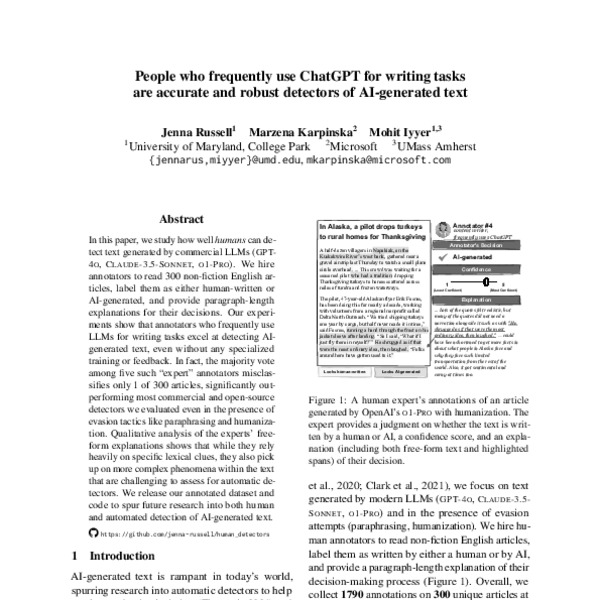
People who frequently use ChatGPT for writing tasks are accurate and robust detectors of AI-generated text
In this paper, we study how well humans can detect text generated by commercial LLMs (GPT-4o, Claude, o1). We hire annotators to read 300 non-fiction English articles, label them as either human-written or AI-generated, and provide paragraph-length explanations for their decisions. Our experiments show that annotators who frequently use LLMs for writing tasks excel at detecting AI-generated text, even without any specialized training or feedback. In fact, the majority vote among five such “expert” annotators misclassifies only 1 of 300 articles, significantly outperforming most commercial and open-source detectors we evaluated even in the presence of evasion tactics like paraphrasing and humanization. Qualitative analysis of the experts' free-form explanations shows that while they rely heavily on specific lexical clues (`AI vocabulary'), they also pick up on more complex phenomena within the text (e.g., formality, originality, clarity) that are challenging to assess for automatic detectors. We release our annotated dataset and code to spur future research into both human and automated detection of AI-generated text.
People who frequently use ChatGPT for writing tasks are accurate and robust detectors of AI-generated text
In this paper, we study how well humans can detect text generated by commercial LLMs (GPT-4o, Claude, o1). We hire annotators to read 300 non-fiction English articles, label them as either human-written or AI-generated, and provide paragraph-length explanations for their decisions. Our experiments show that annotators who frequently use LLMs for writing tasks excel at detecting AI-generated text, even without any specialized training or feedback. In fact, the majority vote among five such “expert” annotators misclassifies only 1 of 300 articles, significantly outperforming most commercial and open-source detectors we evaluated even in the presence of evasion tactics like paraphrasing and humanization. Qualitative analysis of the experts' free-form explanations shows that while they rely heavily on specific lexical clues (`AI vocabulary'), they also pick up on more complex phenomena within the text (e.g., formality, originality, clarity) that are challenging to assess for automatic detectors. We release our annotated dataset and code to spur future research into both human and automated detection of AI-generated text.
Anthropomorphism in AI Companion Communities: Age, Gender, and Emotional Correlates
Artificial intelligence (AI) systems are increasingly integrated into daily life, with millions now using AI chatbots built on Large Language Models (LLMs) for companionship. Both humanlike AI qualities and user predispositions to anthropomorphize relate to social consequences, such as increased trust, social health benefits, and psychological harms. Populations such as children, older adults, or those with mental health vulnerabilities may be particularly susceptible to anthropomorphism and its detriments, but mixed findings complicate the role of demographics. We used publicly available Reddit data from three popular AI companion subreddits to assess relationships between gender, age, anthropomorphism, and elicited emotions, to better understand how different people perceive and are affected by AI companions. We investigated three questions: How do age and gender relate to anthropomorphization of AI?, How does emotional expression relate to anthropomorphization?, and How do age and gender moderate emotion-anthropomorphization relationships? We found that adults and women anthropomorphize AI chatbots more than teens and men, and that positive emotional expression, particularly joy, is positively associated with anthropomorphization, while neutrality is negatively associated with anthropomorphism. Both relationships were stronger in adults than teens. Our findings suggest that the tendency to anthropomorphize may be more broadly distributed across age groups than previously expected, thereby prompting the reevaluation of existing digital safety norms.
Position: Stop Anthropomorphizing Intermediate Tokens as Reasoning/Thinking Traces!
Intermediate token generation (ITG), where a model produces output before the solution, has become a standard method to improve the performance of language models on reasoning tasks. These intermediate tokens have been called \say{reasoning traces} or even \say{thinking traces} -- implicitly anthropomorphizing the traces, and implying that these traces resemble steps a human might take when solving a challenging problem, and as such can provide an interpretable window into the operation of the model's thinking process to the end user. In this position paper, we present evidence that this anthropomorphization isn't a harmless metaphor, and instead is quite dangerous -- it confuses the nature of these models and how to use them effectively, and leads to questionable research. We call on the community to avoid such anthropomorphization of intermediate tokens.
Sense-making reconsidered: large language models and the blind spot of embodied cognition
Large Language Models (LLMs) demonstrate a kind of linguistic competence that theories of embodied and enactive cognition have long deemed impossible for systems lacking the meaningful perspective of a living being, i.e., the capacity for sense-making. Facing up to this unexpected technological development requires confronting what I propose to call the “AI dilemma”: either frontier LLMs are capable of sense-making despite lacking biological embodiment, or the kind of linguistic competence they exhibit does not necessarily require sense-making. In their chapter on cognition, Frank, Thompson, and Gleiser (2024) maintain that no AI system comes close to realizing relevance, a position that derives much of its motivation from past practical failures. However, frontier LLMs have effectively overcome Dreyfus’ commonsense knowledge problem, such that their dismissal as categorically mindless risks undermining Frank et al.’s central claim that human cognition is deeply intertwined with lived experience. I therefore argue in favor of the alternative side of the AI dilemma: human-level linguistic competence of LLMs should be recognized as a novel non‑biological form of sense‑making, based on a technologically‑mediated embodiment whose enabling properties are in need of further theoretical analysis. This reorientation invites enactive theory to clarify which aspects of sense-making may be universal and which aspects are specifically contingent on organic life, thereby advancing its conceptual framework in dialogue with contemporary AI.

Just Asking Questions: Doing Our Own Research on Conspiratorial Ideation by Generative AI Chatbots
Interactive chat systems that build on artificial intelligence frameworks are increasingly ubiquitous and embedded into search engines, Web browsers, and operating systems, or are available on websites and apps. Researcher efforts have sought to understand the limitations and potential for harm of generative AI, which we contribute to here. Conducting a systematic review of six AI-powered chat systems (ChatGPT 3.5; ChatGPT 4 Mini; Microsoft Copilot in Bing; Google Search AI; Perplexity; and Grok in Twitter/X), this study examines how these leading products respond to questions related to conspiracy theories. This follows the platform policy implementation audit approach established by Glazunova et al. (2023). We select five well-known and comprehensively debunked conspiracy theories and four emerging conspiracy theories that relate to breaking news events at the time of data collection. Our findings demonstrate that the extent of safety guardrails against conspiratorial ideation in generative AI chatbots differs markedly, depending on chatbot model and conspiracy theory. Our observations indicate that safety guardrails in AI chatbots are often very selectively designed: generative AI companies appear to focus especially on ensuring that their products are not seen to be racist; they also appear to pay particular attention to conspiracy theories that address topics of substantial national trauma such as 9/11 or relate to well-established political issues. Future work should include an ongoing effort extended to further platforms, multiple languages, and a range of conspiracy theories extending well beyond the United States.
