

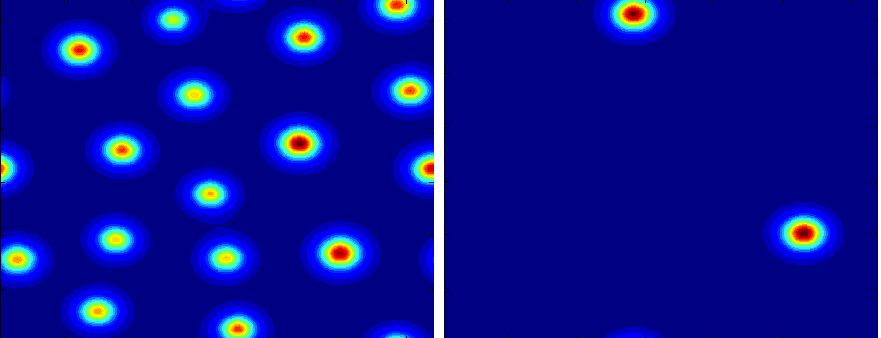
In the latest SIAM Journal on Applied Mathematics, Chaturapruek, et al. describe modeling criminal movements based on where potential criminals live and areas of interest. Data available on distanc…
Artificial Intelligence, Predictive Policing, and Risk Assessment for Law Enforcement
There are widespread concerns about the use of artificial intelligence in law enforcement. Predictive policing and risk assessment are salient examples. Worries include the accuracy of forecasts that guide both activities, the prospect of bias, and an apparent lack of operational transparency. Nearly breathless media coverage of artificial intelligence helps shape the narrative. In this review, we address these issues by first unpacking depictions of artificial intelligence. Its use in predictive policing to forecast crimes in time and space is largely an exercise in spatial statistics that in principle can make policing more effective and more surgical. Its use in criminal justice risk assessment to forecast who will commit crimes is largely an exercise in adaptive, nonparametric regression. It can in principle allow law enforcement agencies to better provide for public safety with the least restrictive means necessary, which can mean far less use of incarceration. None of this is mysterious. Nevertheless, concerns about accuracy, fairness, and transparency are real, and there are tradeoffs between them for which there can be no technical fix. You can't have it all. Solutions will be found through political and legislative processes achieving an acceptable balance between competing priorities.
Predictive Policing Explained
Attempts to forecast crime with algorithmic techniques could reinforce existing racial biases in the criminal justice system.

Predictive Policing and the Politics of Patterns
Abstract Patterns are the epistemological core of predictive policing. With the move towards digital prediction tools, the authority of the pattern is rearticulated and reinforced in police work. Based on empirical research about predictive policing software and practices, this article puts the authority of patterns into perspective. Introducing four ideal-typical styles of pattern identification, we illustrate that patterns are not based on a singular logic, but on varying rationalities that give form to and formalize different understandings about crime. Yet, patterns render such different modes of reasoning about crime, and the way in which they feed back into policing cultures, opaque. Ultimately, this invites a stronger reflection about the political nature of patterns.

Crime Prediction Software Promised to Be Free of Biases. New Data Shows It Perpetuates Them
Millions of crime predictions left on an unsecured server show PredPol mostly avoided Whiter neighborhoods, targeted Black and Latino neighborhoods.

Predictive Policing and the Politics of Patterns
Abstract. Patterns are the epistemological core of predictive policing. With the move towards digital prediction tools, the authority of the pattern is rea
The Mapping Police Violence organization just released a new data platform documenting over 1,000,000 cases of police use of force nationwide across 58% of the U.S. This is the largest public database of its kind, explore the data at https://t.co/CZMUJNhZ5S. Here’s what the
The Mapping Police Violence organization just released a new data platform documenting over 1,000,000 cases of police use of force nationwide across 58% of the U.S. This is the largest public database of its kind, explore the data at https://t.co/a2XBv1ANOv. Here’s what the data…— Samuel Sinyangwe (@samswey) August 28, 2024
When police pull back: Neighborhood‐level effects of de‐policing on violent and property crime, a research note
Abstract Many U.S. cities witnessed both de‐policing and increased crime in 2020, yet whether the former contributed to the latter remains unclear. Indeed, much of what is known about the effects of proactive policing on crime comes from studies that evaluated highly focused interventions atypical of day‐to‐day policing, used cities as the unit of analysis, or could not rule out endogeneity. This study addresses each of these issues, thereby advancing the evidence base concerning the effects of policing on crime. Leveraging two exogenous shocks presented by the onset of the coronavirus 2019 (COVID‐19) pandemic and social unrest after the murder of George Floyd, we evaluated the effects of sudden and sustained reductions in high‐discretion policing on crime at the neighborhood level in Denver, Colorado. Multilevel models accounting for trends in prior police activity, neighborhood structure, seasonality, and population mobility revealed mixed results. On the one hand, large‐scale reductions in stops and drug‐related arrests were associated with significant increases in violent and property crimes, respectively. On the other hand, fewer disorder arrests did not affect crime. These results were not universal across neighborhoods. We discuss the implications of these findings in light of debates concerning the appropriate role of policing in the 21st century.

Machine Bias — ProPublica
There’s software used across the country to predict future criminals. And it’s biased against blacks.

Criminal Justice Fact Sheet
A compilation of facts and figures surrounding policing, the criminal justice system, incarceration, and more.

Federal Immigration Agent Shootings
An aggregated dataset of shootings by agents of Immigration and Customs Enforcement and Customs and Border Protection.

Does Predictive Policing Lead to Biased Arrests? Results From a Randomized Controlled Trial
Racial bias in predictive policing algorithms has been the focus of a number of recent news articles, statements of concern by several national organizations (e.g., the ACLU and NAACP), and simulat...
Does Predictive Policing Lead to Biased Arrests? Results From a Randomized Controlled Trial
Racial bias in predictive policing algorithms has been the focus of a number of recent news articles, statements of concern by several national organizations (e.g., the ACLU and NAACP), and simulat...
Police across the US are training crime-predicting AIs on falsified data
A new report shows how supposedly objective systems can perpetuate corrupt policing practices.

Journalists and Researchers: How to Examine FBI Crime Data for Your Community
Here’s what to know about NIBRS, the FBI’s program for collecting police data from 15,000 agencies across the U.S.
Immigration Enforcement in Los Angeles Under the Second Trump Administration – Deportation Data Project
We rely on our online visual tools to create this report, which means that you can click on any one of the figures and adjust time periods, breakouts, and other aspects to dig into the data in more detail. You can also swap out the Los Angeles ICE area of responsibility for another region to reproduce these figures for your own area of interest.