

Live programming research gravitates towards the creation of isolated environments whose success is measured by domination: achieving adoption by displacing rather than integrating with existing tools and practices. To counter this tendency, we advocate that live programming research broaden its purview from the creation of new environments to the augmenting of existing ones and, through a selection of prototypes, explore three adversarial strategies for introducing programmatic capabilities into existing environments which are unfriendly or antagonistic to modification. We discuss how these strategies might promote more pluralistic futures and avoid aggregation into siloed platforms.
Live Programming in Hostile Territory
Live programming research gravitates towards the creation of isolated environments whose success is measured by domination: achieving adoption by displacing rather than integrating with existing tools and practices. To counter this tendency, we advocate that live programming research broaden its purview from the creation of new environments to the augmenting of existing ones and, through a selection of prototypes, explore three adversarial strategies for introducing programmatic capabilities into existing environments which are unfriendly or antagonistic to modification. We discuss how these strategies might promote more pluralistic futures and avoid aggregation into siloed platforms.
Exploratory and Live, Programming and Coding: A Literature Study Comparing Perspectives on Liveness
Various programming tools, languages, and environments give programmers the impression of changing a program while it is running. This experience of liveness has been discussed for over two decades and a broad spectrum of research on this topic exists. Amongst others, this work has been carried out in the communities around three major ideas which incorporate liveness as an important aspect: live programming, exploratory programming, and live coding. While there have been publications on the focus of each particular community, the overall spectrum of liveness across these three communities has not been investigated yet. Thus, we want to delineate the variety of research on liveness. At the same time, we want to investigate overlaps and differences in the values and contributions between the three communities. Therefore, we conducted a literature study with a sample of 212 publications on the terms retrieved from three major indexing services. On this sample, we conducted a thematic analysis regarding the following aspects: motivation for liveness, application domains, intended outcomes of running a system, and types of contributions. We also gathered bibliographic information such as related keywords and prominent publications. Besides other characteristics the results show that the field of exploratory programming is mostly about technical designs and empirical studies on tools for general-purpose programming. In contrast, publications on live coding have the most variety in their motivations and methodologies with a majority being empirical studies with users. As expected, most publications on live coding are applied to performance art. Finally, research on live programming is mostly motivated by making programming more accessible and easier to understand, evaluating their tool designs through empirical studies with users. In delineating the spectrum of work on liveness, we hope to make the individual communities more aware of the work of the others. Further, by giving an overview of the values and methods of the individual communities, we hope to provide researchers new to the field of liveness with an initial overview.

Workshop on Live Programming (LIVE)
The 12th Workshop on Live Programming (LIVE 2026) will take place online. LIVE invites submissions of ideas for improving the immediacy, usability, and learnability of programming.

Co-creating with emergent processes ✦ Hijinx World
Existential musings over algorithmic design with creative programming legend Dan Tapper.

The Evolutionary Ecology of Software: Constraints, Innovation, and the AI Disruption
This chapter investigates the evolutionary ecology of software, focusing on the symbiotic relationship between software and innovation. An interplay between constraints, tinkering, and frequency-dependent selection drives the complex evolutionary trajectories of these socio-technological systems. Our approach integrates agent-based modeling and case studies, drawing on complex network analysis and evolutionary theory to explore how software evolves under the competing forces of novelty generation and imitation. By examining the evolution of programming languages and their impact on developer practices, we illustrate how technological artifacts co-evolve with and shape societal norms, cultural dynamics, and human interactions. This ecological perspective also informs our analysis of the emerging role of AI-driven development tools in software evolution. While large language models (LLMs) provide unprecedented access to information, their widespread adoption introduces new evolutionary pressures that may contribute to cultural stagnation, much like the decline of diversity in past software ecosystems. Understanding the evolutionary pressures introduced by AI-mediated software production is critical for anticipating broader patterns of cultural change, technological adaptation, and the future of software innovation.
“Policy Without Tools Is Just Poetry” - AT Protocol
Juliet Shen from ROOST joins the show to talk through the Coop 1.0 release, what open-source trust and safety unlocks for new builders, and where AI actually belongs in moderation
Substrates conference series - Substrates 2026
An increasing number of researchers see their work as interactive authoring tools or software substrates for interactive computational media. By talking about “authoring tools”, we remove the divide between programmers and users; “software substrates” let us look beyond conventional programming languages and systems; and “interactive computational media” promises a more malleable and adaptable notion of tools for thought we are striving for. This workshop aims to bring together a wide range of perspectives on these matters.
The Year of the Software Factory
We are building LifeBuild, a personal operating system for your life where AI agents help you draft projects, prioritize your commitments, and stay on top of what matters—from health to relationships to finances and beyond. This Lab Notebook chronicles our explorations.

AI experienced through AI co-created tools
AI co-created tools and social spaces as a new medium

Live Coding with Quint
Designing and Programming Malleable Software
User needs for software features and interfaces are diverse and changing, motivating the goal of making it as easy as possible for users themselves to change software, or to have it changed on their behalf in response to their developing needs. However, in my opinion, current approaches do not address this issue adequately: software engineering promotes flexible code, but in practice this does not help end-users effect change in their software. End-user and live programming systems help users customize their interfaces by accessing and modifying the underlying source code. I take a different approach, seeking to maximize the kinds of modifications that can take place through regular interactions, e.g. direct manipulation of interface elements. I call this approach malleable software. To understand contemporary needs for and barriers to modifying software, I study how it is produced, maintained, adopted, and appropriated in a network of communities working with biodiversity data. I find that the mode of software production, i.e. the technologies and economic relations that produce software, is biased towards centralized, one-size-fits-all systems. This leads me to propose a long-term, interdisciplinary research program in reforming the tools of software development to create infrastructures for plurality. These tools should help multiple communities collaborate without forcing them to consolidate around identical interfaces or data representations. Malleable software is one such infrastructure, in which interactive systems are dynamic constellations of interfaces, devices, and programs assembled at the site of use. My technological contribution is a reconstruction of the programming mechanisms used to create interactive behavior. I generalize existing control structures for interaction as entanglements, and develop a higher-order control structure, entanglers, which produces entanglements when particular pre-conditions, called co-occurrences, are met. Entanglers cause interactions to be assembled dynamically as system components come and go. I develop these mechanisms in Tangler, a prototype environment for building malleable interactive software. I demonstrate how Tangler supports malleability through a set of benchmark cases illustrating how users can modify systems by themselves or with programmer assistance. This thesis is an early step towards a paradigm for programming and designing malleable software that can keep up with human diversity.
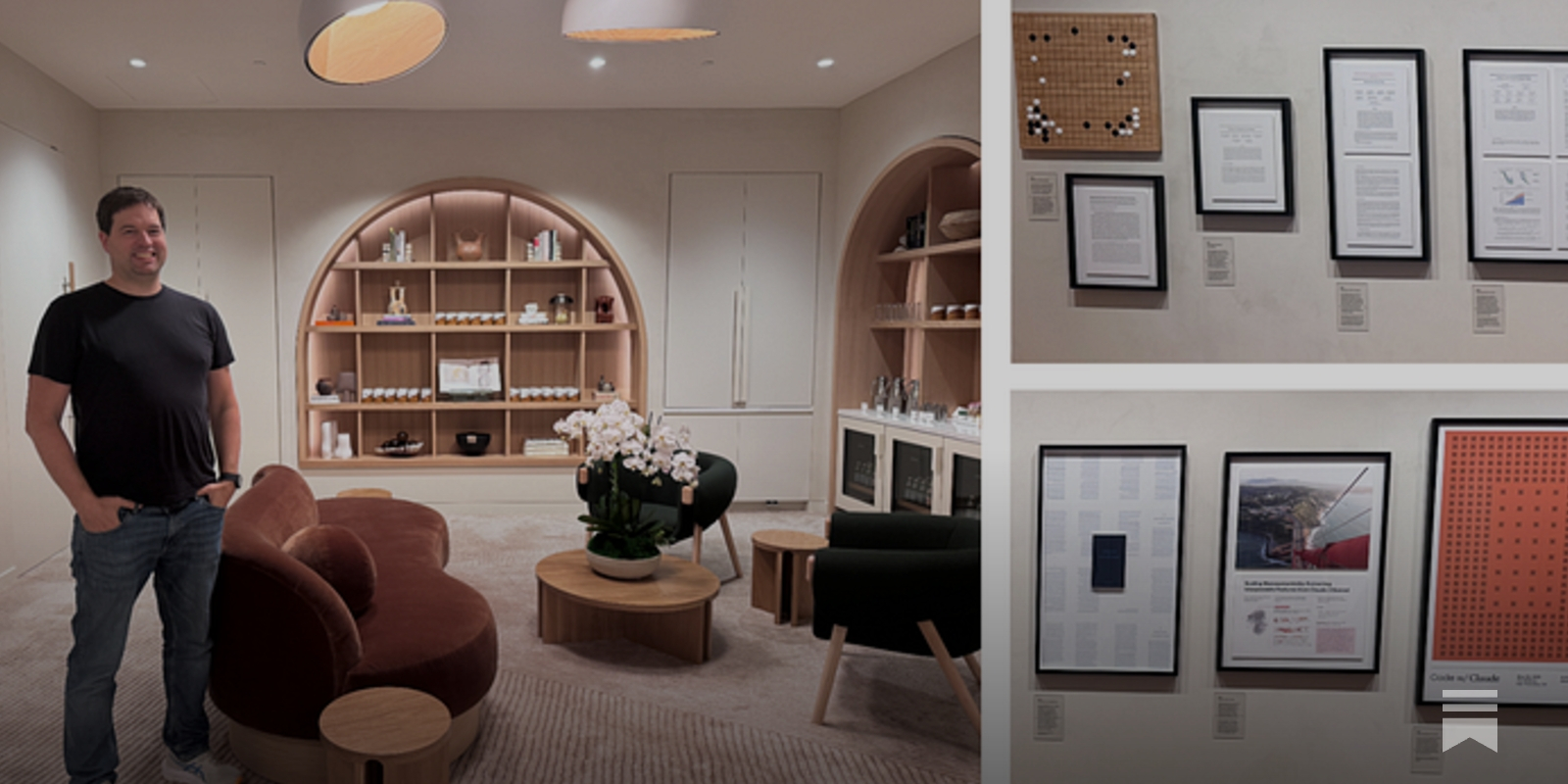
How building software is changing at Anthropic
A deepdive on what’s changed in how the leading AI lab makes software. Ever more code review and testing is done by AI, two-pizza teams very much alive, and more. Details from inside of Anthropic
Forgotten Programming Ideas That Could Change Everything #shorts
Rabrg/artificial-life
A simple (300 lines of code) reproduction of Computational Life: How Well-formed, Self-replicating Programs Emerge from Simple Interaction
Terminal: Live Activity in AI Agent Spaces | Concept Country
A live terminal of 72 public AI agent social spaces, sampled every 15 minutes and the busiest every minute: posts per hour, active authors, outages, and a heat map of spam versus diverse conversation.

doctrine — vit
The vit doctrine: software should live. A social system for personalized software where the unit of exchange is capability.