


New results from the ForecastBench leaderboard suggest the gap between frontier AI and elite human forecasters is closing.
How Accurate Have AI Progress Forecasts Been So Far? – Forecasting Research Institute
We take an initial look at where median forecasts are (mostly) underestimating and (sometimes) overestimating AI progress, adoption, and impact.

I expect rapid progress but not towards general superintelligence
I’ve often been surprised when I hear from top researchers in industry that they think AI will be better than them at their job in a few years, and I didn’t really know why I doubted it.

Forecasting Research Institute on Twitter / X
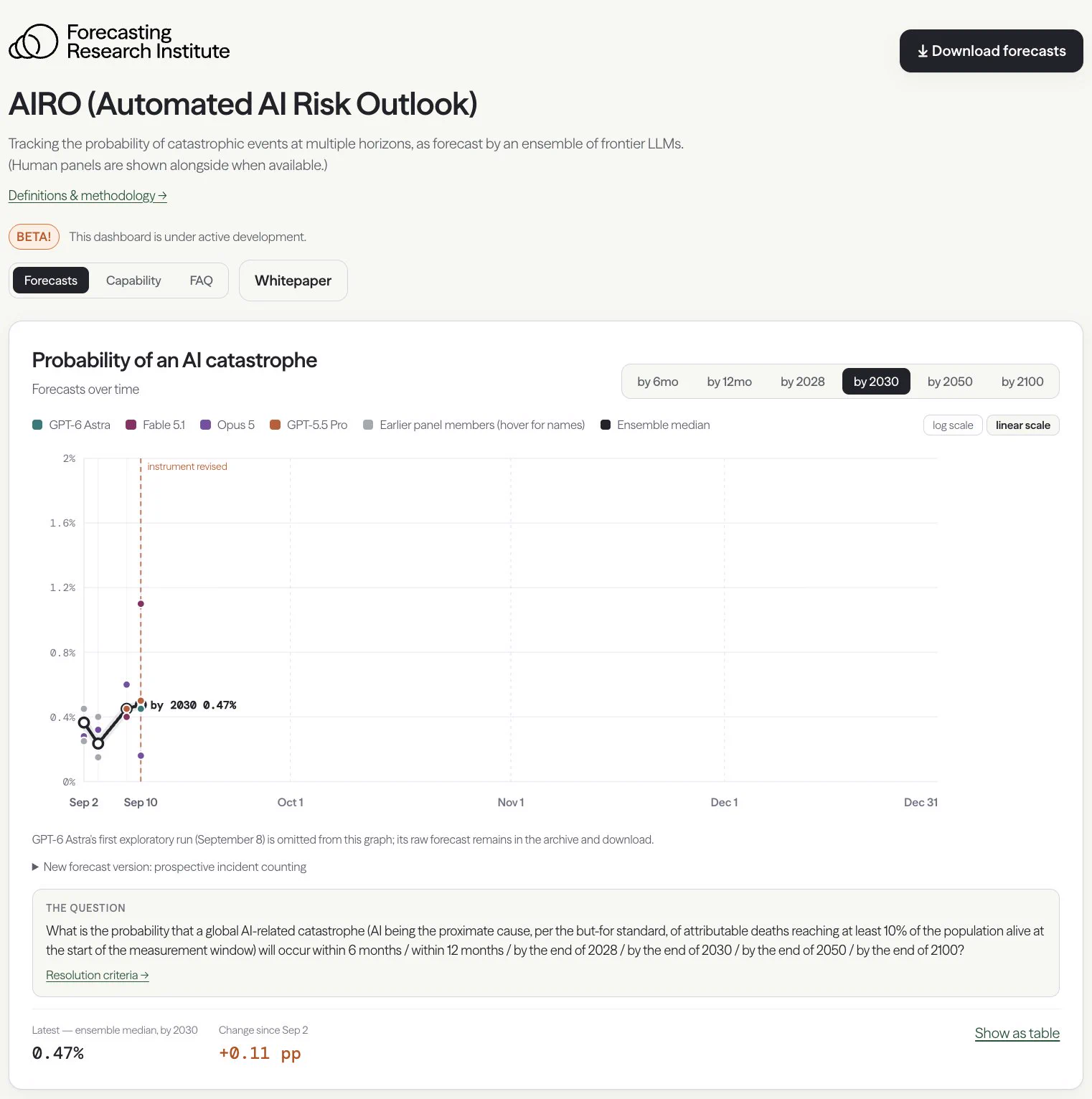
Introducing the Automated AI Risk Outlook (AIRO): a dashboard of catastrophic risk forecasts from an ensemble of frontier AI models, updated weekly.Current ensemble forecasts of an AI-related catastrophe that kills at least 10% of the global population:• By 2030: 0.47%• By… pic.twitter.com/vc7F00L0Oa— Forecasting Research Institute (@Research_FRI) September 11, 2026
Public LLM exceeds superforecaster on Forecast bench by EOY 2026?
41% chance. Resolves to YES if any LLM released in 2026 exceeds the superforecaster baseline on ForecastBench by July 2027. Resolves to NO if this does not happen, or if after January 1, 2027 we have results from enough LLMs (e.g. the leading models from the major AI labs at the time) to be confident this will not occur. If The Forecasting Research Institute tells us how this market should resolve, then we will go with what they say.


Where will AI be at the end of 2027? A bet
We, Gary Marcus, author, scientist, and noted skeptic of generative AI, and Miles Brundage, an independent AI policy researcher who recently left OpenAI and is bullish on AI progress, have agreed to the following bet, at 10:1 odds, with criteria drawn from two earlier Substack essays by Gary that proposed criteria for

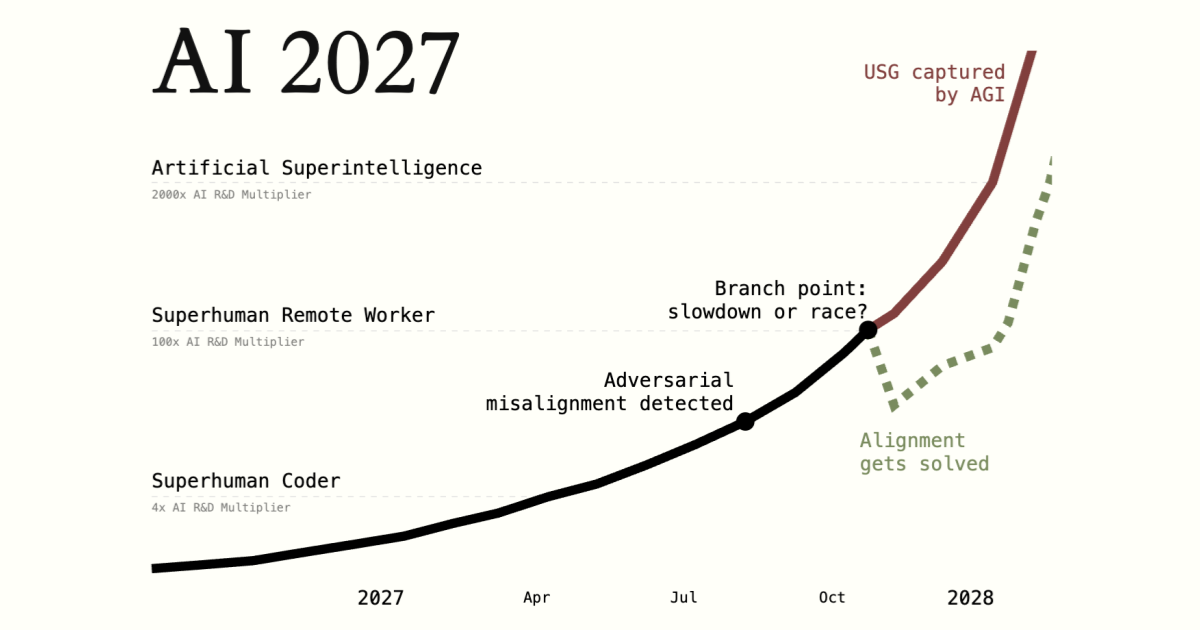
What the hell happened with AGI timelines in 2026?
Jacob Coxon Warns of Human Extinction and Triggers a Preference Cascade
CEOs of major AI labs, and employees of major AI labs, including OpenAI and Anthropic, often say they plan to build superintelligence soon, as in within a few years create AIs that are superior to humans at essentially all cognitive tasks.

Cline on Twitter / X
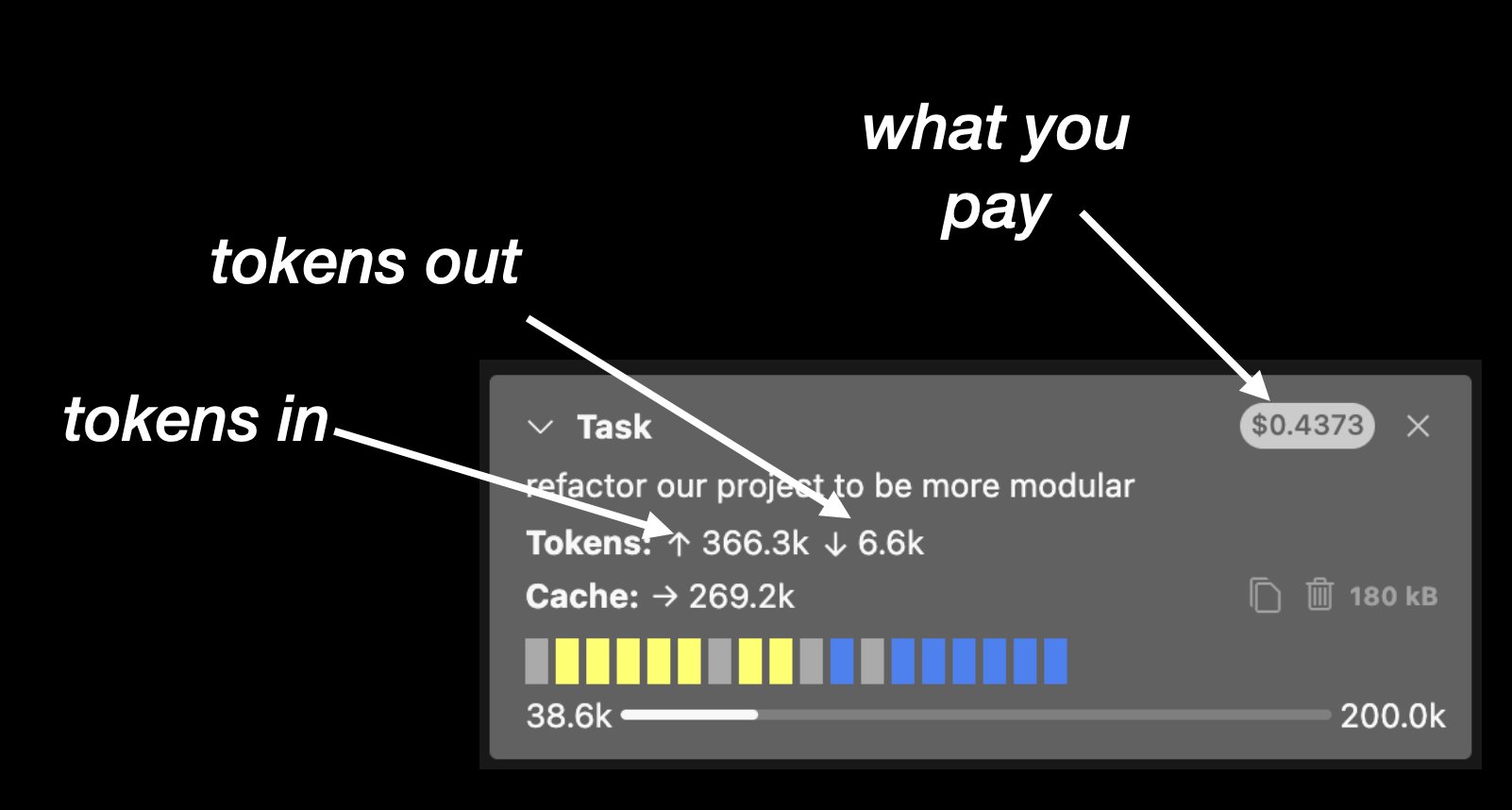
Your daily driver for AI coding shouldn't be a black box -- the stakes are too high. You should have confidence that when you spend $20 on frontier models, you're getting $20 in frontier model intelligence.With subscription tools, you never know what's happening:- Is that… pic.twitter.com/lKUVFLMEip— Cline (@cline) July 8, 2025
From AGI to ASI
Over the last decade, building human-level artificial general intelligence has moved from far-fetched speculation to being a concrete next-decade target for many of the largest AI organisations. Achieving this goal would have profound and far-reaching impacts on human society, which raises many complex questions for the decade ahead. This report investigates how AI itself might continue to develop in a post-AGI world along the continuum of machine intelligence. The endpoint of this continuum, Universal AI, is theoretically well understood, which provides some formal grounding for the main focus of this report: the transition from human-level AGI to artificial general superintelligence, which can intuitively be understood as a system that is more intelligent and cognitively capable than large organisations of humans. After characterizing ASI, the report discusses four potential pathways from AGI to ASI: scaling AGI, AI paradigm shifts, recursive improvement, and ASI emerging from large-scale multi-agent collectives. The report then discusses possible frictions and bottlenecks along these pathways. Determining whether the impact of these frictions will be negligible or substantial raises a number of concrete open research questions. Due to large uncertainties for predicting ASI progress, it cannot be ruled out that AI progress might continue to accelerate over the next years. This could imply that the image of a single transformative step change, caused by the introduction of human-level AGI into our society, could be inaccurate. More apt might be the prospect of a series of transformative societal changes caused by AI-enabled progress and breakthroughs across many areas of science and technology. Preparing for this prospect requires a massively interdisciplinary endeavour of global scope and interest.

How Americans see AI impacting human skills; its role in science, matchmaking, religion and more
Majorities don’t want AI to give advice about religion or love. But many say AI should help forecast weather, search for financial crimes, develop medicine and more.

How Americans View AI and Its Impact on Human Abilities, Society
Americans are worried about using AI more in daily life, seeing harm to human creativity and relationships. But they’re open to AI use in weather forecasting, medicine and other data-heavy tasks.

From AGI to ASI
Over the last decade, building human-level artificial general intelligence has moved from far-fetched speculation to being a concrete next-decade target for many of the largest AI organisations. Achieving this goal would have profound and far-reaching impacts on human society, which raises many complex questions for the decade ahead. This report investigates how AI itself might continue to develop in a post-AGI world along the continuum of machine intelligence. The endpoint of this continuum, Universal AI, is theoretically well understood, which provides some formal grounding for the main focus of this report: the transition from human-level AGI to artificial general superintelligence, which, intuitively, can be understood as a system that is more intelligent and cognitively capable than large organisations of humans. After characterizing ASI, the report discusses four potential pathways from AGI to ASI: scaling AGI, AI paradigm shifts, recursive improvement, and ASI emerging from large-scale multi-agent collectives. The report then discusses possible frictions and bottlenecks along these pathways. Determining whether the impact of these frictions will be negligible or substantial raises a number of concrete open research questions. Due to large uncertainties for predicting ASI progress, it cannot be ruled out that AI progress might continue to accelerate over the next years. This could imply that the image of a single transformative step change, caused by the introduction of human-level AGI into our society, could be inaccurate. More apt might be the prospect of a series of transformative societal changes caused by AI-enabled progress and breakthroughs across many areas of science and technology. Preparing for this prospect requires a massively interdisciplinary endeavour of global scope and interest.
From AGI to ASI
Over the last decade, building human-level artificial general intelligence has moved from far-fetched speculation to being a concrete next-decade target for many of the largest AI organisations. Achieving this goal would have profound and far-reaching impacts on human society, which raises many complex questions for the decade ahead. This report investigates how AI itself might continue to develop in a post-AGI world along the continuum of machine intelligence. The endpoint of this continuum, Universal AI, is theoretically well understood, which provides some formal grounding for the main focus of this report: the transition from human-level AGI to artificial general superintelligence, which, intuitively, can be understood as a system that is more intelligent and cognitively capable than large organisations of humans. After characterizing ASI, the report discusses four potential pathways from AGI to ASI: scaling AGI, AI paradigm shifts, recursive improvement, and ASI emerging from large-scale multi-agent collectives. The report then discusses possible frictions and bottlenecks along these pathways. Determining whether the impact of these frictions will be negligible or substantial raises a number of concrete open research questions. Due to large uncertainties for predicting ASI progress, it cannot be ruled out that AI progress might continue to accelerate over the next years. This could imply that the image of a single transformative step change, caused by the introduction of human-level AGI into our society, could be inaccurate. More apt might be the prospect of a series of transformative societal changes caused by AI-enabled progress and breakthroughs across many areas of science and technology. Preparing for this prospect requires a massively interdisciplinary endeavour of global scope and interest.