


In Part 9, I explained why it is so important to create placeholders for your work-in-process: to allow you to pursue multiple projects across different spans of time without losing your progress. What we are converging towards is a set of core principles for how Digital Knowledge Work is fundamentally different from previous kinds of work.
Just-In-Time PM #11: Late Starts on the Critical Path - Forte Labs
In Part 10, I argued that digital knowledge work was fundamentally different than other kinds of work, because its structure, features, and purpose could be added or changed after it was built. Principle #4 of Digital Knowledge Work is therefore to “Start everything as late as possible.”

Just-In-Time Project Management: A Digital-First Framework for Modern Projects - Forte Labs
Technology has transformed every aspect of business, from the tools we use to communicate and collaborate, to how products and services are built and

Just-In-Time PM #12: Just-In-Case to Just-In-Time - Forte Labs
In Part 11, I introduced the concept of a “critical path” of tasks in a project, and the rationale for pushing tasks as late as possible on the timeline. The late starts approach inspires a tremendous amount of resistance, especially from creative knowledge workers. It sounds an awful lot like taking control from individual employees, centralizing it in a central decision maker, and forcing people to finish everything at breakneck speed at the last minute.

Just-In-Time PM #9: Placeholders - Forte Labs
In Part 8, we looked at divergence and convergence as the two fundamental modes of all creative work. Now let’s see what this looks like in our day to day schedules. The main feature of the modern workday, you may have noticed, is fragmentation.

Just-In-Time PM #13: Component Thinking - Forte Labs
In Part 12, I described the shift from a just-in-case to a just-in-time philosophy of work, using late starts as an example of the benefits it offers. But if nearly everything can be done later, and there are major benefits to doing so, one question comes to the forefront: what in the world should I do now?

Just-In-Time PM #4: Intermediate Packets - Forte Labs
In Part 3, I argued that having a personal knowledge base is the linchpin of success in a creative economy. A knowledge base allows you to reuse past work, draw from past experiences, share your knowledge in concrete form, and eventually, build products and services out of that knowledge. This requires strategically structuring your work in the first place, as a series of what I call intermediate packets.

Just-in-Time PM #21: Workflow Strategies - Forte Labs
Now it’s time to look at the JIT Project Manager’s toolkit. How do we put these ideas into practice in our day to day work? Through Workflow Strategies, a set of practical techniques for executing modern projects. Here is the full list, according to whether they work better for small or large-scale projects, and what kind of situation they are best suited for.

Just-In-Time PM #6: Evolving Deliverables - Forte Labs
In Part 5, I introduced The Iron Triangle of Project Management and the idea that any given deliverable can be reduced or expanded in scope at any time. How should you use this newfound ability? You should use it to: Get started Maintain momentum Test assumptions

Just-In-Time PM #8: Divergence and Convergence - Forte Labs
In Part 7, I argued for the importance of interacting with information, instead of just passively consuming it. Interaction results in better learning at the same time as it creates valuable deliverables. But incorporating all these new ideas about how work is completed – flow cycles and intermediate packets, downscoping and evolving deliverables, interaction over consumption – can be a little overwhelming.

Just-In-Time PM #14: Personal Productivity Networks - Forte Labs
In Part 13, we looked at the benefits of Component Thinking, which involves thinking of any product we are working on as made up of subcomponents, which can be evolved or swapped out over time. Now I’d like to take a step back and consider the big picture of what it means to work in small packets.

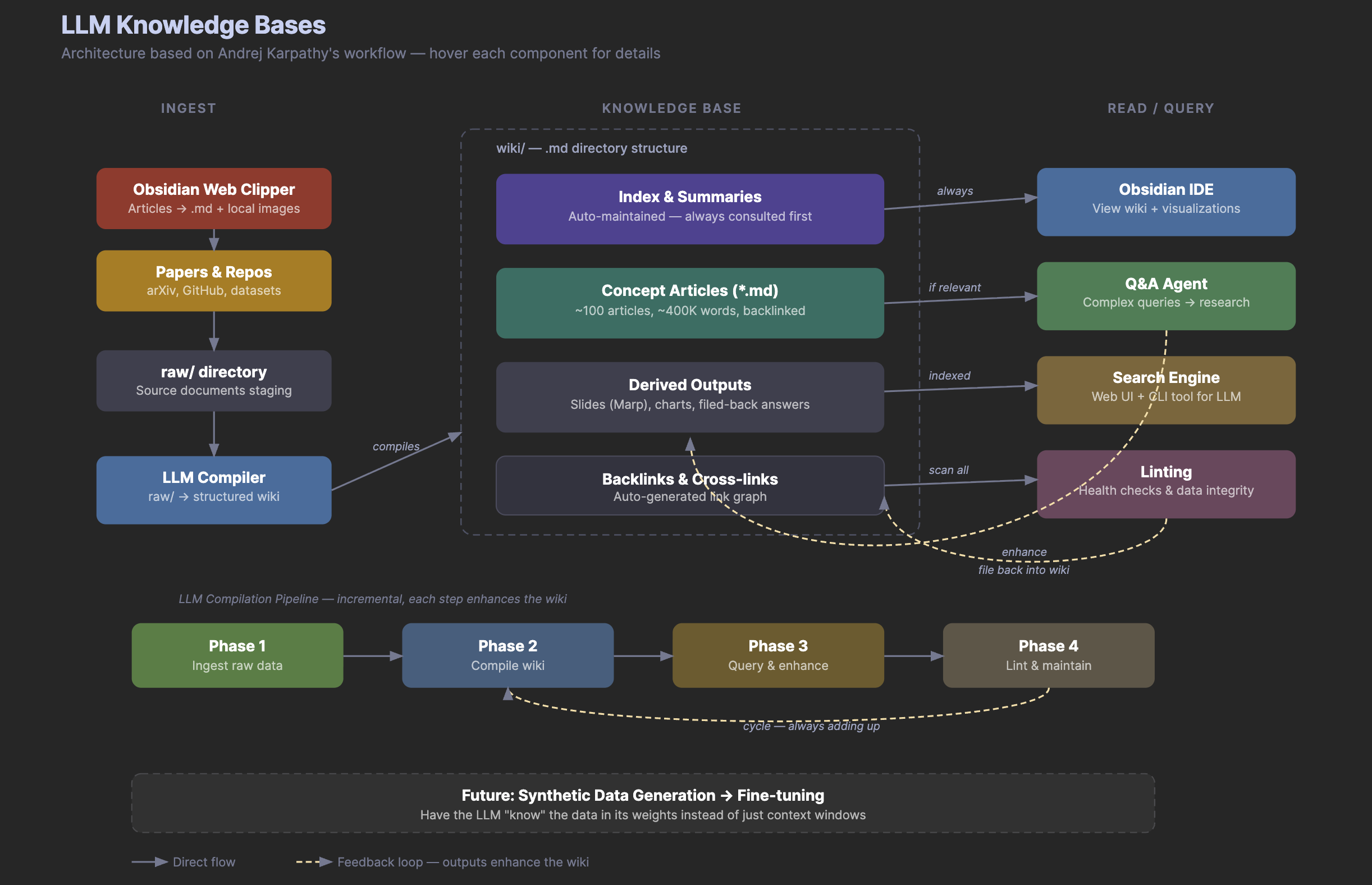
LLM Knowledge Bases
A visual breakdown of Andrej Karpathy's approach to building personal knowledge bases powered by LLMs. Learn the 4-phase pipeline: ingest, compile, query, and maintain - with an interactive architecture diagram.
Just-In-Time PM #3: Flow Cycles - Forte Labs
In Part 2, I described the sublime and powerful experience of flow, which could be considered the “holy grail” of productivity. I argued that there is theoretically no minimum amount of time necessary to get into flow, contrary to popular belief. But in reality, as always, it’s a bit more complicated. Let’s look at what this looks like in a typical working session of a couple hours.

Muse: Designing a studio for ideas
Physical workspaces inspire a fast, fluid digital tool for creative thinking.
Special Issue Editorial – Accumulation and Evolution of Design Knowledge in Design Science Research: A Journey Through Time and Space
Sir Isaac Newton (1676) famously said, “If I have seen further, it is by standing on the shoulders of giants.” Research is a collaborative, evolutionary endeavor—and it is no different with design science research (DSR), which builds upon existing design knowledge and creates new design knowledge to pass on to future projects. However, despite the vast, growing body of DSR contributions, scant evidence of the accumulation and evolution of design knowledge has been articulated in an organized DSR body of knowledge. Most contributions rather stand on their own feet than on the shoulders of giants, and this continues to limit how far we can see, curtailing the extent of the broader impacts that can be made through DSR. In this editorial, we aim at providing guidance on how to position design knowledge contributions in wider problem and solution spaces. We propose (1) a model conceptualizing design knowledge as a resilient relationship between problem and solution spaces, (2) a model that demonstrates how individual DSR projects consume and produce design knowledge, (3) a map to position a design knowledge contribution in problem and solution spaces, and (4) principles on how to use this map in a DSR project. We show how fellow researchers, readers, editors, and reviewers, as well as the IS community as a whole, can make use of these proposals, and also illustrate future research opportunities.
Just-In-Time PM #5: The Iron Triangle - Forte Labs
In Part 4, I introduced the idea of “intermediate packets.” Instead of delivering value in a big project that spans huge amounts of time, we want to deliver it in smaller chunks at more frequent intervals. This follows a basic principle that has revolutionized many industries: small batch sizes.

Today I’m playing with an idea that’s been on my mind for too long: storing design systems tokens on the #Atmosphere My proof of concept works, and that Makes Me Happy™
