Now it’s time to look at the JIT Project Manager’s toolkit. How do we put these ideas into practice in our day to day work? Through Workflow Strategies, a set of practical techniques for executing modern projects. Here is the full list, according to whether they work better for small or large-scale projects, and what kind of situation they are best suited for.
Just-In-Time Project Management: A Digital-First Framework for Modern Projects - Forte Labs
Technology has transformed every aspect of business, from the tools we use to communicate and collaborate, to how products and services are built and

Just-In-Time PM #12: Just-In-Case to Just-In-Time - Forte Labs
In Part 11, I introduced the concept of a “critical path” of tasks in a project, and the rationale for pushing tasks as late as possible on the timeline. The late starts approach inspires a tremendous amount of resistance, especially from creative knowledge workers. It sounds an awful lot like taking control from individual employees, centralizing it in a central decision maker, and forcing people to finish everything at breakneck speed at the last minute.

Just-In-Time PM #10: Structure, Features, and Purpose - Forte Labs
In Part 9, I explained why it is so important to create placeholders for your work-in-process: to allow you to pursue multiple projects across different spans of time without losing your progress. What we are converging towards is a set of core principles for how Digital Knowledge Work is fundamentally different from previous kinds of work.

Just-In-Time PM #6: Evolving Deliverables - Forte Labs
In Part 5, I introduced The Iron Triangle of Project Management and the idea that any given deliverable can be reduced or expanded in scope at any time. How should you use this newfound ability? You should use it to: Get started Maintain momentum Test assumptions

Work Smarter: The Cocktail of Simplicity, Manageable Adversity, and Muntzing
Sometimes deliberate roadblocks can be a good thing to get more efficient and effective products and workflow. Here's how.
Just-In-Time PM #5: The Iron Triangle - Forte Labs
In Part 4, I introduced the idea of “intermediate packets.” Instead of delivering value in a big project that spans huge amounts of time, we want to deliver it in smaller chunks at more frequent intervals. This follows a basic principle that has revolutionized many industries: small batch sizes.

Patrick Collison on Twitter / X
I want some kind of LLM workflow tool.• Ability to manage a set of input files (Markdown or similar), plus other general-purpose context.• With real-time collaboration. (And maybe some concept of snapshots or VCS integration.)• And the ability to create/manage a inference…— Patrick Collison (@patrickc) June 6, 2026
Just-In-Time PM #9: Placeholders - Forte Labs
In Part 8, we looked at divergence and convergence as the two fundamental modes of all creative work. Now let’s see what this looks like in our day to day schedules. The main feature of the modern workday, you may have noticed, is fragmentation.

PhilipK Devblog
In my experience, you can speed up your workflow in UI and Game development, by writing tests for the edge/hard-to-reproduce cases.
Ship working code while you sleep with the Ralph Wiggum technique
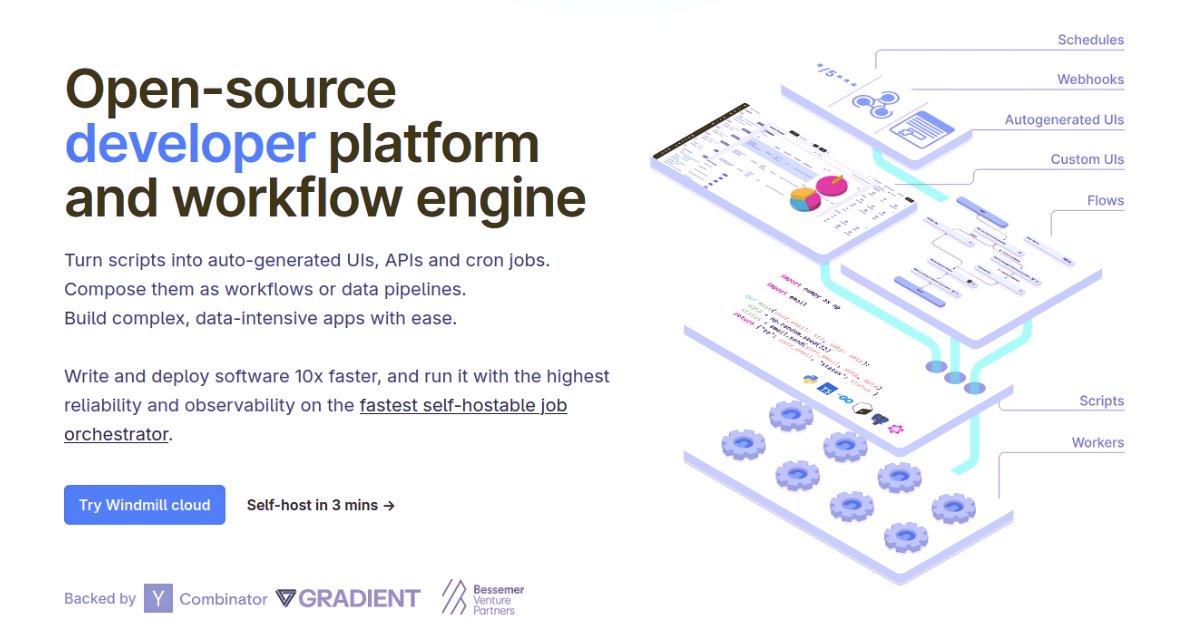
Windmill | Build, deploy and monitor internal software at scale
Open-source workflow engine to build workflows, data pipelines and internal tools at scale. Self-hostable, for developers and AI, with enterprise security.
Build tools around workflows, not workflows around tools | thesephist.com
This March, I spent a couple of days traveling through western Iceland.
Build, debug & deploy with AI
Query and edit large codebases, generate apps from images or PDFs, and automate complex workflows—all from your terminal with Gemini 3.

Just-In-Time PM #13: Component Thinking - Forte Labs
In Part 12, I described the shift from a just-in-case to a just-in-time philosophy of work, using late starts as an example of the benefits it offers. But if nearly everything can be done later, and there are major benefits to doing so, one question comes to the forefront: what in the world should I do now?

Optimizing Agentic Workflows using Meta-tools
Agentic AI enables LLM to dynamically reason, plan, and interact with tools to solve complex tasks. However, agentic workflows often require many iterative reasoning steps and tool invocations,...

Dagu: The workflow engine that doesn't turn into an SRE project.
Dagu is a lightweight alternative to Airflow or Cron with a Web UI. Define DAGs in a simple declarative YAML format. It supports shell commands, docker containers, k8s jobs, remote commands via SSH, and more. It was designed to be easy to use, self-contained, and require no coding, making it ideal for small teams.