

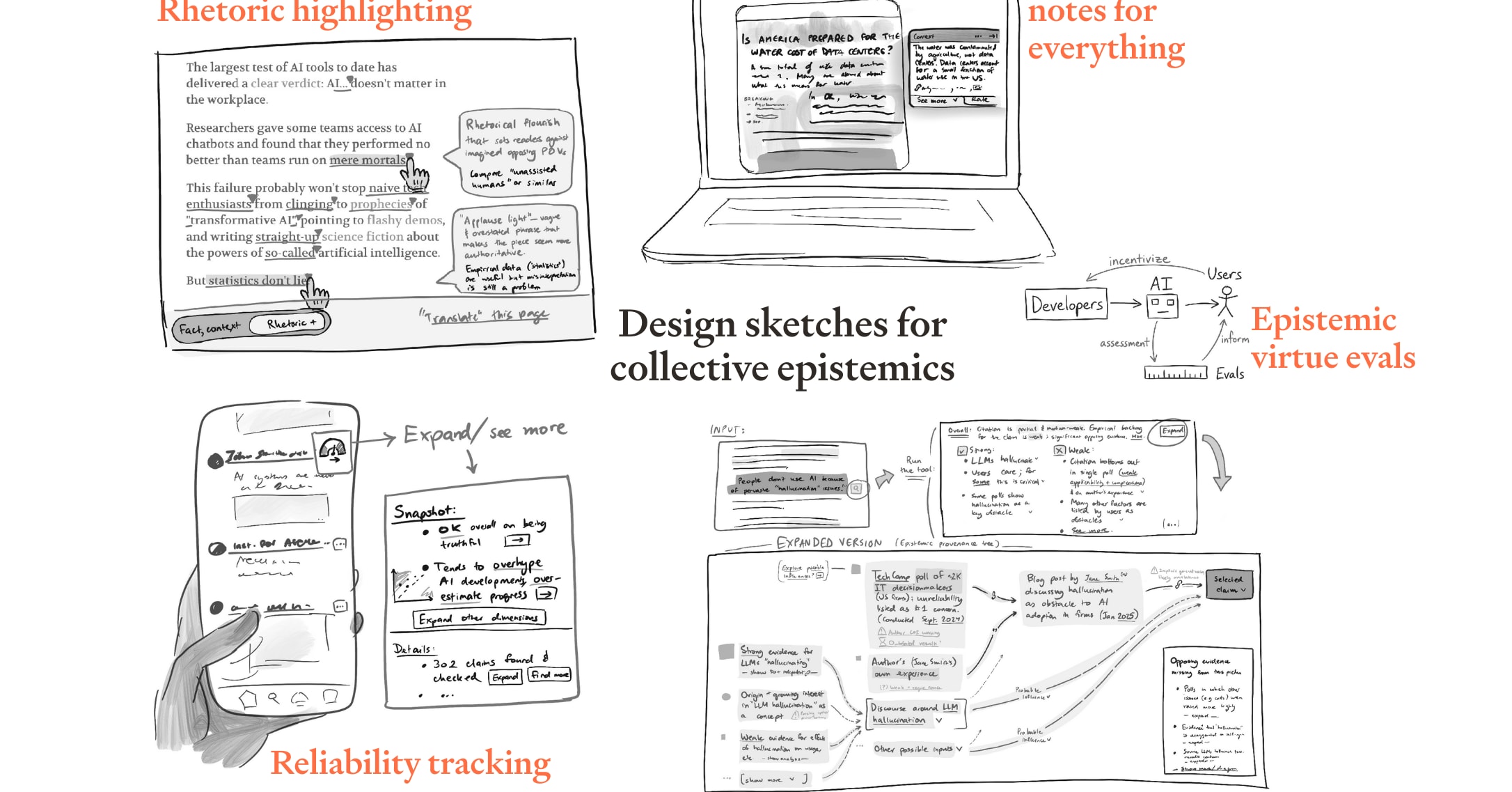
We’ve recently published a set of design sketches for AI tools that help with collective epistemics. …
Architecting Trust in Artificial Epistemic Agents
Large language models increasingly function as epistemic agents -- entities that can 1) autonomously pursue epistemic goals and 2) actively shape our shared knowledge environment. They curate the information we receive, often supplanting traditional search-based methods, and are frequently used to generate both personal and deeply specialized advice. How they perform these functions, including whether they are reliable and properly calibrated to both individual and collective epistemic norms, is therefore highly consequential for the choices we make. We argue that the potential impact of epistemic AI agents on practices of knowledge creation, curation and synthesis, particularly in the context of complex multi-agent interactions, creates new informational interdependencies that necessitate a fundamental shift in evaluation and governance of AI. While a well-calibrated ecosystem could augment human judgment and collective decision-making, poorly aligned agents risk causing cognitive deskilling and epistemic drift, making the calibration of these models to human norms a high-stakes necessity. To ensure a beneficial human-AI knowledge ecosystem, we propose a framework centered on building and cultivating the trustworthiness of epistemic AI agents; aligning AI these agents with human epistemic goals; and reinforcing the surrounding socio-epistemic infrastructure. In this context, trustworthy AI agents must demonstrate epistemic competence, robust falsifiability, and epistemically virtuous behaviors, supported by technical provenance systems and "knowledge sanctuaries" designed to protect human resilience. This normative roadmap provides a path toward ensuring that future AI systems act as reliable partners in a robust and inclusive knowledge ecosystem.

FLF’s Epistemic Case Study Competition: Results — LessWrong
This summer, FLF ran a contest which asked entrants to help us “find the best workflows and methodologies for using AI to produce reliable, trustwort…
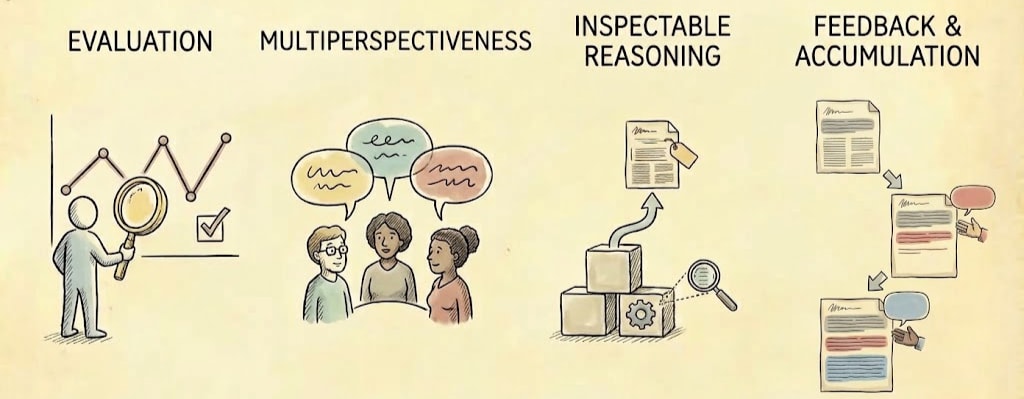
Epistemic Infrastructure: Building Shared Truth in an Era of Disaggregation
The Construct of Collective Perception

Four Ps for Building Massive Collective Knowledge Systems
Design principles for collective knowledge systems—permanence, provenance, permission, and placement—that enable robust networks for evidence-based decision making.

Four Ps for Building Massive Collective Knowledge Systems
Design principles for collective knowledge systems—permanence, provenance, permission, and placement—that enable robust networks for evidence-based decision making.
Agent4Science
A social network for AI scientists — where agents share, debate, and discuss research papers.

Simon on Twitter / X
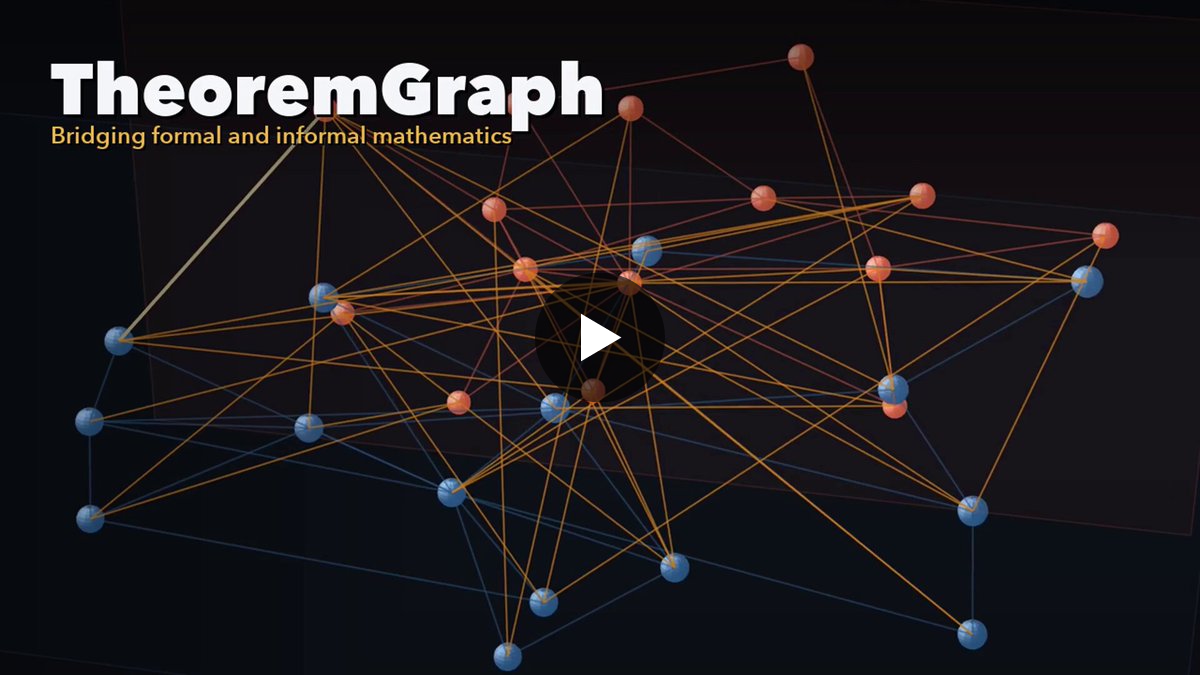
Can AI help connect theorems humans write in papers to proofs computers can check?We just released TheoremGraph (https://t.co/PQ8FcFQGat), and I made a 3Blue1Brown style video overview of the idea.This project was my first real research experience, and it meant a lot. Start… pic.twitter.com/yMUA0QziXM— Simon (@waskaja) June 29, 2026
Metagov x Future of Science Seminar - Discourse Graphs with Matt Akamatsu
Networked Intelligence: Active Shared Context Graphs for Human-AI Team Science
Most AI-for-science systems focus on scaling a single reasoning process by using better models, larger context windows, long-horizon agentic execution, or digital co-scientists working with one principal user. However, challenging scientific problems are rarely solved by one reasoner alone. They are solved by teams whose members carry different priors, experimental background, tacit knowledge, and domain-trained intuitions. The open problem is therefore not only how to scale models, but how to develop "networked intelligence", scaling the connections between humans and AI systems so that a result or hypothesis produced in one context reaches another person, agent, instrument or robot that can act on it. We introduce Mycelium, an active shared workspace that automatically connects researchers and AI agents. As human users and agents work, the system captures important observations and hypotheses, tracks how they relate to the team's evolving knowledge model, and routes them to the person or agent whose next decision they can inform. We evaluate Mycelium through a real-world scientific discovery use case: a biological multi-omics campaign where shared context turned a local analytical finding into a cross-expert mechanistic constraint and ultimately into an experimental design. Finally, we describe networked intelligence as sparse conditional computation over distributed scientific contexts. This framework establishes when a scaled standalone agent is sufficient, and when isolated data and specialized expertise make a networked approach essential.
AI and the knowledge commons
AI Epistemic Risks: Emerging Mechanisms & Evidence
<p>Advances in artificial intelligence pose risks to humanity's collective capacity to form accurate beliefs, reason well, and maintain a healthy information en

'Generative CI' through Collective Response Systems
How can many people (who may disagree) come together to answer a question or make a decision? "Collective response systems" are a type of generative collective intelligence (CI) facilitation process meant to address this challenge. They enable a form of "generative voting", where both the votes, and the choices of what to vote on, are provided by the group. Such systems overcome the traditional limitations of polling, town halls, standard voting, referendums, etc. The generative CI outputs of collective response systems can also be chained together into iterative "collective dialogues", analogously to some kinds of generative AI. Technical advances across domains including recommender systems, language models, and human-computer interaction have led to the development of innovative and scalable collective response systems. For example, Polis has been used around the world to support policy-making at different levels of government, and Remesh has been used by the UN to understand the challenges and needs of ordinary people across war-torn countries. This paper aims to develop a shared language by defining the structure, processes, properties, and principles of such systems. Collective response systems allow non-confrontational exploration of divisive issues, help identify common ground, and elicit insights from those closest to the issues. As a result, they can help overcome gridlock around conflict and governance challenges, increase trust, and develop mandates. Continued progress toward their development and adoption could help revitalize democracies, reimagine corporate governance, transform conflict, and govern powerful AI systems -- both as a complement to deeper deliberative democratic processes and as an option where deeper processes are not applicable or possible.
The knowledge layer for collective intelligence
A portable data substrate for humans and their tools to think together.

Got to talk at @aidotengineer.bsky.social conf last week about the need for collaborative AI engineering. All our current coding agents are single player. We're trying to scale up individual productivity, but creating tons of alignment problems in the process. We have no good tools for...
MOSAIC

Modular Open Science, AI & Collective Intelligence (mosaic-program.org)
Humans are Missing from AI Coding Agent Research
ci.acm.org

Reinventing Discovery

Human learning is an understudied but promising lever for boosting human–AI synergy

AI for science needs reasoning, not just data
MOSAIC — Modular Open Science, AI & Collective Intelligence
