By Jonathan Mayer and Arvind Narayanan. Blocking cookies is bad for privacy. That’s the new disingenuous argument from Google, trying to justify why Chrome is so far behind Safari and Firefox in offering privacy protections. As researchers who have spent over a decade studying web tracking and online advertising, we want to set the record […]
Award-winning security research reveals a host of never-seen, currently unblockable web-tracking techniques
Who Left Open the Cookie Jar? A Comprehensive Evaluation of Third-Party Cookie Policies won the Distinguished Paper prize at this year's Usenix Security Conference; its authors, researchers at Belgium's Catholic…

Review | Goodbye, Chrome: Google’s Web browser has become spy software
Our latest privacy experiment found Chrome ushered more than 11,000 tracker cookies into our browser — in a single week.

Kevin Boone: The privacy nightmare of browser fingerprinting
If you were worried about tracking cookies, you really don’t want to know about browser fingerprinting.
Privacy vs. Profit: The Impact of Google's Manifest Version 3 (MV3) Update on Ad Blocker Effectiveness
Google's recent update to the manifest file for Chrome browser extensions, transitioning from manifest version 2 (MV2) to manifest version 3 (MV3), has raised concerns among users and ad blocker providers, who worry that the new restrictions, notably the shift from the powerful WebRequest API to the more restrictive DeclarativeNetRequest API, might reduce ad blocker effectiveness. Because ad blockers play a vital role for millions of users seeking a more private and ad-free browsing experience, this study empirically investigates how the MV3 update affects their ability to block ads and trackers. Through a browser-based experiment conducted across multiple samples of ad-supported websites, we compare the MV3 to MV2 instances of four widely used ad blockers. Our results reveal no statistically significant reduction in ad-blocking or anti-tracking effectiveness for MV3 ad blockers compared to their MV2 counterparts, and in some cases, MV3 instances even exhibit slight improvements in blocking trackers. These findings are reassuring for users, indicating that the MV3 instances of popular ad blockers continue to provide effective protection against intrusive ads and privacy-infringing trackers. While some uncertainties remain, ad blocker providers appear to have successfully navigated the MV3 update, finding solutions that maintain the core functionality of their extensions.

Keeping Data Private | Web Browser Engineering
Our browser has grown up and now runs (small) web applications. With one final step—user identity via cookies—it will be able to run all sorts of personalized online services. But capability demands responsibility: our browser must now secure cookies against adversaries interested in stealing them. Luckily, browsers have sophisticated systems for controlling access to cookies and preventing their misuse.
Challenges to Making Sense of the 21st Century - The Consilience Project
We use cookies on our website, please read our Privacy Policy for more information Okay, thanks

The State of Mozilla: 2015 Annual Report
In addition to Cookies necessary for this site to function, we’d like your permission to set some additional Cookies to better understand your browsing needs and improve your experience. Rest assured — we value your privacy.

Google’s Chrome Antitrust Paradox
This Article examines Google’s dominance of the browser market, highlighting how Google’s Chrome browser plays a critical role in reinforcing Google’s dominance in other markets. While Google portrays Chrome as a neutral platform built on open-source technologies, this Article shows that Chrome is, in fact, instrumental in Google’s strategy to reinforce its dominance in the online advertising, publishing, and browser markets. The examination of Google’s strategic acquisitions, anticompetitive practices, and the implementation of so-called “privacy controls” underlines that Chrome is far from a neutral gateway to the web. Rather, it serves as a key tool for Google to maintain and extend its market power, often to the detriment of competition and innovation in the digital economy.This Article illustrates how Chrome not only bolsters Google’s position in online advertising and publishing through practices such as coercion and self-preferencing, but also leverages its advertising clout to engage in a “pay-to-play” paradigm—the cornerstone of Google’s larger strategy of market control. It also outlines potential regulatory interventions and remedies by drawing on historical antitrust precedents. Lastly, this Article proposes a triad of solutions motivated by an analysis of Google’s abuse of Chrome, including behavioral remedies targeting specific anticompetitive practices, structural remedies involving an internal separation of Google’s divisions, and divestiture of Chrome from Google into an independent organization.Despite Chrome’s dominance and its critical role in Google’s ecosystem, as well as its recent legal troubles with the Department of Justice, it so far has avoided significant antitrust action. A key reason for this inaction lies in the long-standing precedent supporting the hegemony of technology firms and the uncertainty surrounding Chrome’s viability as a standalone entity. This Article attempts to address these issues to enable antitrust actions that are essential in remedying current market imbalances. Such actions are also critical to mitigate future threats to competition from an increasingly monopolistic technology landscape, thereby fostering a competitive digital environment that promotes innovation and protects consumer interests.
Thank you for ad blocking | thankyouforadblocking.com is a public awareness campaign focused on increasing awareness about the danger associated with online advertising.
I became interested with the topics of privacy and internet user rights more than 20 years ago in my native Finland, which at the time was toted as the first information society in the world. I was one of the first commercial internet developers, and became fascinated with the user data aspect of the internet the moment I saw awstats for the first time. It was an early server-log based web analytics solution, in the time when there were no tracking tag based solutions available. The idea of allowing 3rd-party tags on websites came later. Today it is not hard to find premium websites with more than 100 such 3rd-party tags.
Using Ads to Sustain Open Source
Why someone who loves Privacy Badger, uses a non-tracking browser, and never cared for ads, is advocating their ethical use for open…
How Chrome tracks you and how to limit it | Proton
Learn how Chrome tracks your activity, what information it sends to Google, and which privacy settings can reduce tracking while you browse.

Welcome to MyHub | MyHub.AI
MyHub.ai saves very few cookies onto your device: we need some to monitor site traffic using Google Analytics, while another protects you from a cross-site request forgeries. Nevertheless, you can disable the usage of cookies by changing the settings of your browser. By browsing our website without changing the browser settings, you grant us permission to store that information on your device. More details in our Privacy Policy.
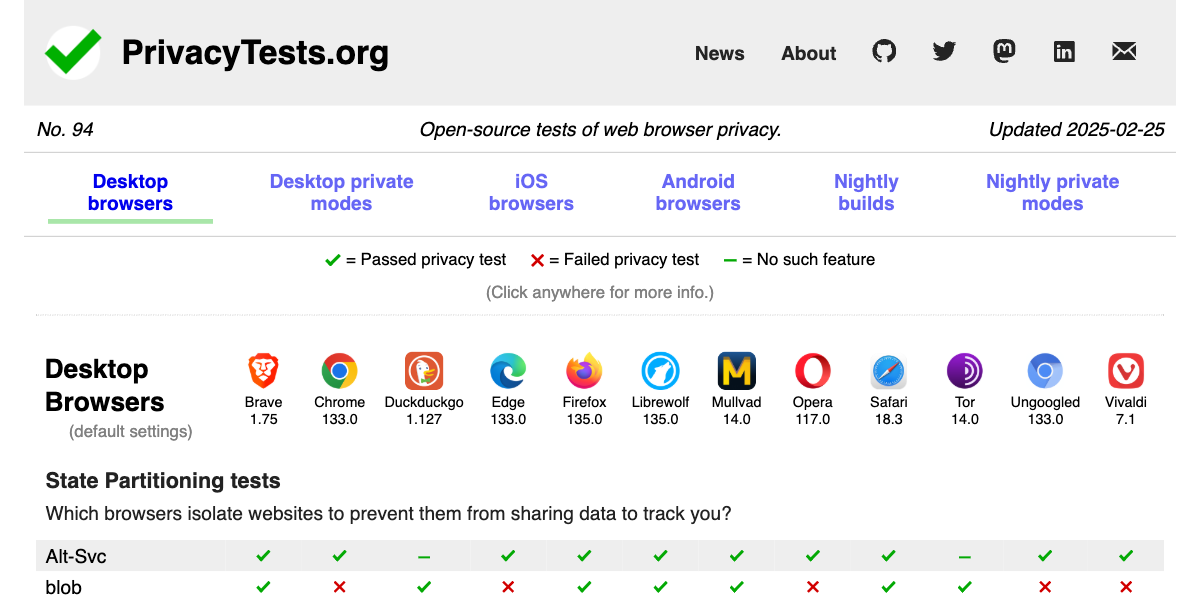
Which browsers are best for privacy?
An open-source privacy audit of popular web browsers.
Privacy concerns with Google
Privacy concerns with Google include a wide range of issues and controversies related to collection, use, and sharing of user data across Google products, services, and platforms, including Google Search. Since the mid-2000s, civil liberties organizations and government regulators have criticized and taken action against Google related to Internet privacy issues in its data collection and data retention policies, web tracking practices, cooperation with intelligence agencies and law enforcement agencies, and other activities. These concerns are a frequent theme in criticism of Google.
The web should remain anonymous by default | The Mozilla Blog
The unique architecture of the web enables a much higher degree of user privacy than exists on other platforms. Many factors contribute to this, but an ess

SLAP and FLOP: Apple's Lack of Full Site Isolation and iOS Browser Ban Puts Users at Risk - Open Web Advocacy
TL:DR; Yet again Apple’s ban on third-party browser engines weakens security rather than strengthens it.