


Thinking better isn't about learning more; it's about doing a few simple things that really help create unstoppable progress.
Opinion | Think Less, Think Better (Published 2016)
A wandering mind has less innovative thoughts.

Your Brain Can Only Take So Much Focus
Research has shed light on the power of focus and its role as a hidden driver of success. Yet as helpful as focus can be, research also shows there’s a downside to it: excessive focus exhausts the focus circuits in your brain. It can drain your energy, make you lose self-control, impair your decision-making, and make you less collaborative. The brain operates optimally when it toggles between focus and unfocus. When you unfocus, you engage a brain circuit called the default mode network (DMN). The DMN activates old memories, goes back and forth between the past, present, and future, and recombines different ideas. Using this new and previously inaccessible data, you can imagine creative solutions or predict the future, and more. There are many simple and effective ways to activate this circuit in the course of a day, such as positive constructive daydreaming, napping, and consciously thinking from another person’s perspective.

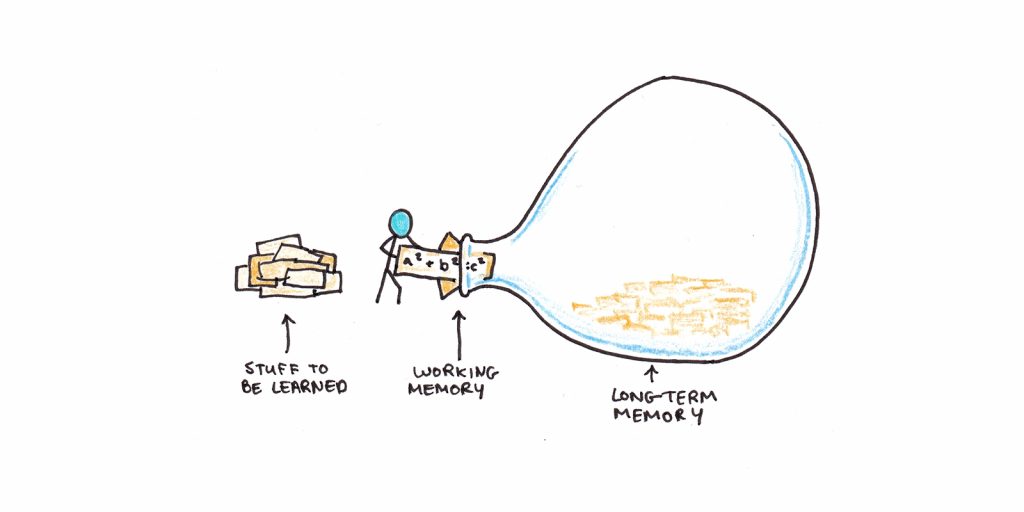
Cognitive Load Theory and its Applications for Learning - Scott H Young
What makes learning hard? How can we make it easier? Cognitive load theory explains how we learn and how to do it better.
Learning How to Learn (And 20+ Studies) – Max's Two Cents
I have been interested in cognitive science and effective learning methods for years. I’ve read multiple books and articles and put many ideas to test. In this post, I aim to synthesize my notes and provide references to scientific studies.

It's getting harder to focus every day
I’m feeling it right now. I had to set a timer for 15 minute on my computer and block all distractions to write this. If I didn’t force myself to focus I would easily get distracted by something after few minutes. Even when I’m doing things that I’ve been waiting to do it, I still feel the urge to do something else. I don’t know how and when this happened. During the last few years I was always studying, working, and doing open source. And actually got stuff done. Doing all of those at the same time requires paying attention to what I wanted to do and ignore the noise.
Do not give up your brain
It's tempting to just let tools think for you, but you still need to be able to think for yourself and stay sharp.

Feeling unproductive? Maybe you should stop overthinking.
In order to get something done, maybe we need to think less.

The Top Idea in Your Mind
July 2010I realized recently that what one thinks about in the shower in the morning is more important than I'd thought. I knew it was a good time to have ideas. Now I'd go further: now I'd say it's hard to do a really good job on anything you don't think about in the shower.Everyone who's worked on difficult problems is probably familiar with the phenomenon of working hard to figure something out, failing, and then suddenly seeing the answer a bit later while doing something else. There's a kind of thinking you do without trying to. I'm increasingly convinced this type of thinking is not merely helpful in solving hard problems, but necessary. The tricky part is, you can only control it indirectly. [1]I think most people have one top idea in their mind at any given time. That's the idea their thoughts will drift toward when they're allowed to drift freely. And this idea will thus tend to get all the benefit of that type of thinking, while others are starved of it. Which means it's a disaster to let the wrong idea become the top one in your mind.What made this clear to me was having an idea I didn't want as the top one in my mind for two long stretches.I'd noticed startups got way less done when they started raising money, but it was not till we ourselves raised money that I understood why. The problem is not the actual time it takes to meet with investors. The problem is that once you start raising money, raising money becomes the top idea in your mind. That becomes what you think about when you take a shower in the morning. And that means other questions aren't.I'd hated raising money when I was running Viaweb, but I'd forgotten why I hated it so much. When we raised money for Y Combinator, I remembered. Money matters are particularly likely to become the top idea in your mind. The reason is that they have to be. It's hard to get money. It's not the sort of thing that happens by default. It's not going to happen unless you let it become the thing you think about in the shower. And then you'll make little progress on anything else you'd rather be working on. [2](I hear similar complaints from friends who are professors. Professors nowadays seem to have become professional fundraisers who do a little research on the side. It may be time to fix that.)The reason this struck me so forcibly is that for most of the preceding 10 years I'd been able to think about what I wanted. So the contrast when I couldn't was sharp. But I don't think this problem is unique to me, because just about every startup I've seen grinds to a halt when they start raising money � or talking to acquirers.You can't directly control where your thoughts drift. If you're controlling them, they're not drifting. But you can control them indirectly, by controlling what situations you let yourself get into. That has been the lesson for me: be careful what you let become critical to you. Try to get yourself into situations where the most urgent problems are ones you want to think about.You don't have complete control, of course. An emergency could push other thoughts out of your head. But barring emergencies you have a good deal of indirect control over what becomes the top idea in your mind.I've found there are two types of thoughts especially worth avoiding � thoughts like the Nile Perch in the way they push out more interesting ideas. One I've already mentioned: thoughts about money. Getting money is almost by definition an attention sink. The other is disputes. These too are engaging in the wrong way: they have the same velcro-like shape as genuinely interesting ideas, but without the substance. So avoid disputes if you want to get real work done. [3]Even Newton fell into this trap. After publishing his theory of colors in 1672 he found himself distracted by disputes for years, finally concluding that the only solution was to stop publishing:
Opinion | Can You Get Smarter? (Published 2015)
There is much that you can do to keep cognitively sharp.

Why Some Students Learn Faster
A hypothesis about teaching and learning
Why Some Students Learn Faster
A hypothesis about teaching and learning
Writing is Thinking: Learning to Write with Confidence
Learning to write is learning to think, because writing is thinking. They are two peas in a powerful pod. This article goes over my writing process, focused on minimizing the activation energy to get started.

You Can Increase Your Intelligence: 5 Ways to Maximize Your Cognitive Potential

Works in Progress: The Long Journey to Doing Good Better
The more I learn, the more I realize how much I don’t know. — Albert Einstein

Math Academy
The Math Academy curriculum and pedagogy leverage cutting-edge cognitive learning theory. Why? Because it’s been studied extensively, backed up and proven to work. We aren’t providing edu-tainment. This isn’t enrichment. We teach math as if we were training a professional athlete or musician, or anyone looking to acquire a skill to the highest degree possible. This is real work for a student who is serious about learning math. We expect every student using our system to actually master the material, and do it efficiently and effectively.