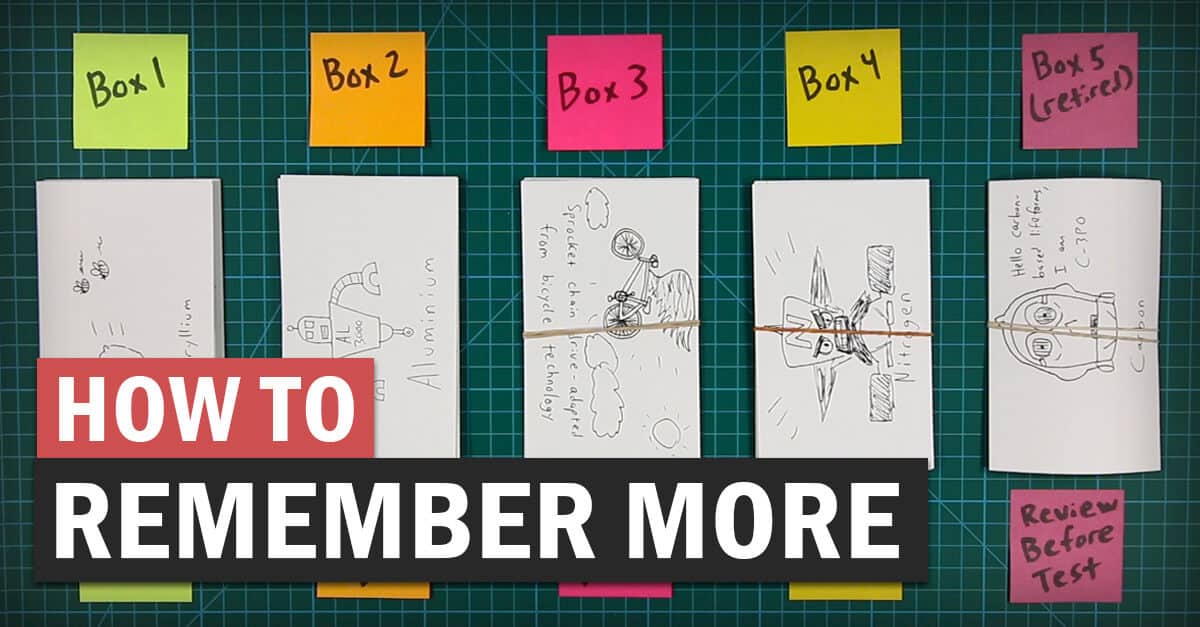
We are not taught how to learn in school, we are taught how to pass tests. The spacing effect is a far more effective way to learn and retain information that works with our brain instead of against it. Find out how to use it here.
How to Remember More of What You Learn with Spaced Repetition
Using spaced repetition in conjunction with other study techniques can help you memorize information much, much more quickly. Here's how to do it.
Spaced mathematics practice improves test scores and reduces overconfidence
Abstract The practice assignments in a mathematics textbook or course can be arranged so that most of the problems relating to any particular concept are massed together in a single assignment, or these related problems can be distributed across many assignments–a format known as spaced practice. Here we report the results of two classroom experiments that assessed the effects of mathematics spacing on both test scores and students' predictions of their test scores. In each experiment, students in Year 7 (11–12 years of age) either massed their practice into a single session or divided their practice across three sessions spaced 1 week apart, followed 1 month later by a test. In both experiments, spaced practice produced higher test scores than did massed practice, and test score predictions were relatively accurate after spaced practice yet grossly overconfident after massed practice.

Spaced repetition
Spaced repetition is an evidence-based learning technique that is usually performed with flashcards. Newly introduced and more difficult flashcards are shown more frequently, while older and less difficult flashcards are shown less frequently in order to exploit the psychological spacing effect. The use of spaced repetition has been proven to increase the rate of learning.

Math Academy
Q. Michael Pershan’s main critique of spaced repetition in the context of Math Academy?A. It reinforces his memory of a shallow understanding.
Why Some Students Learn Faster
A hypothesis about teaching and learning
Why Some Students Learn Faster
A hypothesis about teaching and learning
Why Some Students Learn Faster
A hypothesis about teaching and learning
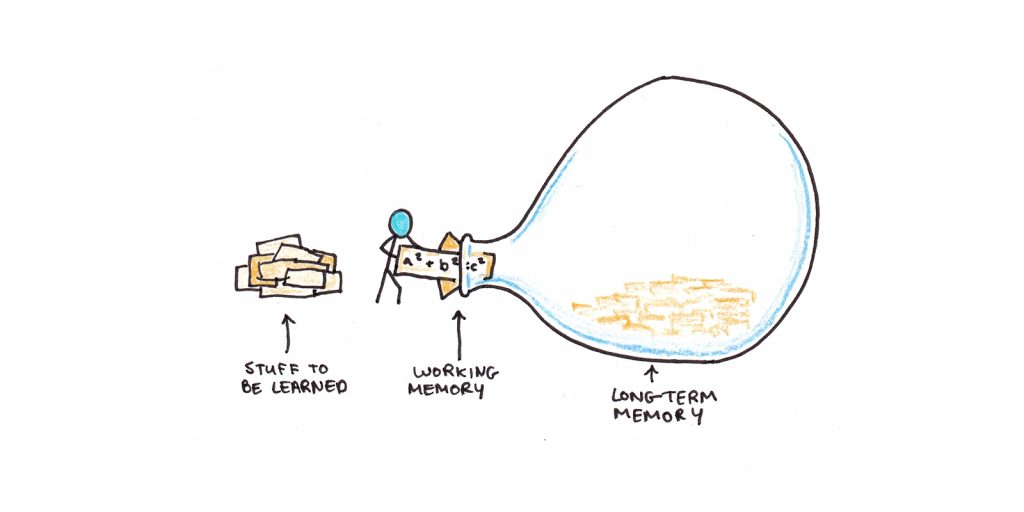
Cognitive Load Theory and its Applications for Learning - Scott H Young
What makes learning hard? How can we make it easier? Cognitive load theory explains how we learn and how to do it better.
How to write good prompts: using spaced repetition to create understanding
Using spaced repetition to create understanding
Learning How to Learn (And 20+ Studies) – Max's Two Cents
I have been interested in cognitive science and effective learning methods for years. I’ve read multiple books and articles and put many ideas to test. In this post, I aim to synthesize my notes and provide references to scientific studies.
Dylan Wiliam on Twitter / X
The best journal article titles tell you what the study actually found, rather than being a teaser to make you read the paper. Here's a good example: "Spaced mathematics practice improves test scores and reduces overconfidence" https://t.co/iXxdkAgYPM ($)— Dylan Wiliam (@dylanwiliam) December 31, 2024
Using spaced repetition systems to see through a piece of mathematics
By Michael Nielsen, January 2019
How Learning Happens | Seminal Works in Educational Psychology and Wha
How Learning Happens introduces 28 giants of educational research and their findings on how we learn and what we need to learn effectively, efficiently, and

Mochi - Spaced repetition flashcards
Take notes and make flashcards using markdown, then study them using spaced repetition.
Excess Capacity Learning
How do humans learn from experience? Traditionally, cognitive scientists have assumed that discovering generalizable patterns requires that humans compress rich and noisy experiences. However, recent computer science results suggest otherwise — systems can learn by ‘overfitting’ and expanding all the details of their experiences. We offer a new perspective on learning based on a cognitive system’s representational capacity, which can be constrained (forcing the system to compress details of past experiences), sufficient (to memorize past experiences), or excess (allowing the system to expand on the details of past experiences). This framework has implications for understanding learning across cognitive, clinical, and developmental contexts.
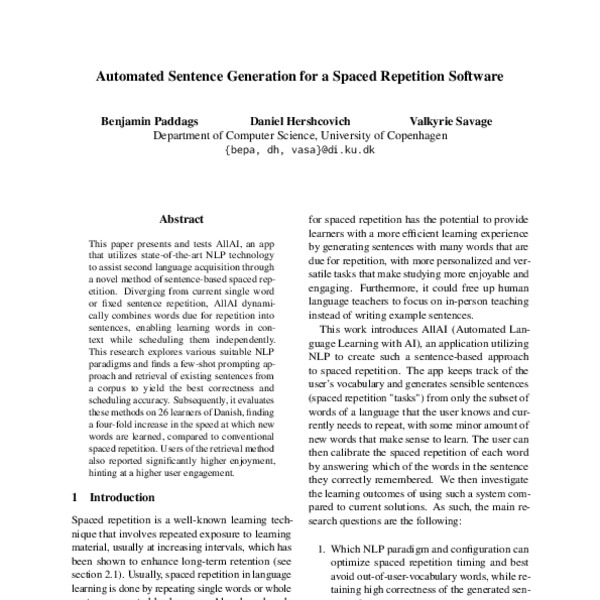
Automated Sentence Generation for a Spaced Repetition Software
This paper presents and tests AllAI, an app that utilizes state-of-the-art NLP technology to assist second language acquisition through a novel method of sentence-based spaced repetition. Diverging from current single word or fixed sentence repetition, AllAI dynamically combines words due for repetition into sentences, enabling learning words in context while scheduling them independently. This research explores various suitable NLP paradigms and finds a few-shot prompting approach and retrieval of existing sentences from a corpus to yield the best correctness and scheduling accuracy. Subsequently, it evaluates these methods on 26 learners of Danish, finding a four-fold increase in the speed at which new words are learned, compared to conventional spaced repetition. Users of the retrieval method also reported significantly higher enjoyment, hinting at a higher user engagement.