

We place AI engineers with research labs working on hard scientific problems.
Which ‘AI scientist’ suits your lab? A guide for the perplexed
General-purpose AI tools for science, such as Claude Science, promise to accelerate research. But which is right for you?
Rethinking AI for Science Funding
As science stands at an inflection point, how do we organize capital to shape the future of discovery?
AI has supercharged scientists—but may have shrunk science
Analysis of 41 million papers finds that although AI expands individual impact, it narrows collective scientific exploration
Using X-Labs to Unleash AI-Driven Scientific Breakthroughs | IFP
How to adapt our science funding mechanisms to the unique infrastructure needs of large-scale AI projects

From Genius Science to Scenius Science - Cosmik Labs
Why personal AI tools might not be all we need to revolutionize science
How to build an AI scientist: first peer-reviewed paper spills the secrets
AI Scientist, an autonomous research tool, first released in 2024, has now undergone peer review, highlighting its strengths and limitations.
Infinite Researchers | AI-Powered Scientific Discovery
What happens to the speed of discovery if we have infinite researchers? Explore AI experiments accelerating breakthroughs.

AI for science needs reasoning, not just data
AI agents that can model the human process of research will accelerate discoveries in science.

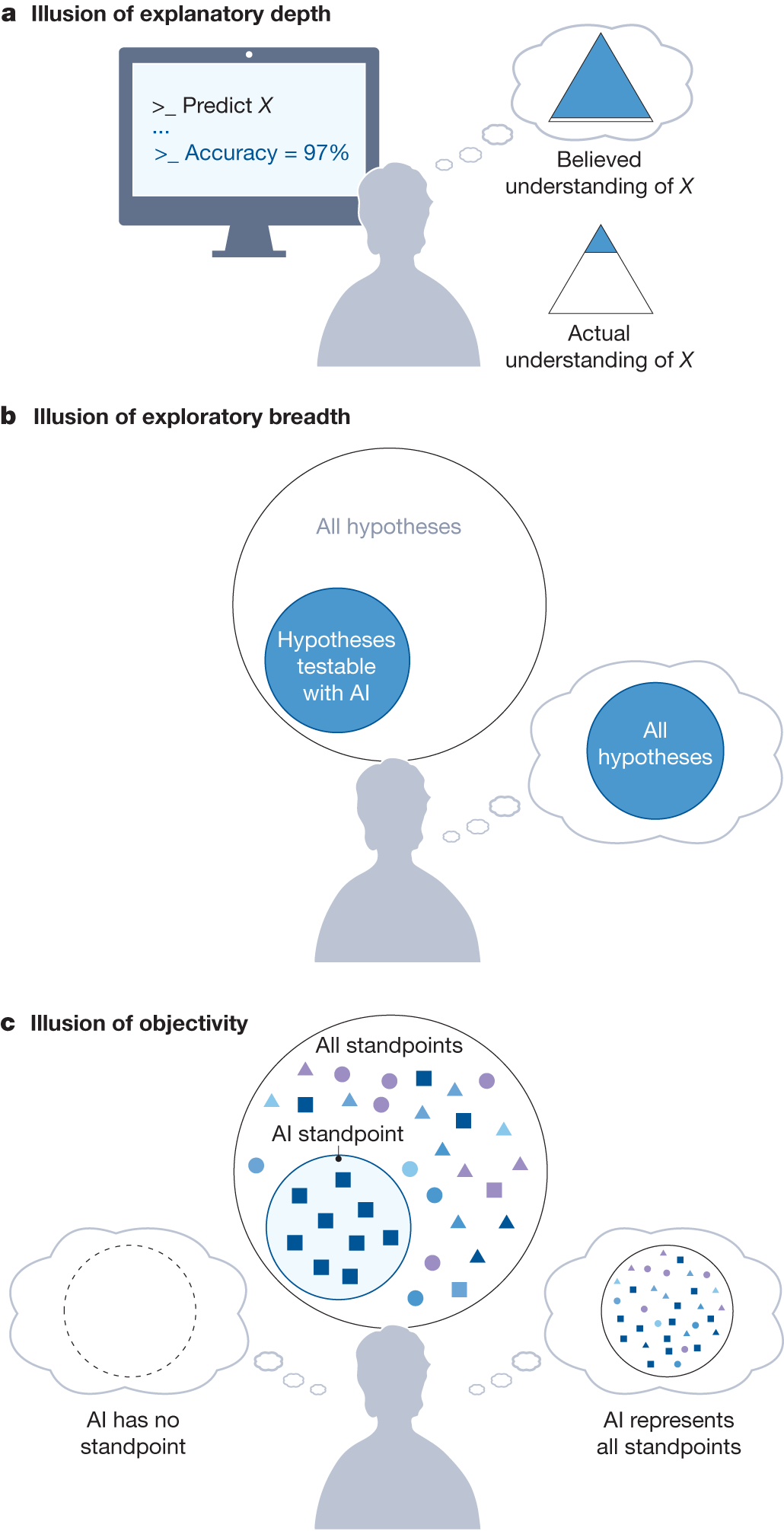
Artificial intelligence and illusions of understanding in scientific research
Scientists are enthusiastically imagining ways in which artificial intelligence (AI) tools might improve research. Why are AI tools so attractive and what are the risks of implementing them across the research pipeline? Here we develop a taxonomy of scientists’ visions for AI, observing that their appeal comes from promises to improve productivity and objectivity by overcoming human shortcomings. But proposed AI solutions can also exploit our cognitive limitations, making us vulnerable to illusions of understanding in which we believe we understand more about the world than we actually do. Such illusions obscure the scientific community’s ability to see the formation of scientific monocultures, in which some types of methods, questions and viewpoints come to dominate alternative approaches, making science less innovative and more vulnerable to errors. The proliferation of AI tools in science risks introducing a phase of scientific enquiry in which we produce more but understand less. By analysing the appeal of these tools, we provide a framework for advancing discussions of responsible knowledge production in the age of AI.
On the Value of Doing a PhD in the Age of AI
Many students who are just now embarking on a PhD in AI are understandably anxious. It feels like our field is zooming forward ever faster. Our clever methods are often surpassed before they are published. Our deep insights seem less critical to frontier lab progress. AI is automating aspects of the research process that used to require years of specialized training.
Deep Research, information vs. insight, and the nature of science
What AI will accelerate in the scientific process, what it cannot do, and how we can prepare for new manners of scientific investigation.
AI scientists are changing research — institutions, funders and publishers must respond
The ability to automate the discovery process in some areas of scientific inquiry raises unanswered questions about how research should be conducted.
Charting AI’s Role in Scientific Discovery — Renaissance Philanthropy – A brighter future for all through science, technology, and innovation
Renaissance Philanthropy, with support from Google.org , is conducting a landscape study of AI integration in scientific research — and we want your perspective.

Bending the Curve: How AI is Transforming Scientific Discovery
Discover how researchers use LLMs and specialized AI models like AlphaFold as complementary tools to accelerate innovation and expand the scientific frontier.

No. 018: Genesis Mission $5B, Challengescape problem directory, team science vs. solo AI agents - The Hallway Track
The Hallway Track No. 018 - How AI is affecting the practice of science
ScientistTwo: Pioneering the Human Knowledge Frontier with Autonomous AI
Scientific discovery is defined by the ability to identify the boundaries of existing knowledge and venture into unexplored territory. The ultimate vision for AI in science is problem-driven autonomous research: given a fundamental challenge by a human expert, the AI independently navigates the scientific landscape, uncovers theoretical and empirical bottlenecks, and systematically expands the frontier of knowledge. In this paper, we introduce ScientistTwo, a fully autonomous multi-agent framework designed to realize this vision. Specifically, ScientistTwo takes an initial problem as input, establishes state-of-the-art baselines, formulates novel hypotheses, and coordinates specialized agents to orchestrate an end-to-end discovery cycle without human intervention. Moreover, the framework rigorously conducts experiments using diverse datasets and metrics, refines methodologies through automated ablation studies, and validates research findings via a closed-loop simulated peer-review rebuttal engine. To evaluate ScientistTwo's capabilities against the highest standards of human scientific achievement, we benchmark it across papers accepted at top-tier conferences such as ICLR, ICML, and NeurIPS. As a result, ScientistTwo autonomously generates expert-level, publishable papers and fully verified, executable codebases. Its solutions consistently outperform human state-of-the-art models, and achieve higher average review ratings than human-authored papers under automated AI review agents. These results show that ScientistTwo is not merely an assistive tool but an autonomous scientific pioneer capable of pushing the frontiers of human discovery. Project website: https://scientist-two.github.io/
