
chat with private and local large language models

Extending AI chat with Model Context Protocol (and why it matters)
Posted on Tuesday 11 Feb 2025. 2,995 words, 24 links. By Matt Webb.

HuggingChat - Chat with AI models
Making the community's best AI chat models available to everyone

Tinfoil Private Chat
Private AI chat application supporting open source models through Tinfoil
Build A Large Language Model (From Scratch), Published by Manning, ISBN 978-1633437166
Implement a ChatGPT-like LLM in PyTorch from scratch, step by step
Clio: Privacy-Preserving Insights into Real-World AI Use
How are AI assistants being used in the real world? While model providers in theory have a window into this impact via their users' data, both privacy concerns and practical challenges have made analyzing this data difficult. To address these issues, we present Clio (Claude insights and observations), a privacy-preserving platform that uses AI assistants themselves to analyze and surface aggregated usage patterns across millions of conversations, without the need for human reviewers to read raw conversations. We validate this can be done with a high degree of accuracy and privacy by conducting extensive evaluations. We demonstrate Clio's usefulness in two broad ways. First, we share insights about how models are being used in the real world from one million Claude.ai Free and Pro conversations, ranging from providing advice on hairstyles to providing guidance on Git operations and concepts. We also identify the most common high-level use cases on Claude.ai (coding, writing, and research tasks) as well as patterns that differ across languages (e.g., conversations in Japanese discuss elder care and aging populations at higher-than-typical rates). Second, we use Clio to make our systems safer by identifying coordinated attempts to abuse our systems, monitoring for unknown unknowns during critical periods like launches of new capabilities or major world events, and improving our existing monitoring systems. We also discuss the limitations of our approach, as well as risks and ethical concerns. By enabling analysis of real-world AI usage, Clio provides a scalable platform for empirically grounded AI safety and governance.

Announcing CSML, a new open-source language to easily build full-featured chatbots
We are building the framework to support the chatbots of the future

ChatGPT is bullshit
Ethics and Information Technology - Recently, there has been considerable interest in large language models: machine learning systems which produce human-like text and dialogue. Applications of...

The People Who Marry Chatbots
A growing community is building a life with large language models.

Measuring Social Norms of Large Language Models
We present a new challenge to examine whether large language models understand social norms. In contrast to existing datasets, our dataset requires a fundamental understanding of social norms to solve. Our dataset features the largest set of social norm skills, consisting of 402 skills and 12,383 questions covering a wide set of social norms ranging from opinions and arguments to culture and laws. We design our dataset according to the K-12 curriculum. This enables the direct comparison of the social understanding of large language models to humans, more specifically, elementary students. While prior work generates nearly random accuracy on our benchmark, recent large language models such as GPT3.5-Turbo and LLaMA2-Chat are able to improve the performance significantly, only slightly below human performance. We then propose a multi-agent framework based on large language models to improve the models' ability to understand social norms. This method further improves large language models to be on par with humans. Given the increasing adoption of large language models in real-world applications, our finding is particularly important and presents a unique direction for future improvements.
Inside ChatGPT: How AI chatbots work
Large language models like ChatGPT use a complicated series of equations to understand and respond to your prompts. Here’s a look inside the system.

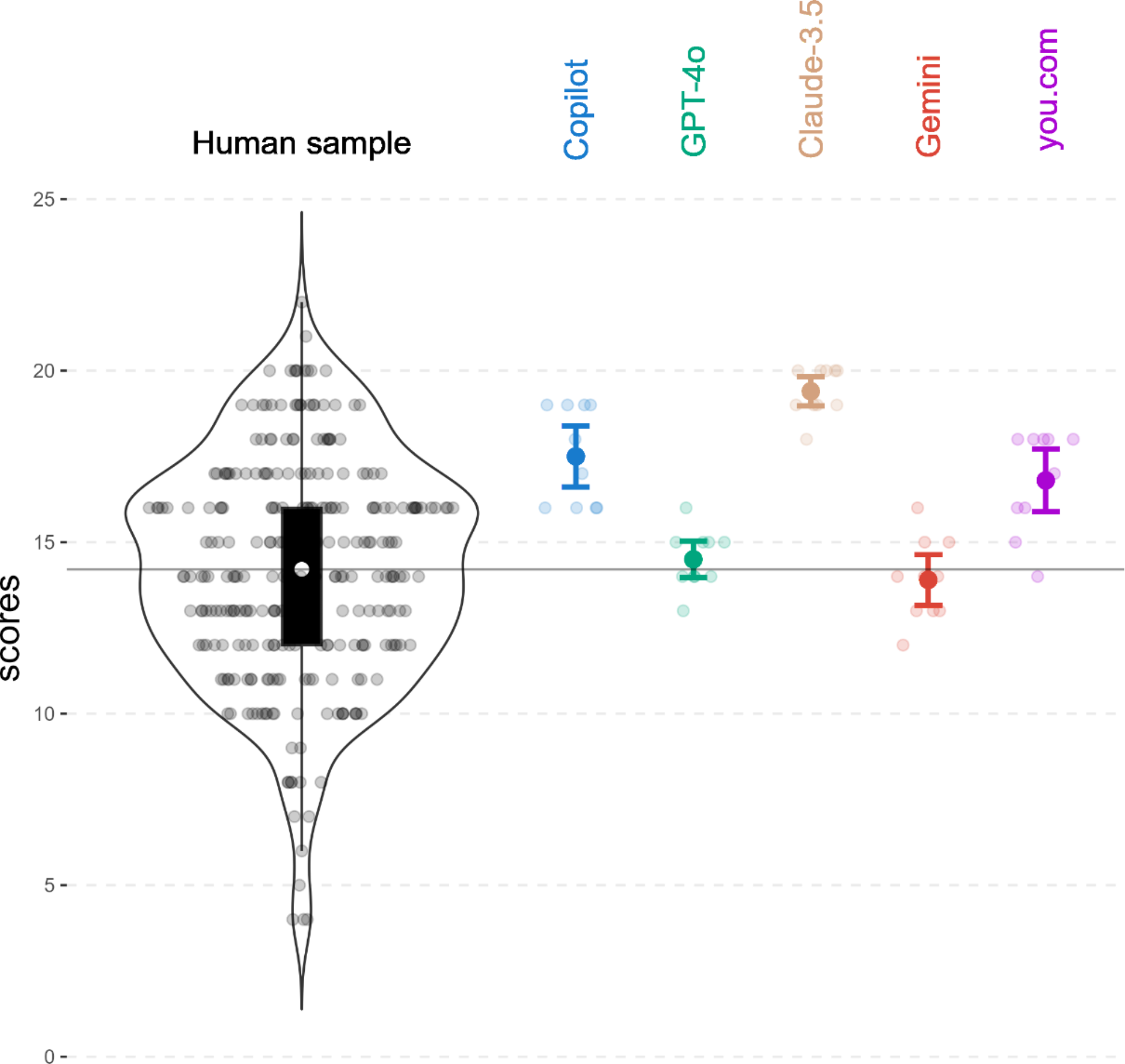
Large language models can outperform humans in social situational judgments
Large language models (LLM) have been a catalyst for the public interest in artificial intelligence (AI). These technologies perform some knowledge-based tasks better and faster than human beings. However, whether AIs can correctly assess social situations and devise socially appropriate behavior, is still unclear. We conducted an established Situational Judgment Test (SJT) with five different chatbots and compared their results with responses of human participants (N = 276). Claude, Copilot and you.com’s smart assistant performed significantly better than humans in proposing suitable behaviors in social situations. Moreover, their effectiveness rating of different behavior options aligned well with expert ratings. These results indicate that LLMs are capable of producing adept social judgments. While this constitutes an important requirement for the use as virtual social assistants, challenges and risks are still associated with their wide-spread use in social contexts.
LibreChat - The Open-Source AI Platform
LibreChat brings together all your AI conversations in one unified, customizable interface.
When Private AI Chats Become Public: Lessons from Grok’s Privacy Spill
Understand the implications of the Grok breach where hundreds of thousands of private chats were leaked to the public.

ChatGPT, Claude, and Grok bypass EU restrictions on Russian state propaganda, RSF investigation finds
Most generative artificial intelligence chatbots give users access to content from Russian state media outlets sanctioned by the European Union, according to a…